Poster Map of the Tribe of Zebulun and Its Surroundings, circa 1200 B.C.

When recounting which Israelite tribes played an important role in the history of the nation, it is unlikely that Zebulun and its neighboring tribes would be among the first named by most Bible readers. Yet a careful study of Scripture reveals that this region played a key role in the life of Israel from its earliest years until the time of Jesus. During the time of Israel’s conquest of Canaan, this region was the site of a momentous victory over the forces of the Canaanite King Jabin of Hazor (Joshua 11; see “The Conquest of Canaan: The Northern Campaign” map). Likewise the prophet Deborah called upon Barak to lead an army of Israelites from the tribes of Naphtali and Zebulun to fight against another King Jabin near Mount Tabor (Judges 4-5; see “Deborah and Barak Defeat Sisera” map). Later in the time of the judges, Gideon and his men from Manasseh, Asher, Zebulun, and Naphtali ambushed a vast army of Midianites, Amalekites, and peoples of the East in the Jezreel Valley (Judges 6-8; see “Gideon Defeats the Midianites” map). Mount Tabor also appears to have been a common cultic center for the surrounding tribes throughout the Old Testament (see Deuteronomy 33:18-19). As such, Tabor does not appear to have been included within any of the tribes’ allotted territory (see Joshua 19), although three of the tribes bordered it (see “Mount Tabor and Its Surrounding Tribal Boundaries” map), and Tabor is reckoned as belonging to Zebulun in the assignment of towns for the Levites (1 Chronicles 6:77). Saul also led the Israelites into battle against a coalition of Philistine forces in the Jezreel Valley, and he and his sons were killed on Mount Gilboa (1 Samuel 28-31; 1 Chronicles 10; see “The Battle at Mount Gilboa” map).

Over the next few centuries, the northern tribes of Israel experienced multiple attacks and occupations by foreign powers, including by Aram and Babylonia (2 Kings 16-17; 2 Chronicles 28; Isaiah 7-8; see “Border Conflict between Israel and Judah” and “The Final Days of the Northern Kingdom of Israel” maps). In the time of Elijah, King Ahab had a palace in Jezreel, and Elijah challenged the prophets of Baal to a contest on Mount Carmel to see whether Baal or the Lord was truly God. After the people saw that the Lord indeed was God, they killed the prophets of Baal at the Kishon River (1 Kings 18-19; see “Elijah Challenges Ahab” map). Elijah’s student Elisha sometimes stayed at the home of a woman in Shunem, and after her son died, Elisha raised him back to life (2 Kings 4:1-37). Later, King Josiah of Judah was killed at Megiddo as he tried to stop Pharaoh Neco from coming to the aid of the collapsing Assyrian Empire (2 Kings 22-23; 2 Chronicles 34-35; see “Josiah Battles Neco” map). Centuries later the tiny village of Nazareth, located in the tribe of Zebulun, became home to Jesus the Messiah (Matthew 2:19-23; see “Nazareth and Its Surroundings” map), fulfilling the prophecy of Isaiah that “the land of Zebulun and the land of Naphtali, the way of the sea, beyond the Jordan, Galilee of the Gentiles–the people dwelling in darkness have seen a great light, and for those dwelling in the region and shadow of death, on them a light has dawned” (Matthew 4:15-16).

The exact borders of these northern tribes, specifically of Zebulun, Asher, and Manasseh, has been the subject of some debate over the centuries. The borders are carefully delineated in Joshua 19. There the boundaries given for Asher do not include the region of Mount Carmel and Dor, yet two chapters earlier (see Joshua 17:11) the author indicates that Dor (and probably Mount Carmel) did fall within the boundaries of Asher, though it was occupied by Manasseh. Adding to the confusion is Joshua 19:26, which notes that Asher’s territory bordered (“touches”) Carmel and Shihor-libnath, which may have referred to a specific town, but it may also have encompassed the greater alluvial plain of the lower Kishon River. The mouth of the Kishon River as well as the mouth of the Belus River further north were known in ancient times for their glassmaking industries (it is mentioned by both Tacitus, The Histories, 5.7, and Pliny the Elder, Natural History, 5.19), and the name Shihor-libnath means “river of glass/whiteness.” This description of Asher’s border seems to suggest that Zebulun was landlocked, and it is shown this way in virtually every map of the region available today. Yet in the blessings of both Jacob and Moses, Zebulun is associated with the abundance of the sea (Genesis 49:13; Deuteronomy 33:18-19), suggesting that it bordered the sea. A possible resolution for both of these questions (whether Dor was within Asher’s territory and whether Zebulun bordered the sea) may be found in this author’s new understanding of Zebulun’s western border, as shown on this map. (I have since found several maps from 1873 and earlier that display similar borders; see footnote below.) Given that Asher’s border is described as starting at the edge of Carmel and Shihor-libnath and then heading east (not southeast; Joshua 19:26-27), it stands to reason that a different tribe occupied the area to the southeast of Shihor-libnath. The most fitting candidate for this other tribe is Zebulun, since this would also explain its association with the sea. This may also explain why the region of Dor and Carmel, which would have been separated from northern Asher by Zebulun and was occupied by Manasseh even by the time of the completion of the book of Joshua, does not appear to have been regarded as part of the principle territory of Asher.

Older works that display similar boundaries for Zebulun:
• Geographia Sacra, or Scripture Atlas, Comprising A Complete Set of Maps adapted to elucidate the Events of Sacred History which point out the Situation of every place mentioned in the Old & New Testaments. By J. Wyld, 1823.
• The Bible Atlas; or, Sacred Geography Delineated, In A Complete Series of Scriptural Maps, Drawn From The Latest and Best Authorities, and Engraved By Richard Palmer, 1823.
• Judaea seu Terra Sancta Quae Hebraeorum sive Israelitarum in suas duodecim Tribus divisa secretis ab invicem Regnis Iuda et Israel expressis insuper sex ultimi temporis ejusdem Terrae Provincijs. By Peter Schenk, 1695.
• Palestine or the Holy Land According to its Ancient Divisions & Tribes. By George Philip, 1852.
• Map of Palestine and all Bible lands. By A.L Rawson, 1873.

Shoreline data adapted from research by Naomi Porat, Dorit Sivan, and Dov Zviely. “Late Holocene embayment infill and shoreline migration, Haifa Bay, Eastern Mediterranean.” Israel Journal of Earth Sciences. 57(1):21-23.
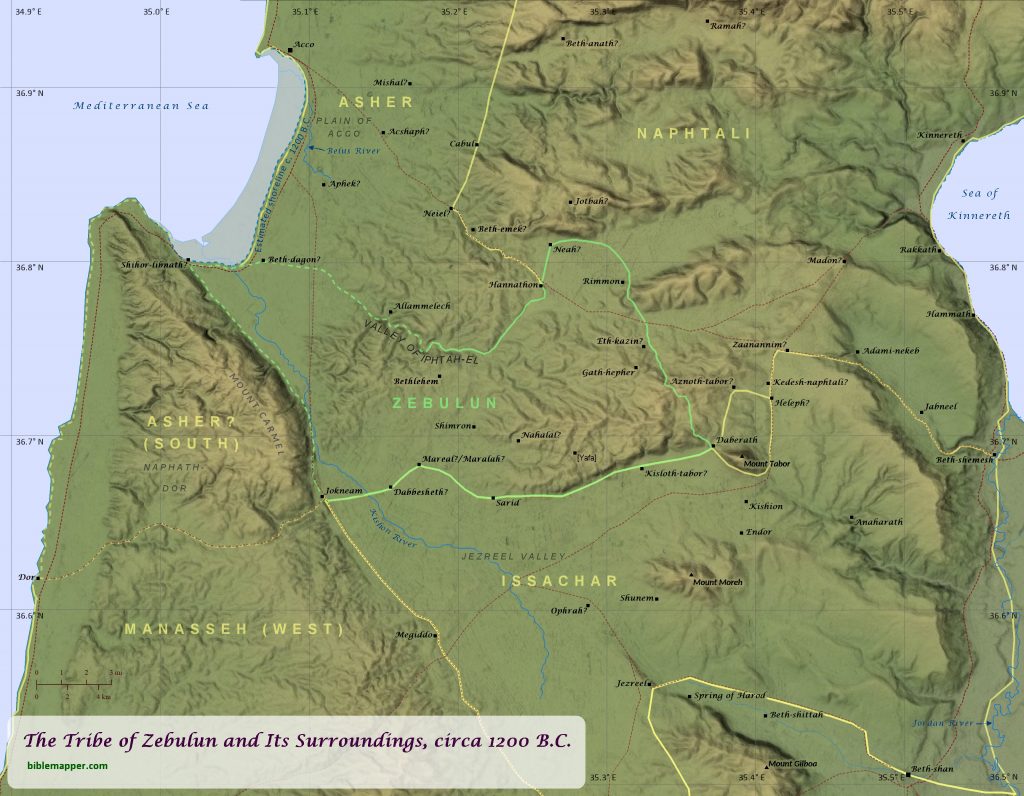
This map is designed to be printed at 18 in. x 14 in., but it may scale acceptably at larger or smaller sizes as well.
⤓ download 384 dpi file

⤓ download 192 dpi file

⤓ index of placenames

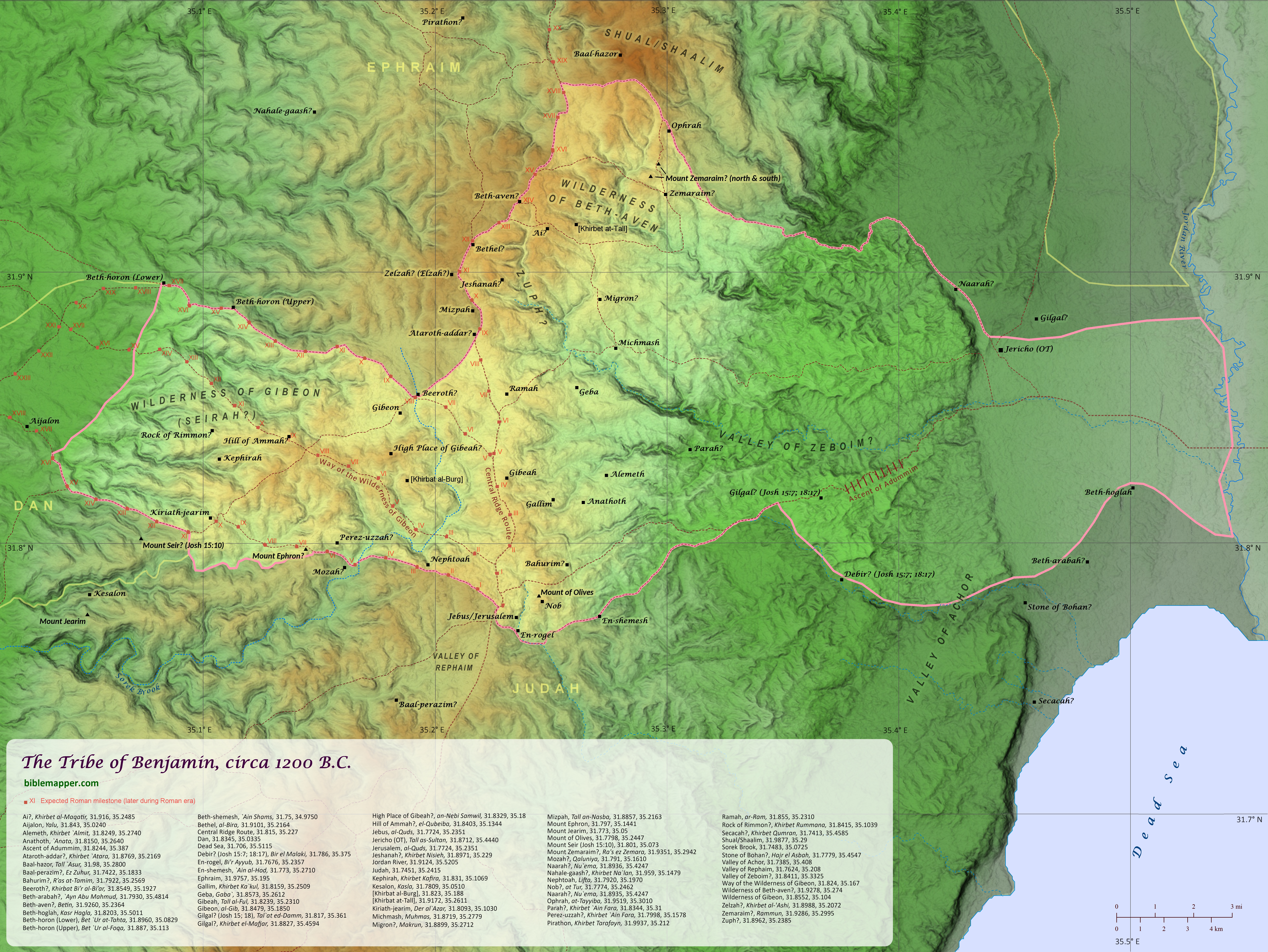
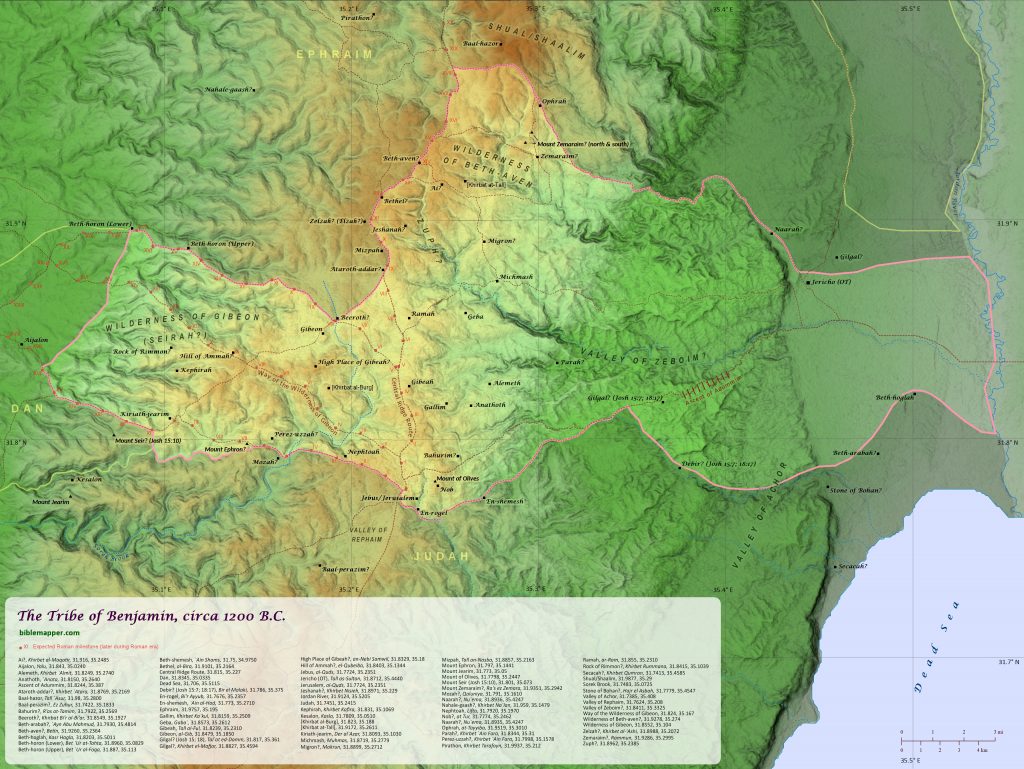
Poster Map of the Tribe of Benjamin, circa 1200 B.C.

The descendants of Jacob’s son Benjamin occupied one of the smallest of the Israelite tribal allotments–measuring a mere 27 miles (43 km) wide by 14 miles (23 km) high–yet the significance of all the biblical events that took place within it is immense. Benjamin was the location of the Israelites’ very first battles to conquer to the Promised Land, beginning with Jericho and moving on to Ai (see “The Israelites Conquer Ai” map). After this, four Gibeonite towns–all located in western Benjaminite territory–deceived the Israelites into forming an alliance with them (see “The Conquest of Canaan: The Southern Campaign” map) in order to avoid being wiped out by them. Two judges (Ehud and Deborah; see “Ehud Rescues Israel” and “Deborah and Barak Defeat Sisera” maps) hailed from Benjamin as did the prophet Samuel (see “The Tribe of Benjamin” map). After the Ark of the Covenant was captured near Aphek and Shiloh was overrun by the Philistines, it appears that the altar was moved to the High Place of Gibeah by the time of Solomon (see “The Ark of the Covenant in the Promised Land” map). In the closing years of the judges, a tragic incident at Gibeah led to a war between Benjamin and the rest of the Israelites tribes (see “Israel Battles Benjamin” map). Saul, the first king of Israel, also hailed from Benjamin (see “Saul Searches for His Father’s Donkeys” map). While King David’s capital was at Hebron, a detachment of his forces attacked those of Saul’s son Ish-bosheth at Gibeon, leading them to flee to the Hill of Ammah (likely the same as Emmaus; see “The Battle at the Pool of Gibeon” map). David later established Jerusalem, technically located within Benjamin’s territory, as his new capital over all Israel (2 Samuel 5:6-9). The borders of Benjamin’s tribal allotment and the adjacent borders of its neighboring tribes are meticulously defined in Joshua 15:1-16:3 and Joshua 18:11-28, demonstrating the biblical writers’ acute awareness of Benjamin’s territory. Several stretches of these borders appear to follow established roads that existed during the settlement era.

This map is designed to be printed at 24 in. x 18 in., but it may scale acceptably at larger or smaller sizes as well.

⤓ download 384 dpi file

⤓ download 192 dpi file

The Battle of Elasa

The intertestamental book of 1 Maccabees and some of the accounts of the Jewish historian Josephus (Antiquities of the Jews, Book XII) recount the early events of the Jewish struggle for independence from the Seleucids, led by Judas Maccabeus and his brothers. These events form some of the backdrop of the New Testament, including the establishment of the festival of Dedication (often called Hannukah), mentioned in John 10:22 (1 Maccabees 4:36-59). Judas was the first to lead Jews to rebel against Seleucid rule and progressively expanded the rebellion to other Jewish regions. After winning a decisive battle at Beth-horon and killing the Seleucid general Nicanor, Judas captured the attention of the growing Roman Republic and established an alliance with them (1 Maccabees 8:23-32). In spite of this, the Seleucid king Demetrius sent a leader named Bacchides to Judah with a large army. They went by the road that leads to Gilgal, and along the way they attacked Jewish forces at Mesaloth in Arbela, likely located near the caves of the cliffs of Arbel in Galilee. Then they camped outside Jerusalem but eventually marched off to Berea. Judas was camped at Elasa with a much smaller army, but he chose to attack the Seleucid forces anyway. Judas’s forces crushed the right wing of the Seleucid forces, but Judas himself was killed, with the battle resulting in significant losses for both sides. Many scholars regard the Roman camp Berea to be same as the ancient town of Beeroth, which participated in the Gibeonite deception during the era of the conquest of Canaan (Joshua 9). At the same time, many scholars incorrectly locate Berea at al-Bira, and this would erroneously suggest that Bethel could not be located at al-Bira, since both Berea and Bethel are both mentioned in 1 Maccabees 9. But Eusebius specifically locates Beeroth at a village at the foot of Gibeon at the seventh Roman milestone on the road to Nicopolis. Eusebius’s comments make it clear that he was speaking of the road from Jerusalem to Gibeon, which continues on to Emmaus Nicopolis. This makes it very unlikely that he was referring to al-Bira, which is located along the Central Ridge Route. Alternatively, this author has found that there is a small ruin called Khirbat Bi’r al-Bi’ar at the foot of Gibeon at the eighth Roman mile along the road from Jerusalem (see map). This is only one Roman mile off from Eusebius’s description, but the seventh milestone is not actually at the foot of Gibeon anyway, so perhaps Eusebius slightly miscalculated the distance. The name of the ruin also appears to reflect the name of the ancient town of Beeroth. Thus, it is very possible that Beeroth (which was likely the same as Berea) was located immediately northeast of Gibeon, as shown on this map, and not at al-Bira. This location for Beeroth also makes sense of the comment in 2 Samuel 4:2, which says that “Beeroth is considered to belong to Benjamin,” because Khirbat Bi’r al-Bi’ar sits technically just outside the border of Benjamin and would benefit from this clarifying statement that it belongs to Benjamin (rather than to Ephraim). Finally, placing Beeroth at Khirbat Bi’r al-Bi’ar leaves open the possibility that al-Bira is actually the location of Bethel, as indicated on this map. Also, while some scholars have argued for placing Elasa at Khirbat Ilasa between Upper and Lower Beth-horon, it seems more likely that it was located at Khirbat al-Ashi, just south of Bethel (al-Bira). Once Beeroth/Berea is correctly located at Khirbat Bi’r al-Bi’ar and Elasa at Khirbat al-Ashi, it becomes clear that the battle, which would likely have taken place somewhere between Elasa and Berea, must have taken place south of Elasa, perhaps on the plain where it is located on this map.

⤓ download hi-res file         ⧗ see in TimeGlider

Celebrating over 200 Maps and 20 Years!

Celebrate with us! At the end of 2024 we posted our 201st map for the Bible Mapper Atlas and finished cataloging over 70,000 freely available photos for over 650 ancient locations, bringing to completion 5 rewarding years of work. Now the start of 2025 marks the 20th anniversary of biblemapper.com and Bible Mapper software. So in celebration of over 200 maps and 20 years, we are offering registration keys for Bible Mapper 5.1 at $20.00 all year long! Please pass the word along about our high quality digital Bible map resources (most of them free!) and our $20 registration key offer.

Here is a complete list of all our resources:

Bible Mapper Atlas: Free, high-quality, digital Bible maps & photos
WebViewer: An online tool to find Bible places & photos
Image Fetcher: An online catalog of photos for hundreds of Bible places
Bible Mapper Software: A high quality tool for making your own custom maps (all the maps in the Bible Mapper Atlas have been created with this software)
TimeGlider: An online, scrollable timeline of Bible events
PassageBrowser: An online Bible browser that displays related Bible maps right next to the passage

Top 10 Bible Mapper Atlas Maps of 2024

Here are 10 of the best Bible Mapper Atlas maps released in 2024, based purely on the author’s personal opinion:

10. Sodom and Gomorrah Are Destroyed
9. Hagar Flees from Sarai
8. Hezekiah Strengthens Judah
7. Nomadic Range of Ishmael’s Descendants
6. The Covenant Is Renewed at Shechem
5. Kadesh-Barnea and Its Surroundings
4. Jacob Travels to Southern Canaan
3. The Israelites Conquer Ai
2. The Kenites at Jabez
1. Edom and the Land of Seir