2 Kings 14; 2 Chronicles 25
If only a single word could be used to summarize King Amaziah’s reign, perhaps conflicted might be the most fitting. To begin with, his own devotion to the Lord appears to have been conflicted, for he is described by the biblical writers as doing what was right in the sight of the Lord, yet he did not do it wholeheartedly, allowing the pagan high places to remain so that people continued to offering pagan sacrifices. Likewise, Amaziah’s reign was marked by at least two military conflicts–one against Edom and the other against Israel. His military conflict against Edom was itself marked by conflict, for initially Amaziah hired one hundred thousand warriors from Israel to help, but then he sent them home empty-handed after a prophet warned him against including Israelites in the battle, and this resulted in the warriors looting Judean towns on their way home. Amaziah’s conflicted decisions continued with his decision to bring home idols of the Edomites after he had just defeated in battle, and then he worshiped them. This then led to Amaziah’s defeat by King Joash (or Jehoash) of Israel and the destruction of 200 yards (183 meters) of Jerusalem’s wall between the Gate of Ephraim and the Corner (see “Poster Map of Jerusalem in the Time of Nehemiah, circa 445 B.C.” map for further information regarding the location of the Corner Gate and the Gate of Ephraim). Joash also seized gold, silver, and vessels that were found in the Temple and the king’s palace, and he took many hostages back to Samaria. Later there was a conspiracy against Amaziah in Jerusalem, and he fled to Lachish. His conspirators caught up with him there, however, and killed him.

⤓ download hi-res file ⧗ see in TimeGlider

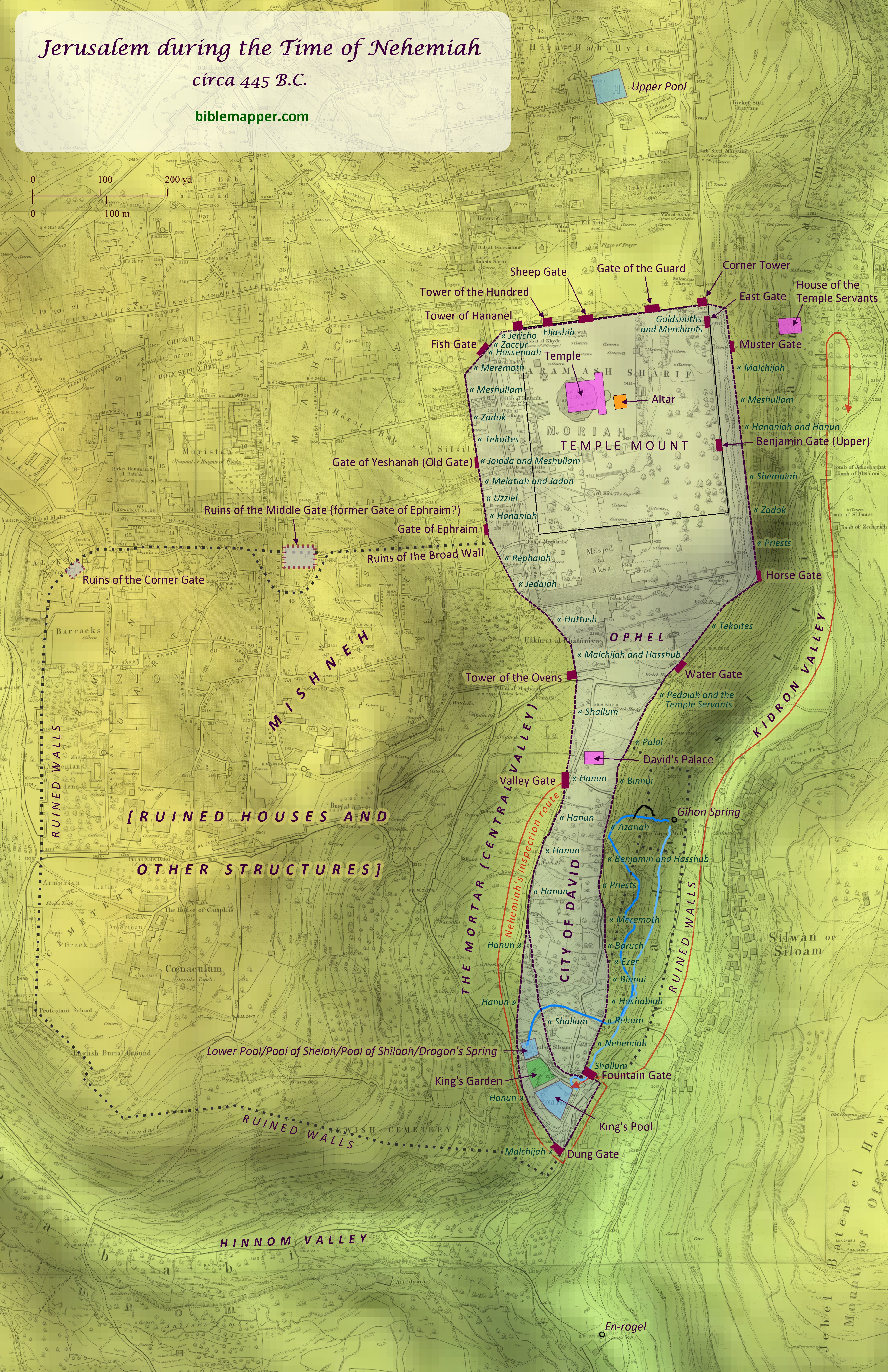
Poster Map of Jerusalem during the Time of Nehemiah, circa 445 B.C.
Author’s Note: This map draws heavily upon the careful work of Dr. Leen Ritmeyer (www.ritmeyer.com) regarding the probable location of gates, walls, and other features, though I have deviated at points from his data, based on my own research and conclusions.
A wealth of archaeological evidence supports the existence and location of many of the structures shown on this map, and great care has been taken to correlate them as faithfully as possible with the data provided in the book of Nehemiah and other biblical texts. Nevertheless, the specific identification of virtually all of these items is open to great debate. For this reason, no attempt has been made on this map to indicate any degree of uncertainty for the identifications that have been included, since the vast majority of these would be marked as uncertain anyway.
The shaded relief has been overlaid with the Ordnance Survey of Jerusalem (1865), by Charles Wilson.
The book of Nehemiah is one of the last books of the Old Testament written, and it recounts the efforts of Nehemiah to rebuild the walls of Jerusalem long after they had been destroyed by the Babylonians (2 Kings 24-25; 2 Chronicles 36:17-21; Jeremiah 39:1-10; see “Nebuchadnezzar’s Final Campaign against Judah” map). Nehemiah had been a trusted official in the Persian royal court who acquired a special commission to return to his ancestral land of Judea for the rebuilding effort (Nehemiah 1-2; see “Jews Return from Exile” map). After arriving in Jerusalem, he quickly surveyed the condition of the walls and then organized the people of Judea into work teams (Nehemiah 2-3). These teams each worked on a designated portion of the walls, and the entire project was completed in 52 days (Nehemiah 6:15). The builders came from Jerusalem and from towns throughout the greater province of Judea, and most of these towns are included in the map of “Judea under Persian Rule”.
It is far beyond the scope of this article to present all the textual and archaeological evidence that forms that basis for the indentifications made on this map, but two specific portions of this map seem to warrant explanation:
One Gate of Ephraim or Two?
The Gate of Ephraim is mentioned in Nehemiah 8:16 and 12:39, and it is noted as lying along the path of the walls that Nehemiah rebuilt. This has indirectly led to some confusion, however, regarding the location of another gate called the Gate of Ephraim in 2 Kings 14:13 and 2 Chronicles 25:23, which both note that King Jehoash of Israel broke down the wall of Jerusalem from the Gate of Ephraim to the Corner Gate, a distance of 400 cubits. This confusion stems from equating the Gate of Ephraim mentioned in 2 Kings and 2 Chronicles with the Gate of Ephraim mentioned in Nehemiah. Assuming the biblical text to be reliable, this assumption would require that the Corner Gate, which is mentioned also in 2 Chronicles 26:9; Jeremiah 31:38; and Zechariah 14:10, would have been located somewhere along the wall about 600 feet (183 meters) from the Gate of Ephraim. Placing it directly west of the Gate of Ephraim of Nehemiah would place it very close to the Middle Gate, perhaps suggesting that the Middle Gate was in fact the Corner Gate. But Jeremiah’s mention of both the Middle Gate (39:3) and the Corner Gate (Jeremiah 31:38) in the same book makes this equation unlikely. Placing the Corner Gate directly north of the Gate of Ephraim near the northwestern corner of the Temple Mount seems plausible at first glance, but this location is very hard to reconcile with both Jeremiah 31:38 and Zechariah 14:10. Jeremiah 31:38 traces a line from the Tower of Hananel to the Corner Gate, but this would make little sense if the Corner Gate were located in very close proximity to the Tower of Hananel. Similarly, Zechariah 14:10 appears to be using the Corner Gate as a marker for the far western extreme of Jerusalem, but a location at the northwest corner of the Temple Mount hardly seems like the intended location.
A more likely solution can be found by regarding the Gate of Ephraim of 2 Kings 14 and 2 Chronicles 25 as different than the Gate of Ephraim of Nehemiah, though perhaps the Gate of Ephraim had been renamed after the exile to hearken back to the old Gate of Ephraim, which had been destroyed. If this is true, the earlier Gate of Ephraim may actually have been the same as the Middle Gate of Jeremiah 39:3 (Jeremiah never mentions the Gate of Ephraim), or perhaps it was a gate near where the Middle Gate was built later. This location, then, would place the Corner Gate at the far western corner of the larger wall around greater Jerusalem, as shown on this map. The distance between these two gates is about 600 feet (183 meters), and the appropriately named Corner Gate would be a fitting candidate to mark the far western extreme of the city.
It should also be noted that this solution, however, requires that the first Gate of Ephraim existed prior to Hezekiah’s building activity. This stands in contrast to the common assertion that the wall encompassing greater Jerusalem (which Josephus calls the First Wall) was built by Hezekiah in response to the dramatic increase in residents that relocated to Jerusalem due to the fall of the northern kingdom of Israel. But the only mention in the Bible of Hezekiah building a new wall is 2 Chronicles 32:5, which notes that he built a wall “outside” the wall that was broken down (2 Chronicles 32:5). This is most likely referencing a wall in the Kidron Valley that has since been found by archaeology, and perhaps a second wall around the Temple Mount. So it would seem that elsewhere Hezekiah merely repaired or replaced portions of a wall that already existed but was in disrepair. This synchronizes well with Isaiah 22:11, where Isaiah rebukes a leader (perhaps Hezekiah) for breaking down houses “to fortify the wall” (not build a new one).
Wall Enclosing the King’s Pool
Another common assumption that is difficult to correlate with Nehemiah is the placement of the King’s Pool and the Lower Pool outside the main wall of the City of David. (The King’s Pool was likely the same as the Old Pool mentioned in Isaiah 22:11. The Lower Pool appears to be alternately called elsewhere the [Pool of] Shiloah/Siloam [Isaiah 8:6] and the Pool of Shelah [Nehemiah 3:15], which is fed by the Dragon’s Spring [Nehemiah 2:13].) Two different passages in Nehemiah (Nehemiah 3:13; 12:31) clearly trace a path along a wall from the Valley Gate (likely midway up the western wall of the City of David) directly to the Dung Gate, with no mention of any other gates or distinct changes in direction. Likewise, both Nehemiah 3:15 and 12:37 note that the Fountain Gate (likely located immediately northeast of the King’s Pool on this map) was reached after passing by the Dung Gate. This author has become convinced that this requires that the Dung Gate lay along a portion of the wall that must have extended directly from the area of the Valley Gate. Further details are given in Nehemiah 3:13, which notes that Hanun and the inhabitants of Zanoah repaired 1000 cubits (1500 feet; 457 meters) of the wall from the Valley Gate to the Dung Gate. If the Valley Gate and the Dung Gate were indeed located at the two places shown on this map, and a wall between them followed the path shown here, the distance between them along the wall would have measured about 1548 feet (472 meters), or 1032 cubits–extremely close to the 1000-cubit distance given in Nehemiah 3:13. The existence of this wall is also supported by Isaiah 22:11-12, which notes that a reservoir for the waters of the Old Pool (likely the same as the King’s Pool on this map) had been build “between the two walls.” This could be understood to refer to Josephus’s First Wall and the wall immediately north of the King’s Pool, but this author suspects instead that it is referring to the wall that must have already existed immediately south of the Lower Pool and the King’s Pool on this map.
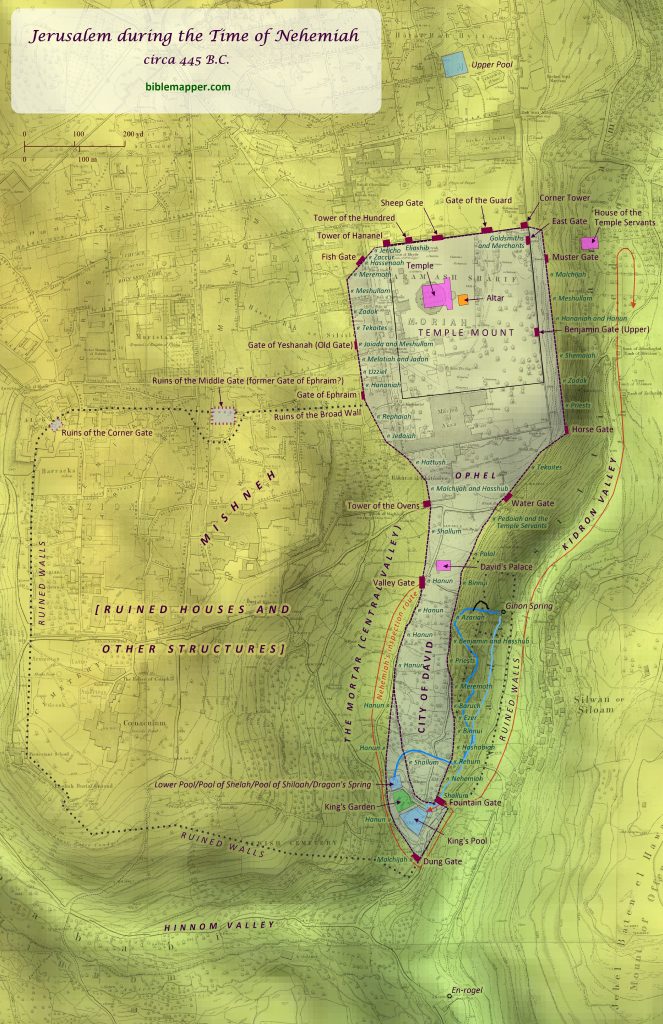
This map is designed to be printed at 11 in. x 17 in., but it may scale acceptably at larger or smaller sizes as well.
Audio-Visual Reading of Genesis 14
Genesis 14
Genesis 14 recounts the story of the failed revolt by the cities of the plain and the subsequent capture and rescue of Abram’s nephew Lot.
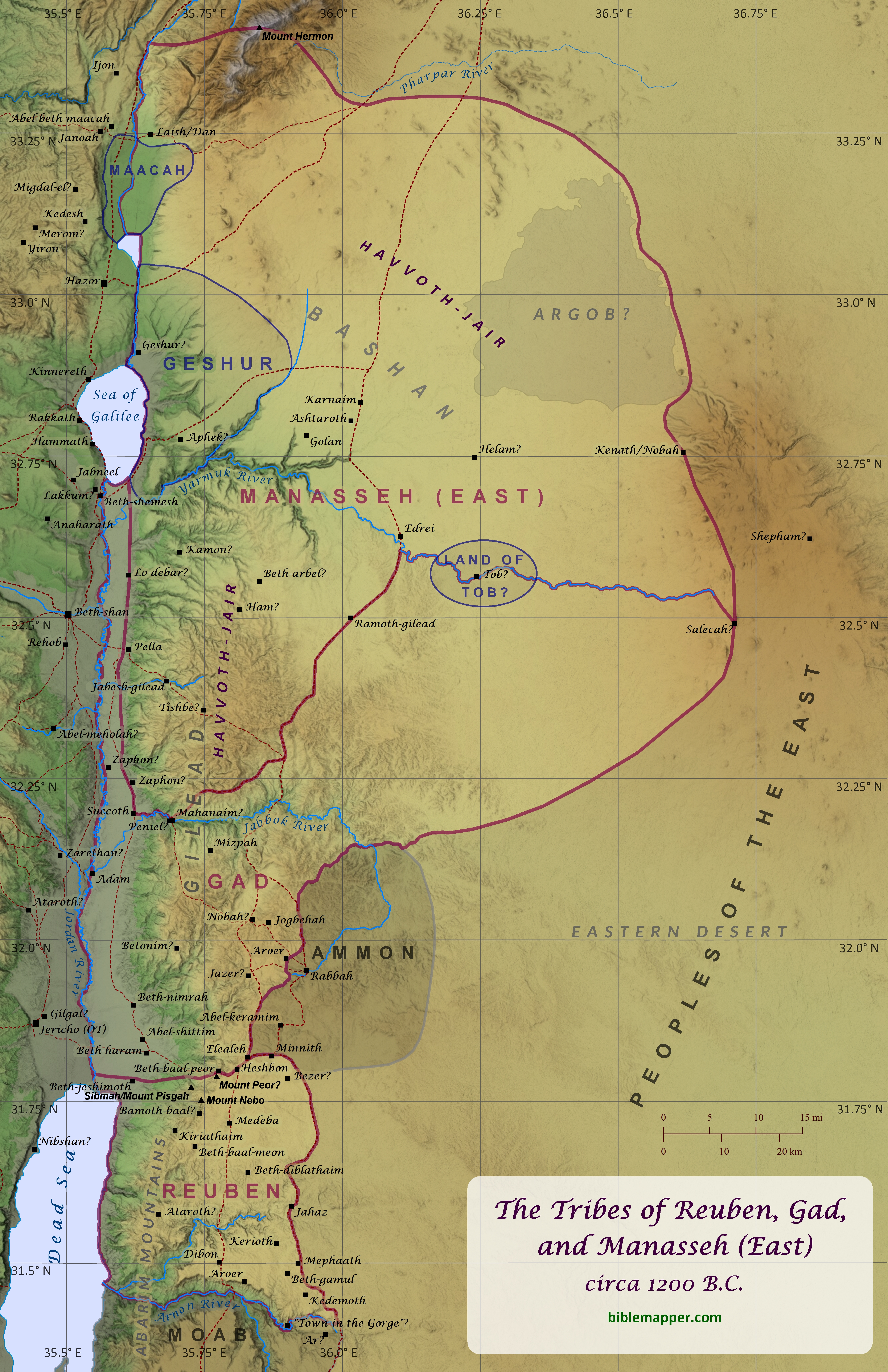
Poster Map of the Tribes of Reuben, Gad, and Manasseh (East)
Though technically not part of the land promised to the Israelites in Numbers 34, the land immediately east of the Jordan River and the northern basin of the Dead Sea (often referred to today as the Transjordan) was conquered by the Israelites as they were preparing to enter the Promised Land (Numbers 21:21-35; 32:1-42; Deuteronomy 2:24-37; Judges 11:19-22). Moses agreed to allot this land to the tribes of Reuben, Gad, and half the tribe of Manasseh, provided that they continued to help the other tribes conquer the land of Canaan (Numbers 32:1-42; Deuteronomy 3:12-20). The area allotted to Reuben had been ruled by King Sihon of the Amorites, who had taken this land years earlier from the Moabites (Numbers 21:26). Moab’s prior rule over the territory alloted to Reuben explains why the plain to the northwest of this region continued to be referred to as the plains of Moab even during the time of Joshua (Joshua 13:32). This region also appears to have been claimed by the Ammonites (Judges 11:13), though it is not clear whether they ever actually controlled it. Sihon had also taken from the Ammonites the area later allotted to Gad (Joshua 13:25; see “Sodom and Gomorrah Are Destroyed” map). North of this was the area of Bashan, which had been ruled by King Og, who was among the last of the Rephaites (Deuteronomy 3:11-13; Joshua 12:4; 13:12). All of this was captured by the Israelites on their way to the Promised Land (Joshua 12:1-6; Deuteronomy 3:1-11).
As far as the specific borders of each of the three eastern Israelite tribes, those of Reuben are delineated in Joshua 13:15-23, those of Gad are delineated in Joshua 13:24–28 (note that Joshua 13:25 asserts that Aroer literally “faced” Rabbah, which in this context meant that it lay west of it, not east), and those of half the tribe of Manasseh are delineated in Joshua 13:29–31. Interestingly, Numbers 32:34-36 notes that Gad rebuilt the towns of Dibon, Ataroth, and Aroer, which Joshua 13:15-23 places within the boundaries of Reuben, but perhaps Gad rebuilt the towns prior to being formally allotted their territory further north. Several other passages also note that Ramoth-gilead, a city of refuge, belonged to Gad (Deuteronomy 4:43; Joshua 20:8; Joshua 21:38; 1 Chronicles 6:80).
It is also interesting to note that virtually all of the eastern land of Manasseh was conquered under the leadership of Jair, who was actually a Judahite by his father’s lineage but was typically regarded a Manassite through his mother’s lineage (Numbers 32:40-42; Deuteronomy 3:14; Joshua 13:30; Judges 10:3-5; 1 Kings 4:13; 1 Chronicles 2:22-23; see “Bashan” map). This may be in keeping with the Manassite tradition of allowing daughters to receive an inheritance (and, presumably, recognition of their descendants) just as they allowed sons to receive an inheritance (Numbers 27; Joshua 17:1-6; see also “The Towns and Clans of Eastern Judah, circa 1200 B.C.”).
Further insight into the allotments of the Transjordan is gained through 1 Chronicles 5, which notes that Gad’s territory extended as far as Salecah. This requires that its territory was notably larger than it is depicted on most Bible maps today, which typically limit its eastern boundary to the border of Ammon. This may seem at odds with several other passages that mention the Jabbok River as the northern boundary of Sihon’s land and make no mention of Salecah and the land northwest of the Jabbok River (Numbers 21:24; Deuteronomy 3:16; Joshua 12:2; Judges 11:13-22). But, as noted above, several other passages also note that Ramoth-gilead belonged to Gad, which is (like Salecah) located far north of the Jabbok River. This author has concluded that the northeastern boundary between Gad and Manasseh almost certainly followed the Yarmuk River all the way to Salecah and also passed through Tob.
First Chronicles 5 also notes that later, under the reign of Saul, the Israelite eastern tribes joined together to capture territory east of Gilead, which was inhabited by the nomadic descendants of Hagar and her son Ishmael (1 Chronicles 5:10-22; see also “Nomadic Range of Ishmael’s Descendants”), who are often referred to in Scripture as “peoples of the East” (Genesis 29:1; Judges 6-8; 1 Kings 4:30; Job 1:3; Isaiah 11:14; Jeremiah 4:28; Ezekiel 25:4; 25:10). It is not clear, however, that this territory was ever formally considered to belong to the territory of Israel.
Also located within the territory of the Transjordanian tribes were the enclaves of Geshur, Maacah, and the land of Tob. Geshur and Maacah are mentioned among those who remained as non-Israelite enclaves within Israel’s territory ((Joshua 12:5; 13:1-13). The land of Tob must have functioned similarly within Israel as well, because it contributed troops to the Ammonite and Aramean alliance that fought against David’s forces (2 Samuel 10:6). This also makes better sense of Jephthah’s decision to retreat to the land of Tob after he was driven away by his brothers (Judges 11:3).

This map is designed to be printed at 11 in. x 17 in., but it may scale acceptably at larger or smaller sizes as well.
Announcing Bible Mapper, Jr.!
Bible Mapper is pleased to announce the launch of Bible Mapper, Jr.! The new site hosts a growing collection of resources specifically designed to help kids understand where the stories of the Bible happened and why it matters. Each map lesson includes a kid-friendly map, a Bible reading, a Life Lesson, and an article that unpacks what happened in the story and how it can help us follow God more closely. You are welcome to use any resources you find on Bible Mapper, Jr., for any non-commercial purposes. The only requirement is that you cite biblemapper.com as the source of the map or resource, and if you are including it in an online resource, provide a hyperlink back to biblemapper.com. As with all resources produced by Bible Mapper, we hope you find the new site to be rich collection of helpful resources to help kids understand Scripture better.
