Acts 27:39-28:16
As Paul was being transferred to Rome to stand trial before Caesar, his ship was driven by a storm until it was wrecked near the small island of Malta. The entire crew was saved, and the people of the island treated them with unusual hospitality. During their time there Paul prayed for many who were sick, and they were healed. Three months after they first arrived on the island Paul was placed on another ship to finish the voyage to Rome. Along the way they stopped at Syracuse and Rhegium and then disembarked at Puteoli to finish the trip to Rome on foot. Some believers there invited them to spend a week with them before continuing on to Rome. In the meantime, other believers in Rome heard that Paul was coming and traveled as far as the Forum of Appius–forty miles away–to escort him the rest of the way to Rome. Once in Rome Paul was put under guard but was allowed to live in his own private lodging for two years as he awaited trial. During that time he he welcomed all who visited him and boldly taught about Jesus Christ and the Kingdom of God.

⤓ download hi-res file 🔍 see in TimeGlider

The Tribe of Benjamin
The tribe of Benjamin was descended from the youngest son of Jacob (Genesis 35:16-26) and occupied one of the smallest allotments in the Promised Land (Joshua 15-16; 18:11-13), yet it proved to be a people of great consequence throughout the history of Israel. Benjamin’s allotment in the Promised Land fell between Ephraim to the north and Judah to the south, and it was bisected by the Central Ridge Route from north to south. The land west of the Central Ridge Route was occupied primarily by the Gibeonites, who deceived the Israelites during the early phases of their conquest of the Promised Land so that they were granted a peace treaty and allowed to remain in the land (Joshua 9; see map). The warriors of Benjamin were renowned for their skill as ambidextrous archers and slingers (Judges 20:16; 1 Chronicles 8:40; 12:2), and the Benjaminite judge Ehud was likewise left-handed (Judges 3:12-30). The judge Deborah was also from Benjamin and held court between Bethel and Ramah (Judges 4:1-5). Near the end of the time of the Judges the tribe of Benjamin was involved in a tragic war against the rest of the tribes of Israel but were spared complete annihilation (Judges 19-21). Later the prophet Samuel was born in Ramah and held court at Bethel, Gilgal, Mizpah, and Ramah (1 Samuel 7:15-17), and he anointed Saul, another Benjaminite from Gibeah, as Israel’s first king (1 Samuel 9-10). Long after this the northern tribes of Israel rebelled against the rule of the Davidic dynasty, but Benjamin remained loyal to Judah (1 Kings 12:21; 2 Chronicles 11:1). Later, however, Benjamin’s territory was divided between the two kingdoms (1 Kings 15:16-22; 2 Chronicles 16:1-6). After the people of Judah returned from exile in Babylon, Benjamin’s territory was included in the minor Persian province of Judea (Ezra 2; Nehemiah 7; see map). Hundreds of years later the apostle Paul underscored the distinguished history of the tribe of Benjamin when he proudly declared himself to be a Benjaminite, a “Hebrew of Hebrews” (Philippians 3:5).


Cities of the Lycus Valley: Hierapolis, Laodicea, and Colosse
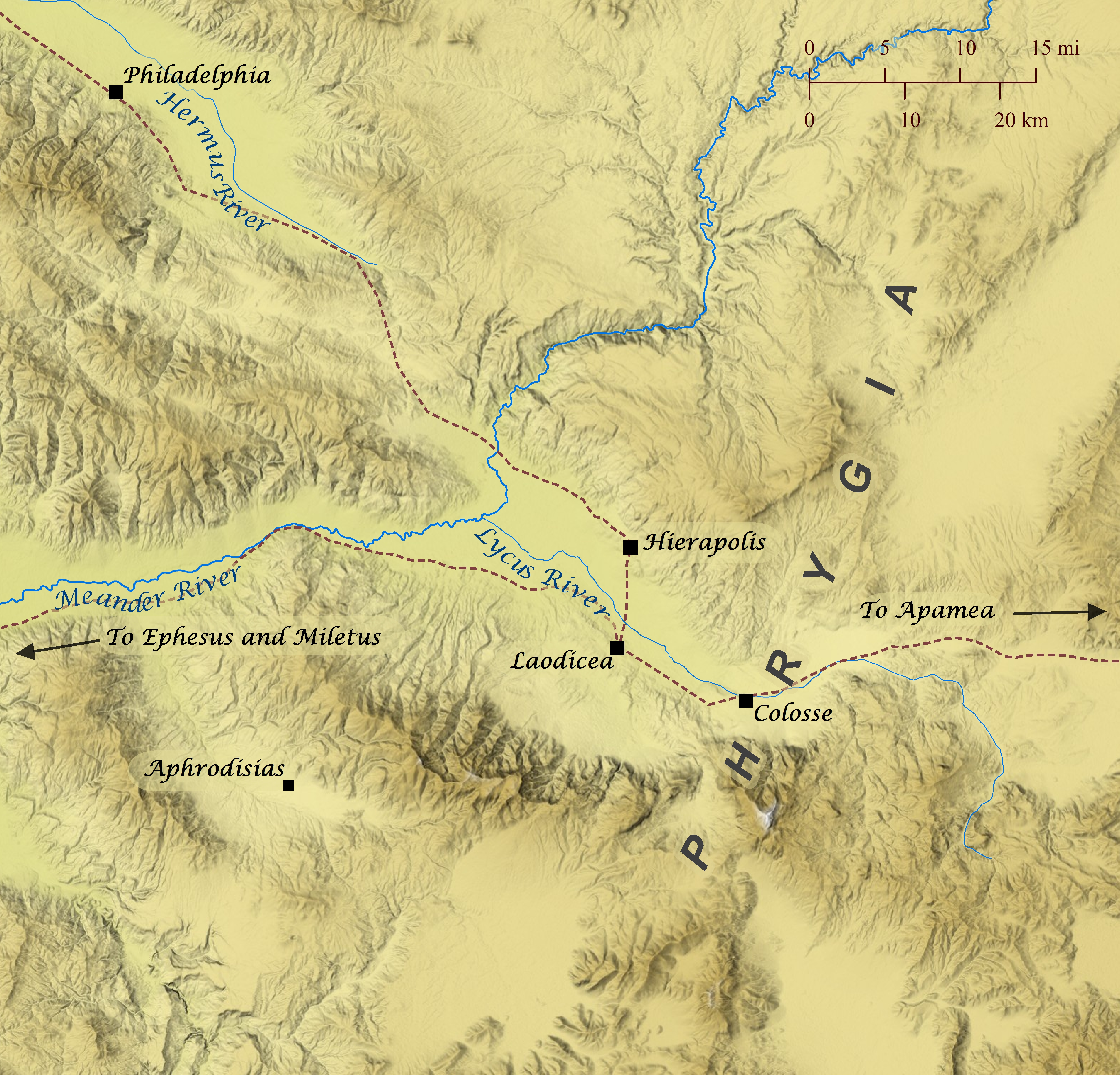
The cities of Hierapolis, Laodicea, and Colosse–all of which are referenced in Colossians 4:13–were located within about 12 miles (19 km) of each other along the Lycus River in the region of Phrygia. Two main Roman roads heading east joined at Laodicea and continued on to Apamea and Iconium. Though Paul almost certainly passed through this area on his way to Ephesus during his third missionary journey (Acts 18:23; 19:1; see map), apparently he never personally met the believers there (2:1). Instead Paul’s coworker Epaphras, a native of Colosse, first brought the gospel to the Colossians and perhaps to the people of Laodicea and Hierapolis as well (Colossians 1:6-7; 4:12). Even so, Paul appears to have held the same degree of concern for these believers as he did for believers of the churches he personally founded. Paul urged the Colossian believers to make sure that his letter to them is read to the believers at Laodicea and also that his letter to the Laodiceans is read to the Colossians. The letter to the Laodiceans may be what we now regard as the letter to the Ephesians (4:16). Laodicea is also one of the churches addressed by the apostle John in Revelation (3:14-22), where John rebukes them for being lukewarm instead of hot or cold. This imagery is likely drawn from Laodicea’s lukewarm water sources, which were a result of the city being located too far from Hierapolis’s renowned hot springs and also too far from Colosse’s cold springs. John also references several other characteristic traits of Laodicea, such as their wealth, their eye ointment, and their cloth, which was made from their distinctive black wool. Philadelphia, another city addressed by John in Revelation (3:7-13), was located about fifty miles northwest of the Lycus Valley cities.

⤓ download hi-res file 🔍 see in TimeGlider
Galilee throughout Bible Times
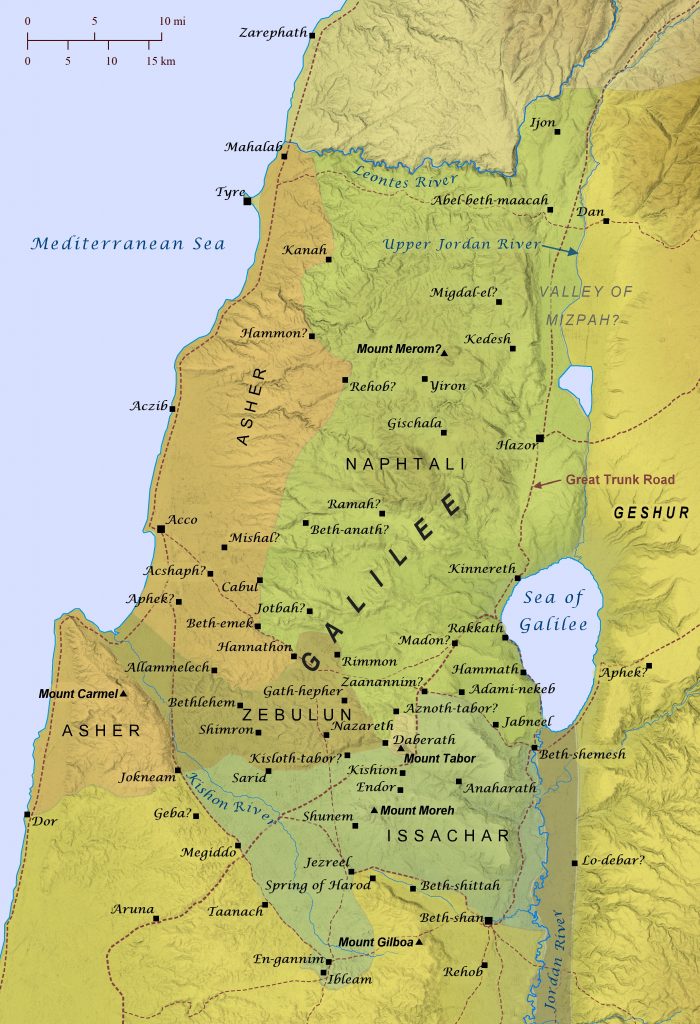
Throughout Bible times, nature and history combined to make the region of Galilee in northern Israel a land of great diversity. Galilee’s mountainous terrain is covered with lush vegetation made possible by the region’s abundant rainfall. Upper Galilee, which was occupied by the tribe of Naphtali, is home to the highest mountains in Israel west of the Jordan River. Further south the terrain gives way to the smaller foothills of Lower Galilee, which was occupied by the tribe of Zebulun. Yet Galilee’s rich diversity was also found in the character of its population, which was shaped by centuries of tumultuous history. Galilee is often characterized as a rural “backwater” region of Bible times, perhaps because of its remoteness from Jerusalem and the apparent disdain some Jews exhibited toward its residents during New Testament times (e.g., John 1:46). But this oversimplification fails to consider Galilee’s promixity to the Great Trunk Road–an international highway connecting Mesopotamia and Anatolia with Egypt–and to the city of Tyre–one of the most internationally connected cities in the ancient Near East during the entire Old Testament period (see Ezekiel 27). Also, over time portions of Galilee were occupied by Aram and then by Assyria due to bribes paid by Judean kings (1 Kings 15:16-22; 2 Kings 16-17; 2 Chronicles 28; Isaiah 7-8), and this led to the population becoming increasingly multi-ethnic–so much so that the prophet Isaiah referred to the region as “Galilee of the nations,” whose people had been humbled and were living in gloom and distress (9:1). Even after the Maccabees reclaimed Galilee for Israel around 104 B.C., its population remained somewhat multi-ethnic throughout the New Testament, and its residents were typically more familiar with Greek than those living in other parts of Judea. Yet by the time Jesus’ family settled in Nazareth the region was also home to a significant population of devout Jews. And it was in this complex amalgam of rural and cosmopolitan, Jewish and Gentile, that Jesus of Nazareth grew up and conducted much of his ministry.

Illyricum
Though the book of Acts undoubtedly provides an accurate account of the apostle Paul’s journeys, a careful study of Paul’s letters suggests that Acts must not be an exhaustive account. This can be seen most clearly in Paul’s mention in Romans 15:19 of preaching the gospel “from Jerusalem all the way around to Illyricum.” Paul’s letter to the Romans was likely written at Corinth during his third missionary journey, yet Illyricum is never explicitly mentioned in Acts as one of Paul’s destinations up to that point. Acts 20:2 does, however, mention that on his way to Corinth Paul traveled “through that area,” referring to Macedonia, which borders the southern portion of Illyricum. Perhaps Luke intentionally used this vague phrase to indicate that Paul actually traveled throughout Macedonia instead of simply passing through it. The Egnatian Way would have provided efficient travel to the western coast of Macedonia, and from there Paul could have easily visited southern Illyricum. Alternatively, Paul may have organized a trip to Illyricum by ship during his three month stay in Corinth just before he wrote his letter to the Romans. Later, in Paul’s second letter to Timothy (4:10), he also mentions that Titus has gone to Dalmatia (in southern Illyricum), perhaps confirming that Paul had already established contacts there during an earlier visit.

