
2 Chronicles 14
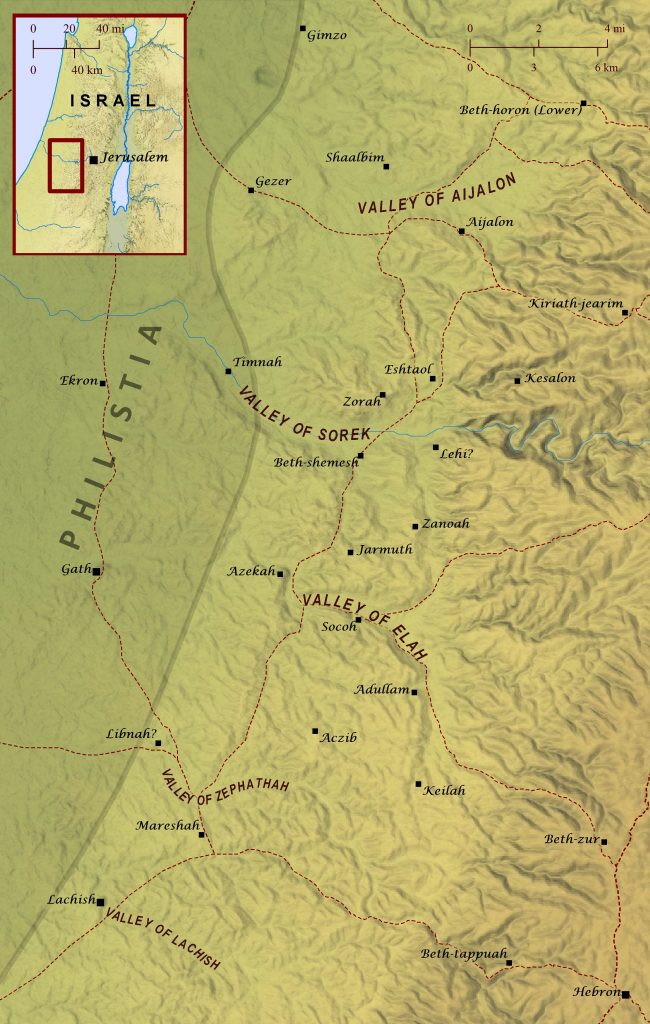
The book of 2 Chronicles contains the sole mention of an otherwise unknown battle between King Asa of Judah and Zerah the Cushite around 895 B.C. Prior to his description of the battle, the Chronicler notes that Asa had undertaken a campaign to fortify many of the towns throughout Judah, since the land was at peace and afforded them the means to do so. Apparently these efforts raised concerns among the Cushite peoples who dwelt along the western coast of Arabia (see Genesis 10:6-7), who likely feared that Asa was trying to tighten his control over important international trade routes that passed through southern Judah. The Arabian Cushites were well known for their gold, incense, and precious stones (1 Kings 9:28; 10:10-11; 22:48; 1 Chronicles 29:4; 2 Chronicles 8:18; 9:1-10; Job 22:24; 28:16; Psalm 45:9; Isaiah 13:12; 60:6; Jeremiah 6:20; Ezekiel 27:22), which they transported along the Incense Route and other roads to reach eager markets in the coastal cities of Philistia. So a Cushite named Zerah gathered a massive army and met Asa in battle at the Valley of Zephathah just north of Mareshah (see map of the Shephelah). During the battle the Lord struck down the Cushites, and they fled in the direction of Gerar, which may have been where the Cushites had camped in preparation for battle. Asa’s forces pursued them to Gerar and destroyed them completely, carrying off a great deal of plunder. Asa’s troops then destroyed and looted all the villages surrounding Gerar, which had likely hosted some of Zerah’s troops as well.

⤓ download hi-res file 🔍 see in TimeGlider

Earthquakes in the Bible
Throughout much of the ancient Near East earthquakes were at the same time familiar yet terrifying, and the great power demonstrated by them was often associated with God himself. While the most intense seismic activity of the region typically occurs far north of Israel around Pergamum, Ephesus, Melidu, and Tushpa, the land of Israel experiences earthquakes from time to time as well due to its position at the northern extreme of a major fault line running all the way down the Red Sea and into East Africa. The first mention of earthquakes in the Bible might be found in the story of the destruction of the cities of the plain, where it describes phenomena that could be explained as the result of an earthquake that caused subterranean hydrocarbons to explode (Genesis 19:24). Earthquakes also accompanied the giving of the Law at Mount Sinai and the subsequent wanderings of the Israelites in the desert (Exodus 19:18; Numbers 16:31-32; Judges 5:4; Psalm 68:8; Hebrews 12:26). Hundreds of years later the prophet Elijah journeyed to Mount Sinai and witnessed an earthquake as he waited for the Lord to pass by (1 Kings 19:11-12). During the reign of Uzziah of Judah in the eighth century B.C., an earthquake struck the land that was so severe that the prophet Amos dated his oracles by it (Amos 1:1), and over two hundred years later the prophet Zechariah foretold of a coming earthquake that would cause people to flee like they did when they fled from the earthquake in Uzziah’s time (Zechariah 14:5). In several other passages of the Old Testament earthquakes are a common response of the earth to the Lord (2 Samuel 22:8; Psalm 18:7; Isaiah 6:4; 13:13; Nahum 1:5; Habakkuk 3:3-6; Haggai 2:6), and Psalm 46:1-2 describes earthquakes leveling the mountains in order to portray complete insecurity in earthly things. Centuries later Jesus’ crucifixion was accompanied by earthquakes (Matthew 27:54; 28:2). The book of Acts also recounts how an earthquake struck Philippi while Paul and Silas were in jail there, and it was so violent that it broke open the doors and loosed the chains of the prisoners (Acts 16:25-28). Earthquakes are also frequently included in descriptions of things to come in the last days (Matthew 24:7; Mark 13:8; Luke 21:11; Revelation 6:12; 11:13; 16:18).


The Shephelah
The Shephelah, meaning “lowlands,” was a band of gentle hills lying between the coastal plain and the hill country of Israel, and it was covered with sycamore fig trees and olive trees (1 Kings 10:27; 1 Chronicles 1:15; 9:27; 27:28). This pastoral description of the region paints a deceptively peaceful picture, however, for the various valleys that cut through this region from west to east offered invading armies quick access to the heartland and key cities of Israel, making the Shephelah a very strategic stretch of land. Because of this, several important towns kept close watch over its key access points, including Aijalon, Beth-shemesh, Azekah, Libnah, Mareshah, and Lachish. From the very beginning of Israel’s conquest of the land, the valleys of the Shephelah were the location of pivotal battles, beginning with Joshua’s defeat of the Amorites at Aijalon while the sun stood still (Joshua 10:10-14; see “The Conquest of Canaan: The Southern Campaign” map). The Shephelah continued to serve as a buffer between the Philistines and the Israelites from the time of the Judges through the time of the Divided Monarchy. The Valley of Sorek was home to the judge Samson, so it is no surprise that he had several hostile encounters with the Philistines there (Judges 13-16; see “Samson’s Exploits” map). This same valley is also where the Philistines sent the Ark of the Covenant back to Israel after it afflicted them with tumors (1 Samuel 6:1-7:2; see “The Ark of the Covenant Is Captured and Returned” map). Later, young David slew Goliath in the Valley of Elah and sent the Philistines into a panic (1 Samuel 17; see “The Battle at Elah” map), and he also saved the people of Keilah from the Philistines in this valley while on the run from Saul (1 Samuel 23:1-5; see “David Flees from Saul” map). Later Jehoash of Israel defeated Amaziah of Judah at Beth-shemesh (2 Kings 14:11-14), and Asa defeated a massive army of Cushites at the Valley of Zephathah (2 Chronicles 14:9-15; see “Zerah the Cushite” map). During the final days of the northern kingdom of Israel, the Philistines captured several towns within the Shephelah as part of what was likely an effort to compel Judah to join an anti-Assyrian alliance (2 Kings 16-17; 2 Chronicles 28; Isaiah 7-8; see “The Final Days of the Northern Kingdom of Israel” map). After Israel had fallen to the Assyrians, king Sennacherib of Assyria attacked Lachish and Libnah to bring Hezekiah firmly under Assyria’s yoke (2 Kings 18:13-17; 19:8; 2 Chronicles 32:1-23; see “Sennacherib Attacks Judah” map). Years later when King Zedekiah rebelled against the rule of the Babylonians, they came and attacked every fortified city of Judah. Lachish and Azekah in the Shephelah were among the last cities to fall to the Babylonians (Jeremiah 34:1-7; see “Nebuchadnezzar’s Final Campaign against Judah” map). Finally, over four hundred years later Judas Maccabeus launched a surprise attack against Seleucid forces just west of Aijalon (1 Maccabees 3:38–4:25; 2 Maccabees 8:8–8:36).

The Garden of Eden
Genesis 2
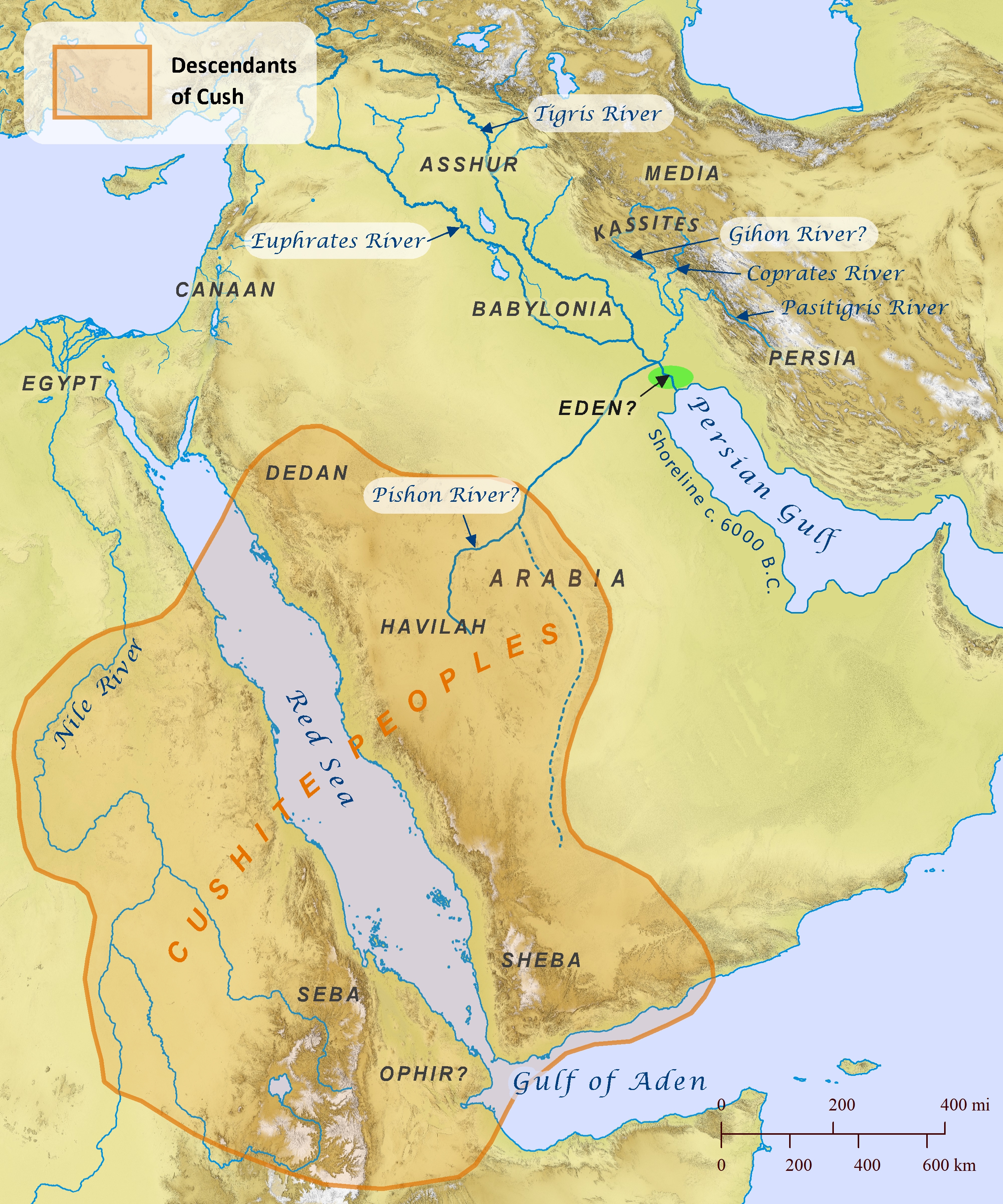
Whether one believes the biblical story of God planting a garden in Eden for Adam and Eve should be understood as allegory or historical event, an unassuming reading of the story suggests that the places mentioned were recognizable to the original audience and would have been sufficient to clarify for them where the garden was located. The story locates the garden of Eden at the confluence of four headwaters into a single river that watered the garden. These four rivers are called the Pishon, the Gihon, the Tigris, and the Euphrates. The identification of the last two rivers is widely accepted as the two great rivers that flow along either side of the lands of Asshur (Assyria) and Babylonia. The identification of the first two rivers, however, has become obscured over time and has been the subject of diverse speculation since at least as far back as the time of the first century Jewish historian Josephus. Some of this confusion stems from the incorrect assumption that Cush, noted as the basin of the Gihon, refers to the kingdom of Cush located immediately south of Egypt in Africa, which leads to the conclusion that the Gihon must be the Nile River (as Josephus also surmised). But the story makes it clear that the four rivers of Eden all joined together to form a single river, and this is difficult to reconcile with a Nile River identification. The Table of Nations (see “Table of Nations: Ham’s Descendants” map), however, includes among the descendants of Cush several tribes along the Arabian coast as well as those of the kingdom of Cush in Africa (Genesis 10:6-7; see also Numbers 12:1; 2 Chronicles 14:8-14), and this may be the region intended in the story of Eden. Or it may be that the term Cush in Genesis 2 refers to the ancient Kassites, whose original homeland was likely just south of the land of Media. If this is the case, the river known to the Greeks as the Choaspes would be the most obvious candidate for the Gihon River, since it did indeed flow “through the entire land of Cush.” It appears that in ancient times this river, along with the Coprates River, joined the Pasitigris River before emptying into the Persian Gulf. Finally, if Havilah, which is associated with high quality gold, resin, and onyx, is to be located at modern Mahd adh Dhahab (“cradle of gold”), as shown here, that would make the modern Wadi al-Batin a good candidate for the Pishon River. This intermittent river running across the middle of Arabia once flowed with greater consistency in ancient times due to a wetter climate.

Paul’s Travels in Southern Galatia
The Roman province of Galatia was home to some of the first churches established by the apostle Paul (Acts 13-14), and it appears he continued to regard these churches with deep affection throughout his ministry (Galatians 4:19-20). Sometime after Paul returned from his first missionary journey, he wrote the letter of Galatians to these churches to warn them against turning away from the gospel of grace and seeking righteousness through obedience to the law of Moses. Later Paul revisited and encouraged these churches during his second and third journeys (Acts 15:41; 18:23). The map shown here depicts the inbound route Paul took during his first journey, though the exact route Paul followed to reach Pisidian Antioch from Perga is uncertain. Some scholars suggest he took the Sebastian Way, which was a well maintained but somewhat indirect route for traveling to Antioch. Others suggest Paul followed the more direct but also more difficult route along the valley of the Cestrus River. During his second and third journeys it appears that Paul approached these churches from the east by taking the road leading from Tarsus to Derbe, and he revisited the churches in the reverse order from his first journey.

