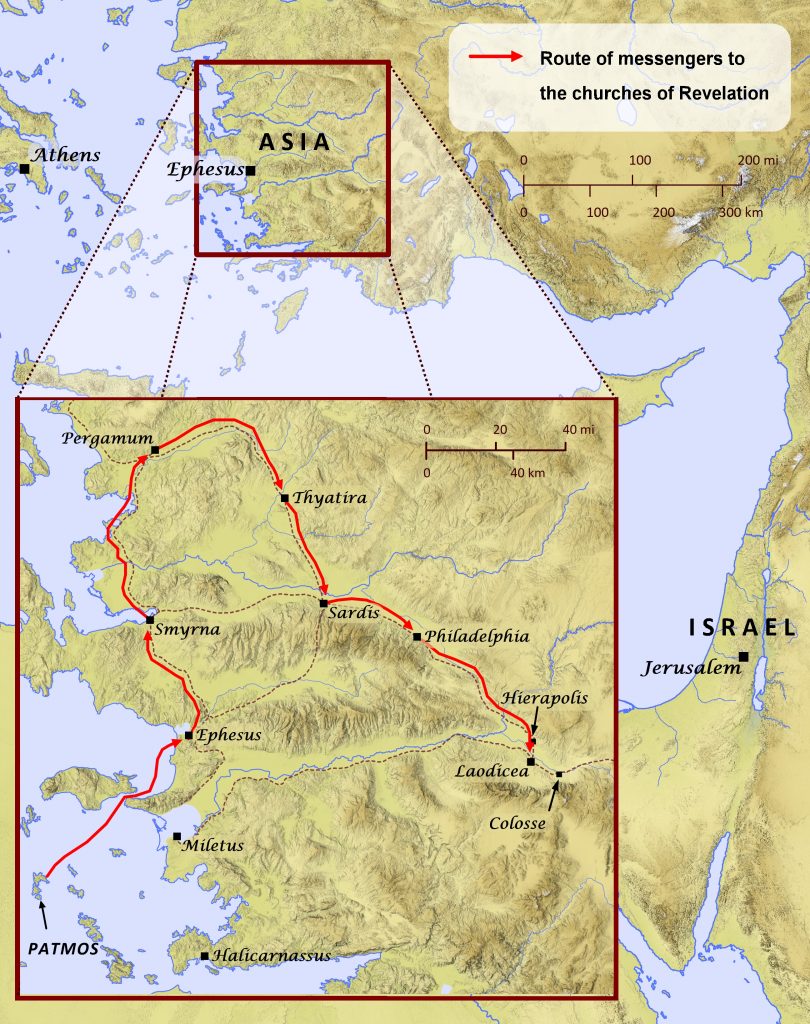
According to church tradition, sometime after ministering at the church in Jerusalem the apostle John moved his ministry to Ephesus, one of the largest cities in the Roman Empire. From Ephesus John ministered to several other churches in the province of Asia, and his letters of 1, 2, and 3 John were likely addressed to churches in or around Ephesus. Later, however, John was exiled to the island of Patmos, and there he recorded visions of the end of the world. Included in his visions were messages specifically addressed to seven different churches throughout Asia, and each message was listed in the order that a courier likely would have delivered it to the church addressed (Revelation 1:11).
⤓ download hi-res file 🔍 see in TimeGlider

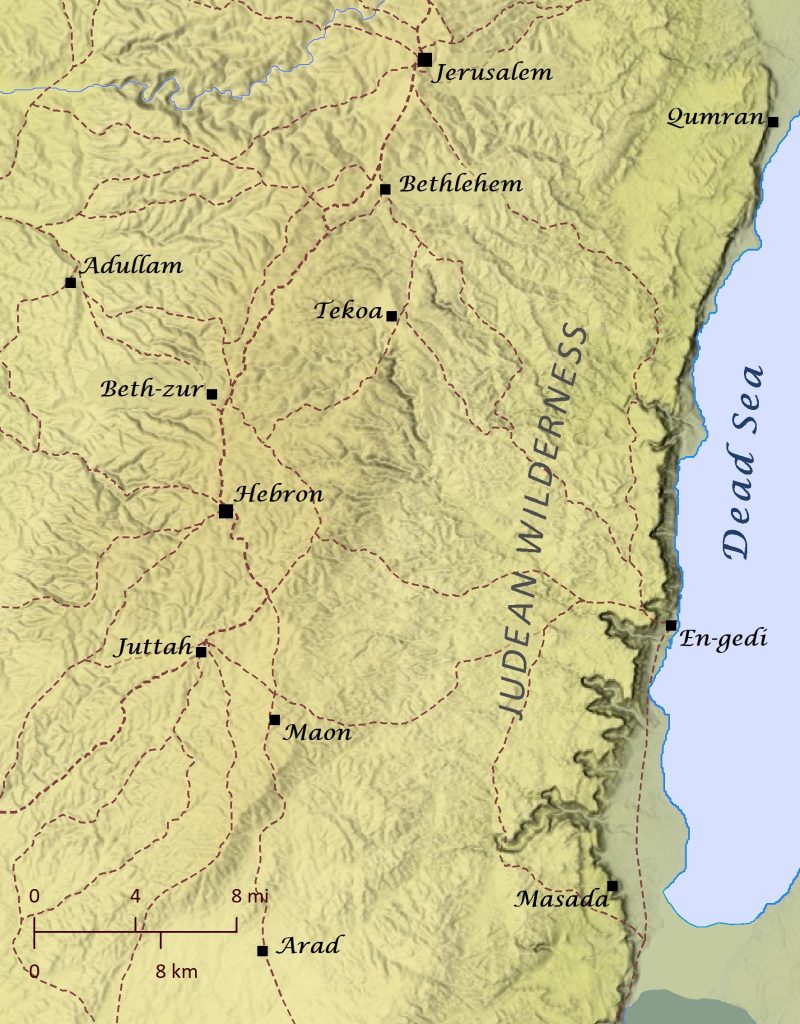
Judah and Its Towns
The land of Judah in southern Israel was home to many important leaders throughout Israel’s history. Abraham, Isaac, Jacob, and Joseph all lived in the hill town of Hebron for a time (Genesis 13:18; 35:27; 37:12-14), and later several of them were buried in the family tomb there (Genesis 23:19; 25:9; 50:12-13). Likewise, David was born in the Judean town of Bethlehem (1 Samuel 16-17), and while he was on the run from Saul, he traveled from hideout to hideout throughout Judah (1 Samuel 19-26), which was no doubt familiar terrain for him. Various strongholds near the oasis of En-gedi in the barren Judean wilderness served as some of David’s hideouts (1 Samuel 23:29), and Masada (which means “stronghold”) was likely among them. When David first became king, he reigned over Judah from the town of Hebron and moved to Jerusalem only after he gained control over all Israel (2 Samuel 5:1-5). His son Absalom later staged a rebellion against him from Hebron (2 Samuel 15:1-12). Hundreds of years later Jesus was born in Bethlehem (Matthew 2:1-12; Luke 2:1-20), and Masada became the final holdout for a group of Jewish zealots during their revolt against the Romans.

Phoenicia and Tyre
The mountainous region of Phoenicia (corresponding roughly to modern Lebanon) lay along the coast of the Mediterranean Sea, just north of ancient Israel. Throughout most of their history the Phoenicians enjoyed a peaceful relationship with the people of Israel. They were renowned for their abundant supply of cedar (2 Kings 19:23; Psalm 29:5; 92:12), which was resistant to termites, and for their purple dye, which was extracted from murex shells along the shore. The name “Phoenicia” means “the land of purple.” The Phoenicians were also renowned as skilled seafarers and international merchants (Isaiah 23:1-3; Ezekiel 27:1-9), establishing trading colonies in places as far away as Carthage (south of Italy) and even Spain. The island city of Tyre was one of the most prosperous of the Phoenician cities. When King Solomon built the first Temple of the Lord in Jerusalem, he partnered with King Hiram of Tyre to float cedar timber down the Mediterranean Sea to Joppa, where it was brought ashore and hauled to Jerusalem (2 Chronicles 2). Solomon also partnered with Hiram to send out merchant ships to very distant lands to bring back exotic goods (1 Kings 10). Hundreds of years later, Jesus ministered in the region of Tyre and Sidon for a time (Matthew 15:21).


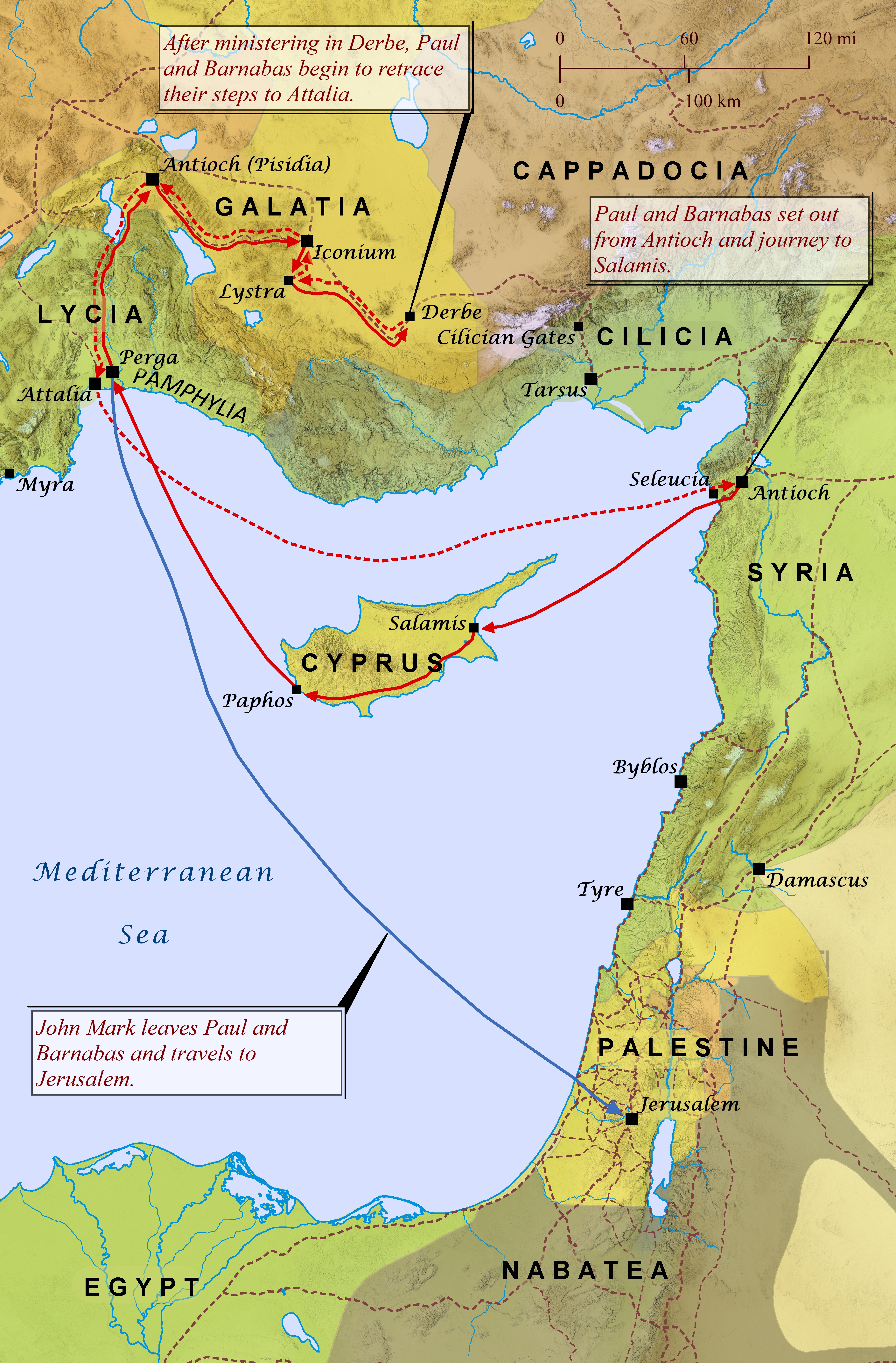
Paul’s First Missionary Journey
Acts 13-14
During their first missionary journey, Paul and Barnabas traveled to several cities in the Roman provinces of Cyprus (Barnabas’s home region; see Acts 4:36-37), Lycia, and Galatia. Over the previous centuries many Jews had been scattered to distant locations like southern Turkey, so this is why Paul and Barnabas were able to find audiences for their message about the Messiah in Jewish synagogues in these cities. Along the way, however, some of these Jews fiercely resisted their message and even persecuted them, and this may have been what led Barnabas’s cousin John Mark (see Colossians 4:10) to leave them and return to Jerusalem. Paul and Barnabas continued on and were able to preach the gospel in Antioch of Pisidia, Iconium, Lystra, and Derbe. Later, Paul, along with Silas, revisited these churches during his second and third missionary journeys to strengthen and encourage them (Acts 15:36-16:5; 18:23). He also wrote the New Testament letter of Galatians to these churches to exhort them to hold firm to the gospel and not follow those who were teaching that righteousness can be achieved by obeying the law of Moses.

? download hi-res file 🔍 see in TimeGlider
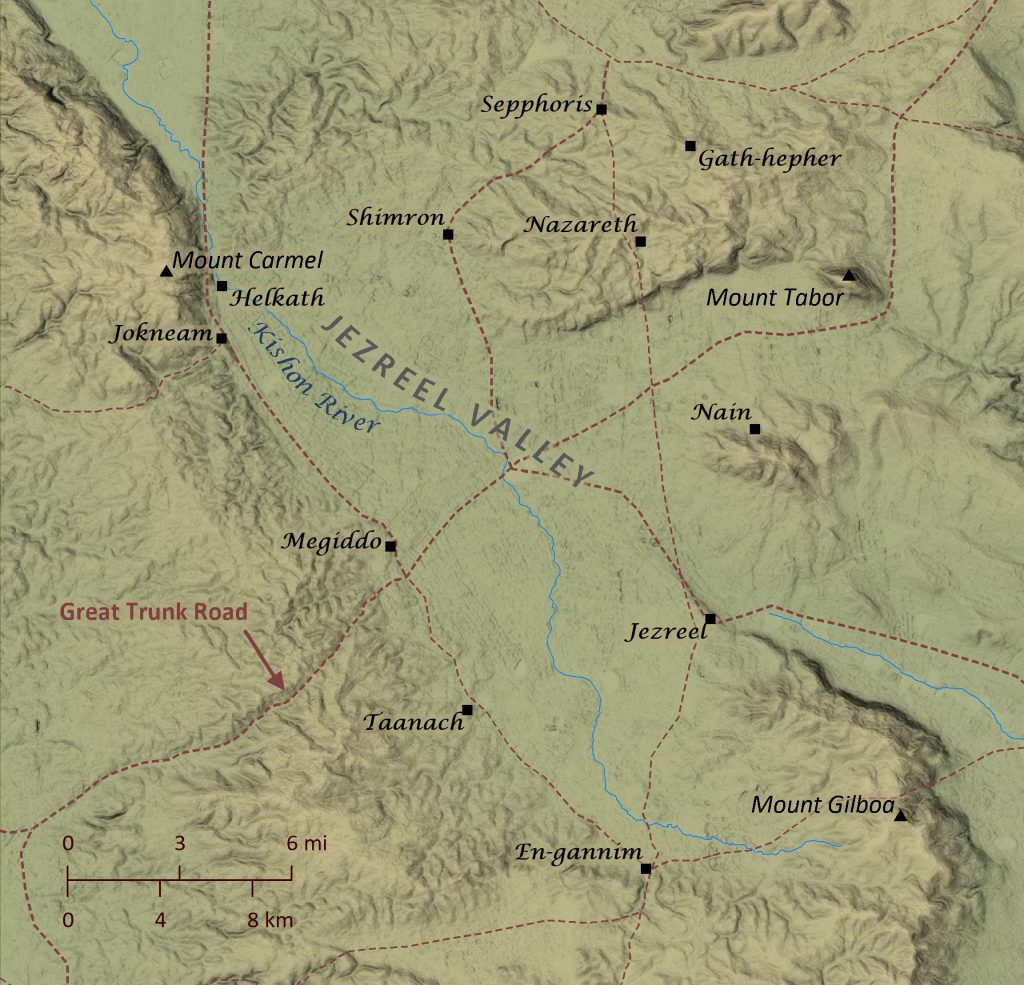
Jezreel Valley and Megiddo
The scenic and spacious Jezreel Valley is located just north of ancient Samaria. This fertile plain served (and still serves) as the breadbasket of Israel-–and the site of numerous bloody battles throughout Bible times. From Gideon (Judges 7) to Deborah (Judges 4-5) to Saul (1 Samuel 28-31) to Josiah (2 Kings 23:29-30; 2 Chronicles 35:20-27), various commanders have recognized the importance of maintaining control over this prolific farmland, but equally important was maintaining control over the Great Trunk Road, which passed through the valley and connected Egypt with Anatolia and Mesopotamia. The Central Ridge Route, which served as the main artery running north and south throughout Israel, also terminated just south of the valley. At perhaps the most strategic location in the valley lay the raised fortress of Megiddo, which guarded a key mountain pass along the Great Trunk Road. Perhaps it was this long and bloody history of Megiddo and the Jezreel Valley that was in the apostle John’s mind as he foretold in the book of Revelation of a great battle between good and evil at a place called Armageddon, which means “Mount Megiddo” (Revelation 16:12-16).