
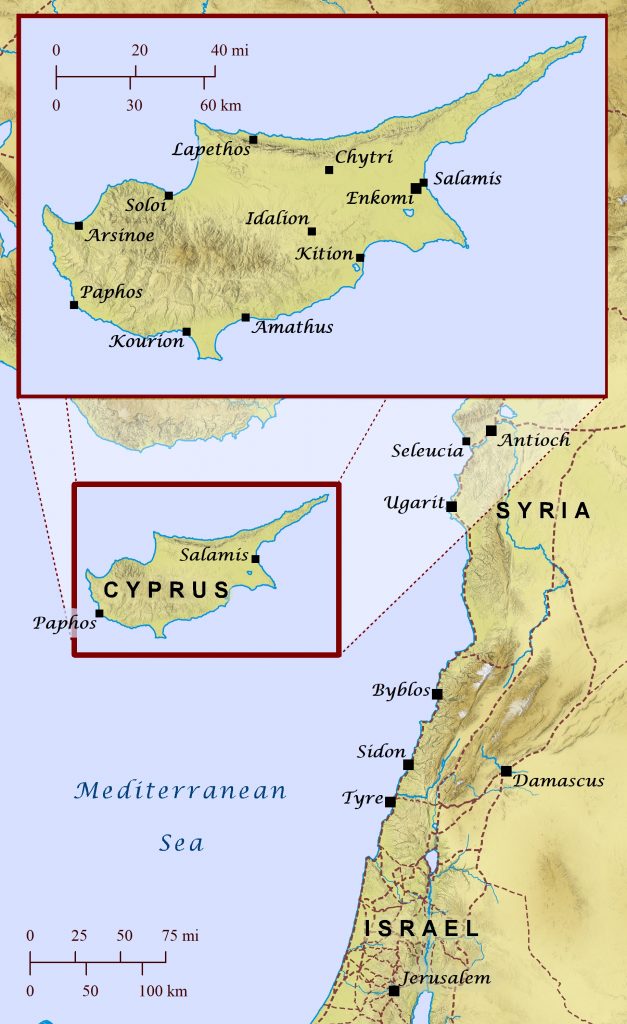
While the island of Cyprus is often remembered as the home region of the apostle Barnabas during the time of the New Testament (Acts 11:19-20), its history intermingles with Israel’s at least as far back as the time of the Exodus, though mostly indirectly. Cyprus was located about 165 miles northwest of Israel, and in ancient times it was covered with forests. It was also abundant in copper, silver, iron, various minerals, wine, oil, and grain and became famous throughout the Near East for these prized resources. A contingent of Mycenaean Greeks inhabited Cyprus by 1400 B.C., and later the island received a larger wave of Greek settlers after Mycenaean culture collapsed in Greece. Cyprus maintained close contacts with cities on the mainland that lay to the north and to the east of the island, but its direct contact with Israel was limited during the Old Testament, perhaps because of Israel’s limited interest in sea travel and trade. The island, or perhaps certain cities such as Kition, are referred to in the Old Testament by the names Elishah and Kittim (Genesis 10:4; Numbers 24:24; 1 Chronicles 1:7; Isaiah 23:1-12; Jeremiah 2:10; Ezekiel 27:6; Daniel 11:30). Eventually the island came under the rule of Assyria and was later controlled by Egypt during the Babylonian era. As with rest of the Near East it was then subsumed into the mighty Persian Empire until Alexander the Great, after which it came under the rule of the Ptolemaic Empire. In 58 B.C., Rome acquired Cyprus and established it as a Roman province. They divided the island into four districts, which were named after the primary town in each district: Salamis, Paphos, Amathus, and Lapethos. As mentioned earlier, the apostle Barnabas (and perhaps his relative John Mark) was from the island of Cyprus (Acts 11:19-20), and when Paul set out with him on the first missionary journey, they went first to Cyprus (Acts 13). Later Barnabas parted ways with Paul and returned to Cyprus with John Mark, presumably on another missionary journey (Acts 15).

Paul’s Travels in Western Anatolia
During his second and third missionary journeys (Acts 15-21), the apostle Paul traveled extensively throughout western Anatolia, most of which formed the Roman province of Asia. During Paul’s third journey, he spent two years ministering in Ephesus, one of the most prestigious cities of the Roman Empire, but eventually the local silversmiths incited a riot, forcing Paul to leave for Macedonia (Acts 19). Eventually the apostle John relocated his ministry to western Anatolia as well, and the seven churches he addressed in the book of Revelation (Ephesus, Smyrna, Pergamum, Thyatira, Sardis, Philadelphia, and Laodicea) were located there (Revelation 1:11).

⤓ download hi-res file 🔍 see in TimeGlider

Ehud Rescues Israel
Judges 3:12-30
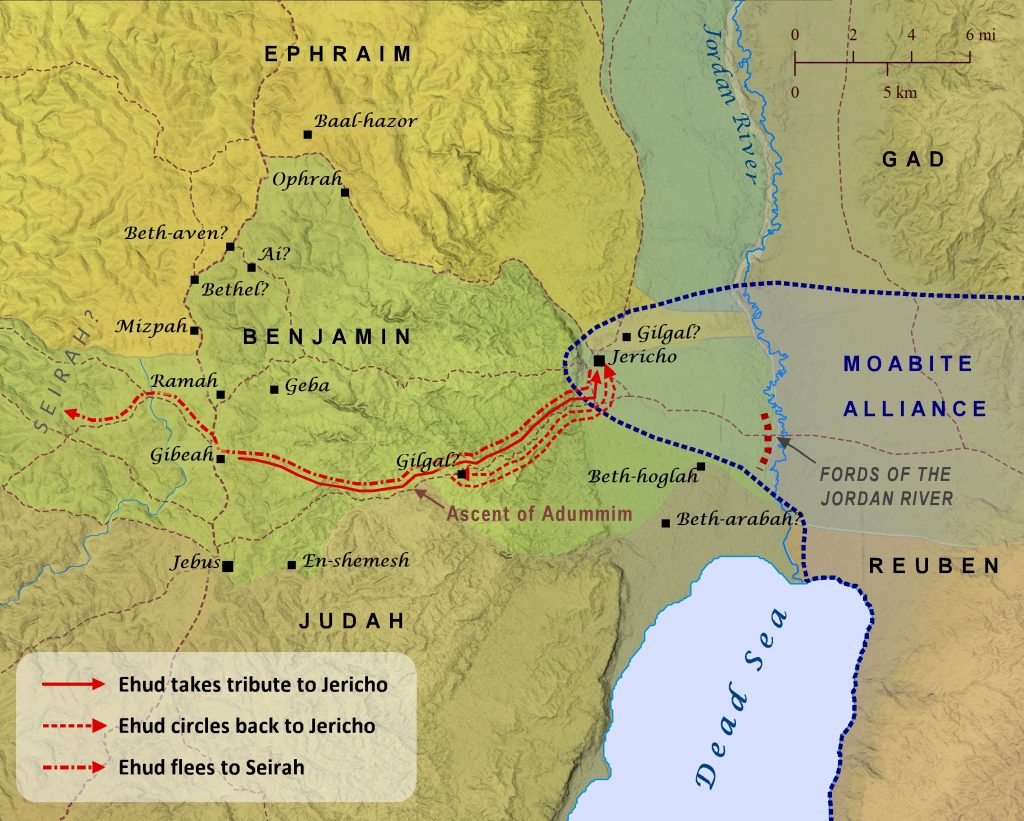
The story of Ehud is set in the time of the Judges, and it follows the familiar pattern of Israel falling into sin, suffering foreign domination, and experiencing deliverance by a deliverer, or judge, whom the Lord raises up to rescue them. On this occasion a coalition of Moabites, Ammonites, and Amalekites, led by Eglon king of Moab, attacked Israel and took control of the “City of Palms,” which was almost certainly Jericho (see Deuteronomy 34:3; 2 Chronicles 28:15), and the Israelites remained subject to him for eighteen years. Then the Lord raised up a left-handed Benjaminite named Ehud (also see article here), and he became the leader of the entourage of Israelites who traveled to Eglon’s headquarters in Jericho to present him with tribute. After delivering the tribute, the entourage set out to return, presumably to the hill country. Given the flow of events and the mention of the stone images near a place called Gilgal (meaning “circle of stones”) on their return journey, it seems most likely that they were following the Ascent of Adummim, and the Gilgal in this story is the same one mentioned in Joshua 15:6-7 and 18:17 (where it is called Geliloth, “circles”), rather than the Gilgal located immediately northeast of Jericho. So Ehud turned back when they reached Gilgal and (perhaps the next day), headed back down to Jericho, and assassinated Eglon in his palace. The story then indicates that Ehud fled along the same route to Seirah (likely referring to the wooded hill country), for it notes that he passed the stone images once again (v. 26). There in the hill country Ehud rallied the other Israelites, who then went down and captured the fords of the Jordan River and killed 10,000 Moabites that tried to cross back into Moabite territory. As a result of the Israelite victory, the Moabites became subject to Israel that day.

Cyrene and Its Surroundings
For most Bible readers, the city of Cyrene is not typically recognized as a significant place for understanding the world of the Bible, yet it is mentioned no less than five times in the New Testament as the place where certain people came from or lived. This underscores how much interaction some residents of Cyrene must have had with believers throughout the early church, both in Jerusalem and in Antioch. The ancient city of Cyrene was established on the narrow band of fertile land along the northern coast of Libya. It was founded around 631 B.C. by Greeks from the island of Thera who had been experiencing a severe drought. Over time several other cities were founded along the coast, forming what has sometimes been called the Pentapolis (“Five Cities”) of Cyrenaica: Cyrene (and its port of Apollonia), Balagrae, Ptolemais, Barca, and Berenice. Cyrenaica came under Persian rule by 525 B.C., and after Alexander’s empire was divided among his generals the region came under Ptolemaic rule. In 96 B.C. the Pentapolis was bequeathed to Rome and was later combined with Crete to form the Roman province of Crete and Cyrenaica. Cyrene and its surrounding lands produced grains, olive oil, wine, figs, apples, wool, beef, and a rare herb called silphium, and the city became renowned for its academic and artistic centers. At its peak it boasted a population of about 100,000 residents, including a large Jewish population. During the time of Jesus a man from Cyrene named Simon, who had likely come to Jerusalem to worship at the Temple during Passover, was compelled to carry Jesus’ cross while Jesus was being led away to his crucifixion (Matthew 27:32; Mark 15:21; Luke 23:26). Other Jews from Cyrene were among those in Jerusalem who heard the apostle Peter’s message in their own language while celebrating the festival of Pentecost (Acts 2:10). Later, other Jews from Cyrene and elsewhere argued with a believer named Stephen and falsely accused him of blasphemy (Acts 6:9). After Stephen was stoned to death and many believers fled Palestine, some Jewish believers from Cyrene were among those who traveled to Antioch and told Gentiles about the good news of Jesus Christ (Acts 11:19-20). Finally, a Cyrenian believer named Lucius was one of several people in Antioch who were led by the Holy Spirit to appoint Barnabas and Paul for missionary service (Acts 13:1).


The World of the Bible
It is common for people today to caricature the biblical writers as having a very limited view of the world and thus a very limited perspective on life. The truth is, however, the writers of Scripture were familiar with a very expansive world–shown here–that stretched over 3000 miles from end to end. Most of the places shown here are directly referenced in the Old Testament, and Rome and its surrounding lands are mentioned in the New Testament. The apostle Paul also mentioned a desire to travel to Spain (Romans 15:24), which is located another 700 miles beyond the western edge of this map. Even the Israelites’ most ancient record of the ancestries of various peoples (Genesis 10) references many of the places shown here, and by the time the Persian Empire reached its zenith around 500 B.C. it covered an area about eight times the size of Texas, bringing within one domain numerous peoples, languages, cultures, and religions. Jesus’ crucifixion likewise demonstrated the diverse context of the biblical world, for the charges posted above his head had to be written in Aramaic, in Latin, and in Greek (John 19:20). All this points to the reality that the world of the biblical writers was not, in fact, extremely limited but instead very cosmopolitan–perhaps even more diverse than the context many of us are familiar with today.

