Saul Rescues Jabesh-Gilead

1 Samuel 11

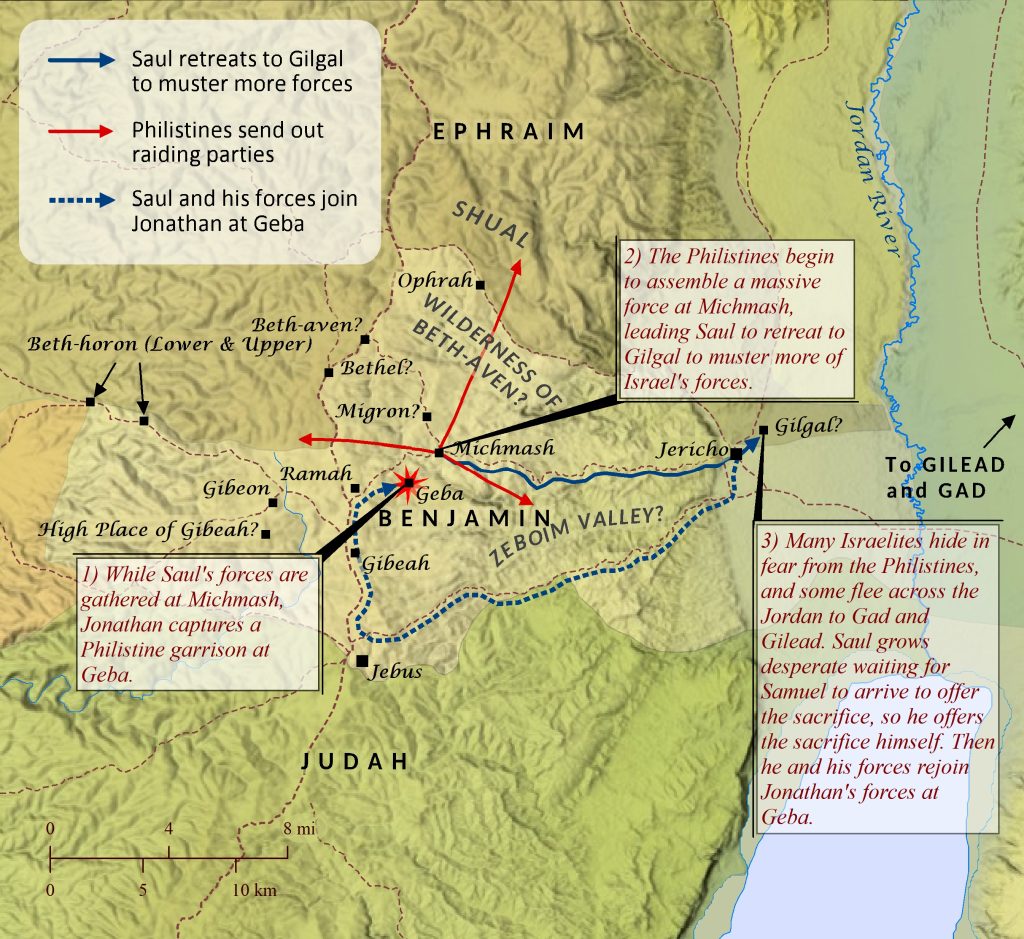
Soon after Saul was anointed king of Israel by Samuel, Saul demonstrated his ability to unite the tribes against a common enemy, fulfilling one of the reasons the people had asked Samuel for a king (1 Samuel 8:19-20). A man named Nahash the Ammonite had besieged the Israelite town of Jabesh-gilead, and before he would grant them a treaty, he required that he gouge out the right eye of every person in the town. Messengers from Jabesh-gilead went throughout Israel seeking someone to rescue them from Nahash. When they reached Gibeah, they told this to the people and then to Saul as he was returning from the fields with his oxen. When Saul heard what was happening, the Spirit of God came upon him powerfully, and he cut up his oxen and sent pieces throughout Israel as a threat to anyone who did not join him to rescue Jabesh-gilead. Saul mustered Israel’s forces at Bezek and sent word to the people of Jabesh-gilead that they would be rescued the next day. The next day Saul did defeat the Ammonites and completely destroyed them. In response, some suggested to Samuel that those who initially opposed Saul’s appointment as king should be put to death, but Samuel instead called for everyone to meet at Gilgal and reaffirm Saul as king. The people did so and celebrated Saul’s kingship with fellowship offerings before the Lord.

⤓ download hi-res file         🔍 see in TimeGlider

PassageBrowser and MapFinder

PassageBrowser is a newly released tool by Bible Mapper that makes it even easier to find Bible Mapper Blog maps related to a particular passage of Scripture. With PassageBrowser you can enter a Bible reference and it will display the Scripture text alongside all relevant Bible Mapper Blog maps. You can select from multiple translations (currently ESV and NLT) to display the Bible text, and the relevant maps are collected by the MapFinder module in the right margin. You can also open the MapFinder module in a separate tab by clicking on the MapFinder header, and it will retrieve maps without displaying the accompanying Bible text. You can even preload a reference into PassageBrowser or MapFinder by appending ?ref=[your Bible reference] to the URL of your browser (e.g., https://biblemapper.com/passagebrowser/?ref=Matt 10-11). To get to PassageBrowser, enter a Bible reference into the search box at the top of the Bible Mapper Blog. The search box is already configured to utilize PassageBrowser if it detects that the search string entered is a Bible reference.

Tarshish

Much like the garden of Eden, the location of the place called Tarshish in the Bible has become shrouded in mystery over time. The word Tarshish is mentioned over 25 times in Scripture, yet few geographical clues are found in these references to help pinpoint the location, and some of them actually seem to contradict each other. The earliest mention of Tarshish occurs in what is commonly called the Table of Nations, the Israelites’ oldest catalog of the peoples of the ancient Near East (Genesis 10:4; 1 Chronicles 1:7). Tarshish is then mentioned by various biblical writers from the time of Solomon to the time of the Babylonian exile. Some passages suggest Tarshish was located in the Mediterranean Sea (Jonah 1:3), while other passages seem to suggest that it could be reached by way of the Red Sea (1 Kings 22:48; 2 Chronicles 20:36-37). A few references indicate that Tarshish was located far from Israel (Isaiah 66:19) along a sea coast, perhaps on an island (Psalm 72:10). The prophet Ezekiel noted that Tarshish traded silver, iron, tin, and lead (Ezekiel 27:12; see also Jeremiah 10:9). Finally, numerous passages speak of “ships of Tarshish” in various contexts and locations (1 Kings 10:22; 22:48; 2 Chronicles 9:21; 20:36-37; Psalm 48:7; Isaiah 2:16; 23:1-14; 60:9; Ezekiel 27:25). Outside of the Bible, a 9th-century B.C. stone tablet from the city of Nora in Sardinia appears to mention Tarshish. The inscription seems to be saying that a certain official had either been coming from Tarshish or was intending to go to Tarshish but was driven to Nora instead. Perhaps a first step to gaining more clarity about the location of Tarshish is to address the frequently used term “ships of Tarshish.” Given the many varied uses of this phrase in Scripture, most scholars now believe it likely referred to a class of ships built for conveying large amounts of goods over long voyages, rather than to the ships’ origin or destination. Thus newer translations often render this phrase as “trading ships.” A second step in identifying where Tarshish was likely located is to investigate its association with tin, silver, and lead–all of which were rare commodities in the ancient world that originated from a limited number of sources. The term Tarshish is likely derived from a Phoenician term meaning “smelting place,” and there were no doubt several such places in the ancient world that derived their name from this word, including Tarsus (in Cilicia), Tharros (in Sardinia), and Tartessos (in Spain). Based on the location of related peoples, it is likely that the Tarshish mentioned in the Table of Nations was located at Tarsus. But isotopic analysis of silver samples found in Israel has confirmed that by the time of Solomon much of Israel’s silver was likely coming from Tharros, so it is possible that the term Tarshish at that time referred to Tharros. Soon after this, however, the primary supplier of silver for Israel shifted further west to Spain, perhaps at a place called Tartessos. Several deposits of tin were also located in Spain and areas further north, bolstering the argument that by this time Tartessos had become the location that later biblical writers meant by the term Tarshish. But then what about 2 Chronicles 20:36-37, which, when more literally translated, seems to insist that King Jehoshaphat was building ships at Ezion-geber on the Red Sea with the intent of sailing to Tarshish? Some scholars have suggested that the Chronicler must have mistaken the phrase “ships of Tarshish” in 1 Kings 22:48 as indicating the destination of the ships. This critical view typically also assumes that Tarshish was located in the Mediterranean Sea, making the Chronicler doubly mistaken. But, in fact, it may be that the term Tarshish, while typically associated with known smelting centers in the Mediterranean Sea, was ultimately a generic term for any smelting place, and thus this passage may be using this term to reference the gold smelting centers at Ophir at the southern end of the Red Sea.

Map adapted from information provided by Vasiliki Kassianidou and Arthur Knapp. Archaeometallurgy in the Mediterranean: The Social Context of Mining, Technology, and Trade. (2008) 10.1002/9780470773536.ch9.

⤓ download hi-res file

Joseph Is Sold into Slavery

Genesis 37

The well known story of Joseph and his brothers opens with his family living in the area of Hebron in the land of Canaan. After many years spent elsewhere, Joseph’s father Jacob had returned to Hebron (Genesis 35:27-29), for that was where Jacob’s father Isaac had settled and where Isaac’s father Abraham had purchased some land to serve as the family burial place (Genesis 23). Joseph’s brothers had gone to Shechem far north of Hebron to graze the family flocks, but apparently Joseph stayed behind. Joseph had earlier angered his brothers and even his father by telling them about some dreams he had that seemed to suggest they would all bow to him one day. Jacob eventually sent Joseph to Shechem to check on his brothers. When he arrived, he did not find his brothers, but another man told him that he overhead his brothers saying that they should go to Dothan. As Joseph was approaching Dothan, his brothers saw him and plotted to kill him, but the oldest brother, Reuben, persuaded them only to throw him into an empty cistern. As the brothers sat down to eat their meal, they saw a caravan of Ishmaelite traders coming from Gilead on their way to Egypt. Their camels were loaded down with gum, balm, and myrrh, which matches Jeremiah’s later association of Gilead with balm and medicinal ointments (Jeremiah 8:22; 46:11). The traders were no doubt making their way to the international trade route that passed near the coast. So instead of killing Joseph, his brothers sold him to the traders, whom the story now refers to as “Midianites.” Both Ishmaelites and Midianites were largely nomadic peoples, and it may be that the term Midianites could be used to refer to any transient group of people, such as a trade caravan. After the Midianites reached Egypt they sold Joseph to Potiphar, the captain of Pharaoh’s guard.

download hi-res file

The Empire of Alexander the Great

Though the conquests of Alexander the Great are barely mentioned in the Old Testament and never mentioned in the New Testament, the eventual impact of his accomplishments upon the world of the New Testament can hardly be overstated. Alexander was born in 356 B.C. in Macedonia, a region in northern Greece that had formerly been subjugated by the Persians from 512 B.C. to 479 B.C. In 336 B.C. at the age of 20 Alexander assumed the throne of Macedonia from his father Philip II, and he immediately united all of Greece under his rule and launched a 10 year campaign with his army to overthrow the entire Persian Empire–a feat he accomplished without losing a single battle to the Persians. Technically speaking, Alexander lived between the Old and New Testament eras, but the prophet Daniel had foretold of Alexander’s actions in chapters 8 and 11 of his book. During his conquests, Alexander passed through Palestine on his way to Egypt, and the cities of Tyre and Gaza made futile attempts to stop him, thereby suffering devastating consequences for their resistance. The high priest of Judea, however, openly submitted to Alexander’s rule and spared the nation from destruction at his hands. Alexander continued his victorious campaign eastward through Babylon, Persepolis, Ecbatana, and Kabul, eventually bringing virtually the entire Persian domain under his rule. After reaching what was called India by the Greeks, Alexander’s army refused to continue pushing eastward, so Alexander was forced to begin the long journey home to Macedonia with his army. Along the way, however, Alexander died in the palace of Nebuchadnezzar II in Babylon in 323 B.C., and his empire was eventually divided among his generals. The impact of Alexander’s actions, however, lived far beyond his death. Besides founding or renaming over 20 cities with the name Alexandria (those most famous being the one in Egypt), Alexander united the entire eastern world under a common language, a simplified form of Greek called Koine. Eventually this led to a new translation of the Old Testament in Koine Greek (the Septuagint), and the New Testament was written in Koine Greek as well, because by that time it had become the most widely spoken language throughout the eastern half of the Roman Empire. Over the following centuries, many of these eastern peoples also adopted Greek values and beliefs in a process commonly called Hellenization (from Hellas, the ancient name of Greece). Many Jews in Palestine and throughout the eastern world were among those who adopted Hellenistic lifestyles and beliefs as well, often mixing them together with more traditional beliefs and practices of Judaism. Over time tensions in Palestine increased between traditional Jews and Hellenistic Jews, eventually erupting into open conflict under the leadership of Mattathias Maccabeus and his sons.

download hi-res file         🔍 see in TimeGlider