Gedaliah Is Assassinated

2 Kings 25; Jeremiah 40-44

Sometime after the Babylonians destroyed Jerusalem and exiled the upper echelons of Judean society to Babylon, they appointed a Judean named Gedaliah as governor over those who remained in the land. At Mizpah Gedaliah encouraged those who remained to embrace Babylonian rule and reestablish their lives in the land, cultivating the land and harvesting crops as they had before. Many Judeans who had fled to neighboring lands heard about this and returned to Judah as well. Among them was a man named Ishmael, a member of the Judean royal family who had been one of the king’s officers. Another officer named Johanan warned Gedaliah that Ishmael had been sent by the king of Ammon to kill Gedaliah, but Gedaliah did not believe him. Eventually Ishmael came to Mizpah with ten other men and killed Gedaliah and all the Judeans and Babylonian soldiers who were there. The next day, eighty men from Shechem, Shiloh, and Samaria were traveling to the Temple of the Lord to make an offering, and Ishmael went out and invited them to stop at Mizpah. But after they entered the city, Ishmael and his men slaughtered many of them and took the others captive. He set out with them to escape to Ammon, but by this time Johanan and the other officers had heard about what had happened and pursued Ishmael, forcing him to turn back toward Gibeon. There Johanan and his men caught up with Ishmael and freed those taken captive, but Ishmael and eight of his men escaped to Ammon. After this Johanan, his officers, and all those he had recovered set out for Egypt, because they feared what the Babylonians would do when they learned that Ishmael assassinated the governor they had appointed. Along the way the Judeans stopped near Bethlehem and consulted Jeremiah, asking him whether they should flee to Egypt. After ten days Jeremiah told the Judeans that they should not go to Egypt and that those who did so would die or suffer hunger there. But Johanan and the other leaders refused to heed Jeremiah’s warning and took everyone–including Jeremiah–with them to Egypt, traveling as far as Tahpanhes. There the Lord told Jeremiah to prophesy that the Babylonians would one day seize the land of Egypt as well. Jeremiah also prophesied against Judeans who had fled to other parts of Egypt, including those in Migdol, Memphis, and Upper Egypt much further south (Jeremiah 44:1).

⤓ download hi-res file         ⧗ see in TimeGlider

Border Conflict between Israel and Judah

1 Kings 15:9-22; 2 Chronicles 16:1-6

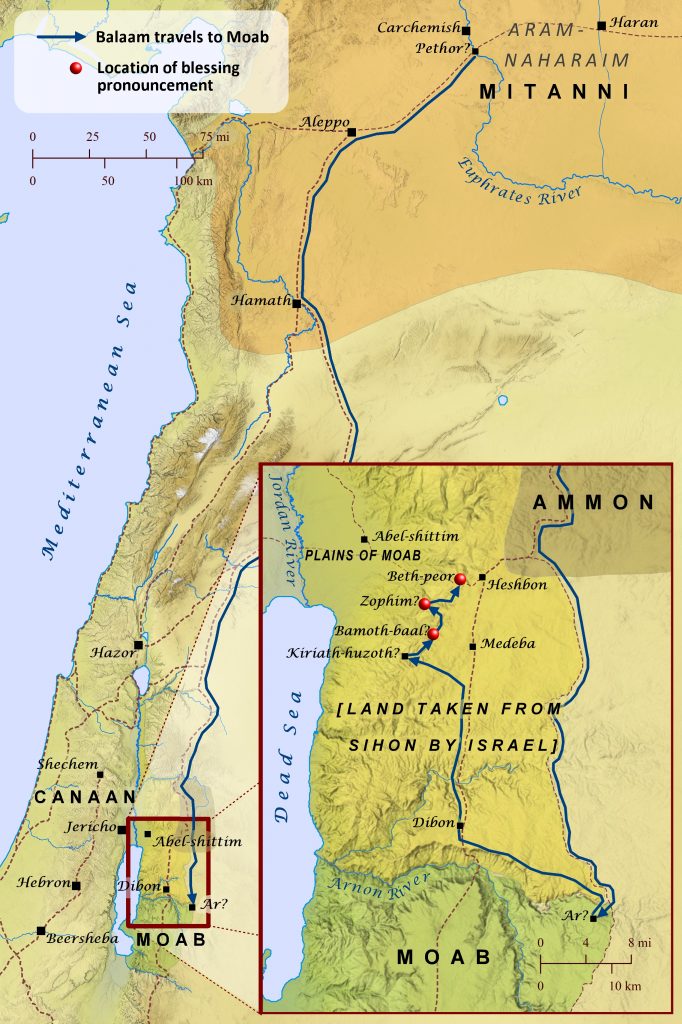
Around 895 B.C., a few decades after Israel divided into the northern kingdom of Israel and the southern kingdom of Judah, a border dispute erupted between the two nations. King Baasha of Israel seized the strategic Judean border town of Ramah and fortified it to gain control over all routes leading to and from Judah along its northern border. King Asa of Judah responded by bribing Beh-hadad I, king of Aram, with all the silver and gold that remained in the treasuries of the Temple and his own palace. Ben-hadad accepted Asa’s bribe and attacked Israel, capturing Ijon, Dan, Abel-beth-maacah, the area of Kinnereth, and all Naphtali. After this Baasha stopped building Ramah and withdraw to his capital city of Tirzah, and Asa ordered everyone in Judah to carry away the stones and timber from Ramah. Asa then used the materials to build up Geba and Mizpah, thereby moving the border further north and ensuring a watchful presence over key routes heading north and east. The Bible is unclear how long Aram retained control over the region of Naphtali. Years later King Ahab of Israel waged several more battles with the Arameans (1 Kings 20-22; 2 Kings 6:24-33), and he may have recovered Naphtali during that time.

⤓ download hi-res file         🔍 see in TimeGlider

Jephthah’s Exploits

Judges 10-12

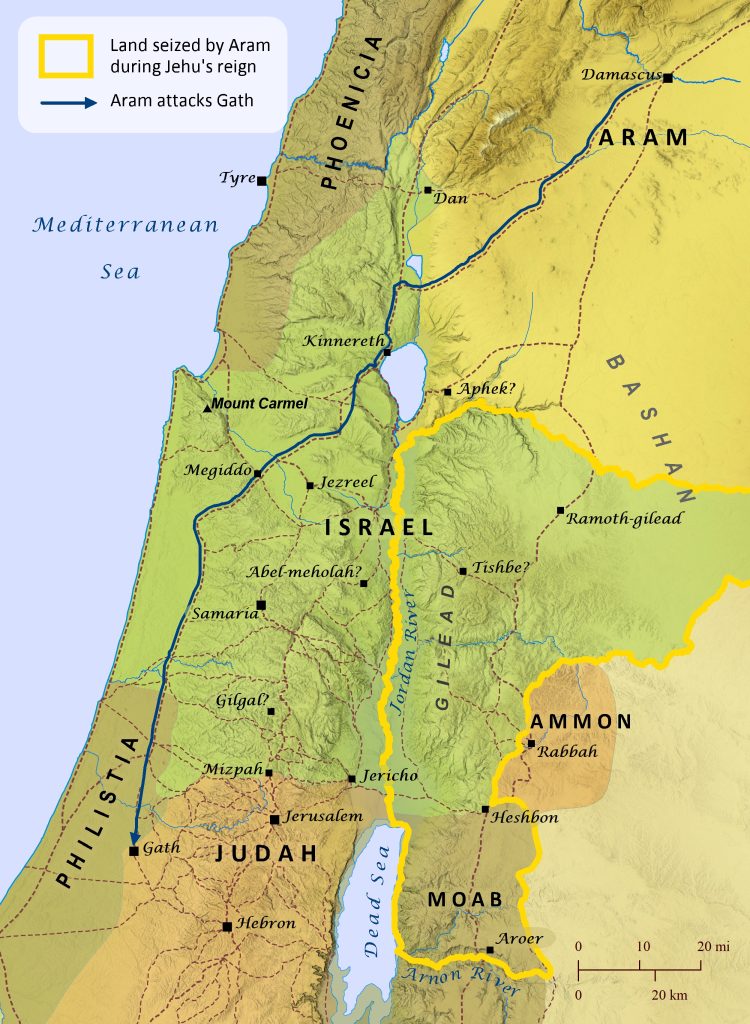
The story of Jephthah is set in the time of the judges, when Israel was settling into the land they had taken possession of many years early under Joshua’s leadership. Continuing their repeated pattern of sin, oppression, repentance, and deliverance, the people of Israel were suffering attacks by the Ammonites, who normally occupied the eastern edge of habitable land east of the Jordan River. The region of Gilead and the tribes of Judah, Benjamin, and Ephraim were the primary targets of these attacks (Judges 10:6-10), and the Israelites cried out to the Lord for help. Jephthah had been born to a prostitute in Gilead and was driven away to the land of Tob by his brothers, but the elders of Gilead sent for him to come and lead them to fight against the Ammonites. When Jephthah returned, he sent a message to the king of Ammon asking him why he was attacking Israel. The king of Ammon answered that the land east of the Jordan River taken under Joshua’s leadership actually belonged to the Ammonites, but Jephthah replied that this land had not belonged to Ammon but to Sihon king of the Amorites. Apparently Sihon had captured this land from the Ammonites as well as the northern half of Moab from the Moabites (Numbers 21:26; Joshua 13:25). He then attacked the Israelites while they were approaching the plains of Moab, and the Israelites defeated him, taking all his land. The king of Ammon ignored Jephthah’s response, so Jephthah attacked the Ammonites and defeated them, devastating twenty of their towns in the process. During the battle, Jephthah made a tragic vow to sacrifice whatever came out of his house to greet him upon his victorious return. When the Ephraimites heard of Jephthah’s war with Ammon, they were angry with him and met him at Zaphon to ask why he never asked them to join him in battle. Jephthah insisted that he had invited them, but they did not come. Then Jephthah’s men fought against the Ephraimites and defeated them, capturing the fords of the Jordan River (shallow crossing points) and killing any Ephraimites who tried to cross back over to Ephraim. Apparently the Gileadites could identify these Ephraimites by their inability to pronounce the sound sh, which the Gileadites could pronounce.

⤓ download hi-res file         ⧗ see in TimeGlider

Paul Travels from Malta to Rome

Acts 27:39-28:16

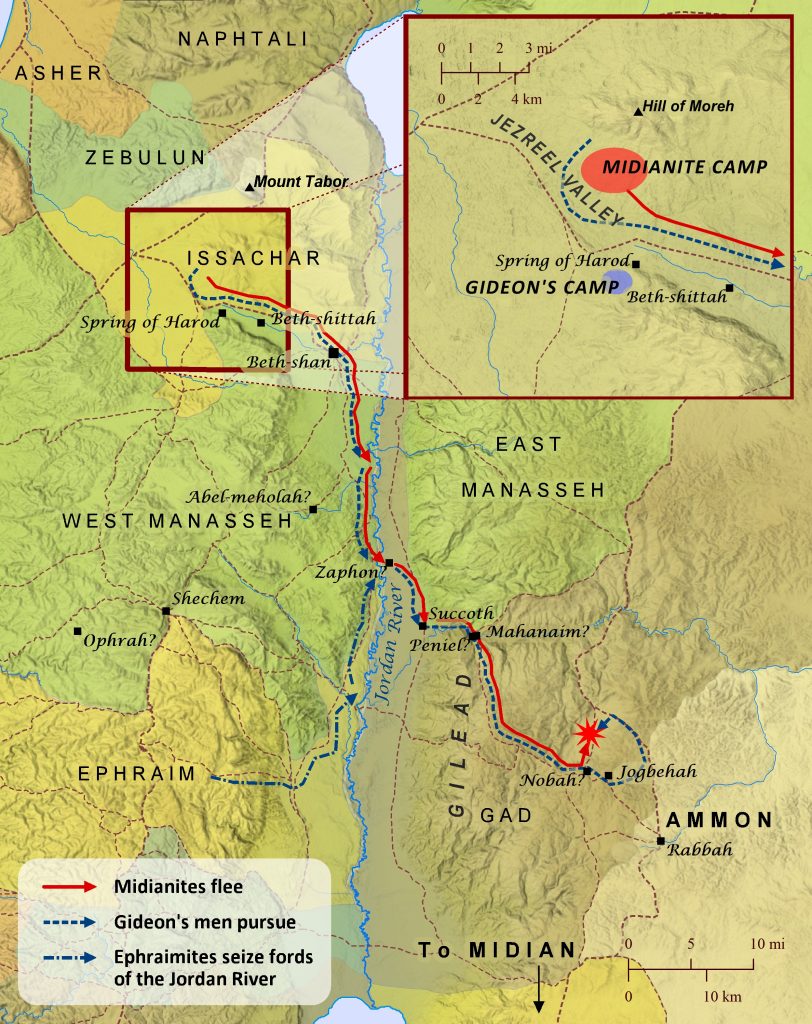
As Paul was being transferred to Rome to stand trial before Caesar, his ship was driven by a storm until it was wrecked near the small island of Malta. The entire crew was saved, and the people of the island treated them with unusual hospitality. During their time there Paul prayed for many who were sick, and they were healed. Three months after they first arrived on the island Paul was placed on another ship to finish the voyage to Rome. Along the way they stopped at Syracuse and Rhegium and then disembarked at Puteoli to finish the trip to Rome on foot. Some believers there invited them to spend a week with them before continuing on to Rome. In the meantime, other believers in Rome heard that Paul was coming and traveled as far as the Forum of Appius–forty miles away–to escort him the rest of the way to Rome. Once in Rome Paul was put under guard but was allowed to live in his own private lodging for two years as he awaited trial. During that time he he welcomed all who visited him and boldly taught about Jesus Christ and the Kingdom of God.

⤓ download hi-res file         🔍 see in TimeGlider

The Tribe of Benjamin

The tribe of Benjamin was descended from the youngest son of Jacob (Genesis 35:16-26) and occupied one of the smallest allotments in the Promised Land (Joshua 15-16; 18:11-13), yet it proved to be a people of great consequence throughout the history of Israel. Benjamin’s allotment in the Promised Land fell between Ephraim to the north and Judah to the south, and it was bisected by the Central Ridge Route from north to south. The land west of the Central Ridge Route was occupied primarily by the Gibeonites, who deceived the Israelites during the early phases of their conquest of the Promised Land so that they were granted a peace treaty and allowed to remain in the land (Joshua 9; see map). The warriors of Benjamin were renowned for their skill as ambidextrous archers and slingers (Judges 20:16; 1 Chronicles 8:40; 12:2), and the Benjaminite judge Ehud was likewise left-handed (Judges 3:12-30). The judge Deborah was also from Benjamin and held court between Bethel and Ramah (Judges 4:1-5). Near the end of the time of the Judges the tribe of Benjamin was involved in a tragic war against the rest of the tribes of Israel but were spared complete annihilation (Judges 19-21). Later the prophet Samuel was born in Ramah and held court at Bethel, Gilgal, Mizpah, and Ramah (1 Samuel 7:15-17), and he anointed Saul, another Benjaminite from Gibeah, as Israel’s first king (1 Samuel 9-10). Long after this the northern tribes of Israel rebelled against the rule of the Davidic dynasty, but Benjamin remained loyal to Judah (1 Kings 12:21; 2 Chronicles 11:1). Later, however, Benjamin’s territory was divided between the two kingdoms (1 Kings 15:16-22; 2 Chronicles 16:1-6). After the people of Judah returned from exile in Babylon, Benjamin’s territory was included in the minor Persian province of Judea (Ezra 2; Nehemiah 7; see map). Hundreds of years later the apostle Paul underscored the distinguished history of the tribe of Benjamin when he proudly declared himself to be a Benjaminite, a “Hebrew of Hebrews” (Philippians 3:5).

⤓ download hi-res file