
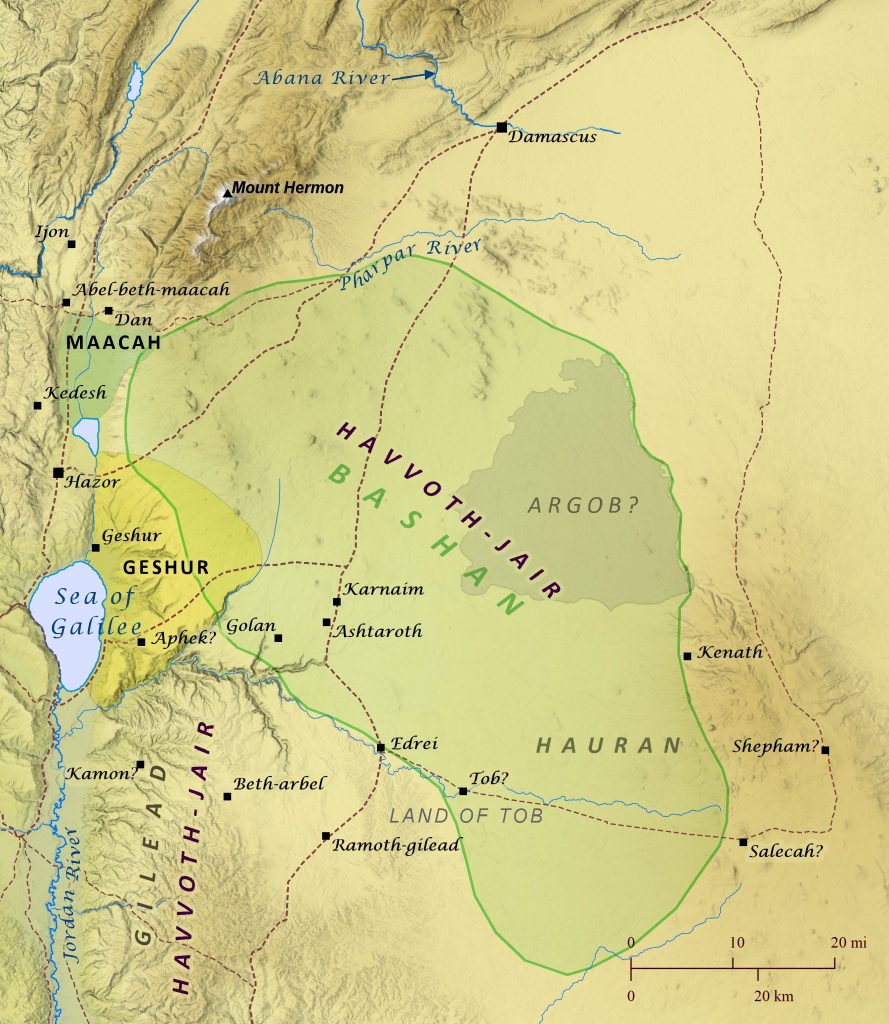
Few areas in Israel have caused more confusion over their related placenames than the plain of Bashan in northeast Israel. This fertile land was seized from King Og after he attacked the Israelites as they were preparing to enter the Promised Land (Numbers 21:32-35; Deuteronomy 2:24-37; 3:1-4), and it was assigned to half the tribe of Manasseh (Deuteronomy 3:13-14; Joshua 13:29-31). It was renowned throughout Bible times as a land of oak forests (Isaiah 2:13; 33:9; Ezekiel 27:6; Zechariah 11:2) and verdant pastures for cattle (Ps. 22:12; Jeremiah 50:19; Ezekiel 39:18; Amos 4:1). Though Bashan’s boundaries were somewhat loosely defined, numerous biblical references to Bashan clarify that it generally encompassed the area shown here. Less clear, however, is the region intended by the scant references to an area called “the Argob” (Deuteronomy 3:4-14; 1 Kings 4:13), a term likely meaning “stony heap.” The Argob was a subregion within Bashan that, in its strictest sense, appears to have referred to an ancient bed of cooled lava that stood (and still stands) about twenty feet above the surrounding plain. At the same time, however, several references note that the Argob encompassed sixty cities, which must have spanned an area well beyond the lava bed, so that the term was essentially equivalent to Bashan. This broader meaning likely grew out of a natural tendency to reference the larger area by its most recognizable nearby feature–the cooled lava bed (e.g., “the whole region of Argob as far as the border of the Geshurites and the Maakathites”). Another placename associated with this region that has caused much confusion among scholars is Havvoth-jair. The term, meaning “settlements of Jair” (Jair was one of the Judges of Israel; see Judges 10:3-5), is used throughout the entire span of Israelite history, from Numbers to Chronicles, with about half of its occurrences limiting the scope of Havvoth-jair to thirty (or twenty-three) towns in Gilead (Numbers 32:40-42; Judges 10:5; 1 Kings 4:13; 1 Chronicles 2:22) and the other half associating it with sixty towns in Bashan (Joshua 13:30; Deuteronomy 3:14; 1 Chronicles 2:23). Some scholars have tried to resolve this apparent discrepancy by assuming that the original scope included only the land we typically regard as Gilead (southwest of Bashan) and that later writers recast history to include Bashan in Havvoth-jair. This explanation, however, seems at odds with the fact that some of the references to Havvoth-jair in Bashan are made as far back as Joshua and as late as the book of Chronicles. Perhaps the most confusing passage is 1 Chronicles 2:22-23, where verse 22 locates Jair’s twenty-three towns in Gilead, but in the very next verse it seems to place Havvoth-jair in Bashan as well, as indicated by the mention of Kenath and sixty towns. It could be, however, that Jair initially captured towns in Gilead, and then later he captured additional towns in Bashan, and they were all regarded as settlements of Jair. This seems even more likely if the mention of Gilead or Bashan in relation to Havvoth-jair are to be understood as restrictive clauses rather than appositive ones. That is, it is very possible that the references to “Havvoth-jair in Gilead” indicate that the author is specifically talking about Jair’s settlements in Gilead, not the ones in Bashan, whereas the mention of “Havvoth-jair in Bashan” is indicating that the author is referring to the settlements in Bashan, not the ones in Gilead. Two other lesser known terms associated with this region are the land of Tob (Judges 11:3-5; 2 Samuel 10:6-8), likely located just south of Bashan, and Hauran, mentioned only in Ezekiel 47:16-18, which formed the southeast extreme of Bashan.

Ahab’s Wars with Aram
Though righteousness often results in worldly blessings (see much of the book of Proverbs), the Bible’s judgment of Ahab as one of the most wicked kings in Israel’s history shows that worldly success cannot always be regarded as a measure of one’s favor before God, because Ahab was also one of the strongest kings in Israel’s history up to that time. Ahab became king after the death of his father Omri, who had usurped the throne and began to reassert Israel’s dominance in the region (1 Kings 16:8-28). Ahab married Jezebel, the daughter of the Sidonian king Ethbaal, and adopted her zealous worship of Baal, even building a temple to Baal in the new capital of Samaria (1 Kings 16:29-33). The Bible devotes three full chapters to recounting several other wicked acts by Ahab and his confrontations with the prophet Elijah (1 Kings 17-19). The Bible also notes that Ahab rebuilt the city of Jericho at the cost of his firstborn son and his youngest son, just as Joshua prophesied (Joshua 6:26; 1 Kings 16:34). Yet the Bible also notes that Ahab engaged Ben-hadad II of Aram in multiple battles (1 Kings 20-22), and Assyrian records note that Ahab fought in a great battle that took place at the city of Qarqar north of Israel (853 B.C.). In that battle a coalition of about a dozen nations (including Israel) fought against the Assyrians and ultimately stopped them from advancing further south into the Levant for several years. Ahab may have also recovered land in northern Israel taken by Aram during Baasha’s reign (1 Kings 15:9-24; see 1 Kings 20:26-34). Archaeological evidence suggests that Ahab fortified Megiddo and Hazor during his reign as well. Soon after the battle at Qarqar Ahab was killed while fighting alongside King Jehoshaphat of Judah to recapture Ramoth-gilead from Aram (1 Kings 22).


The Community at Qumran
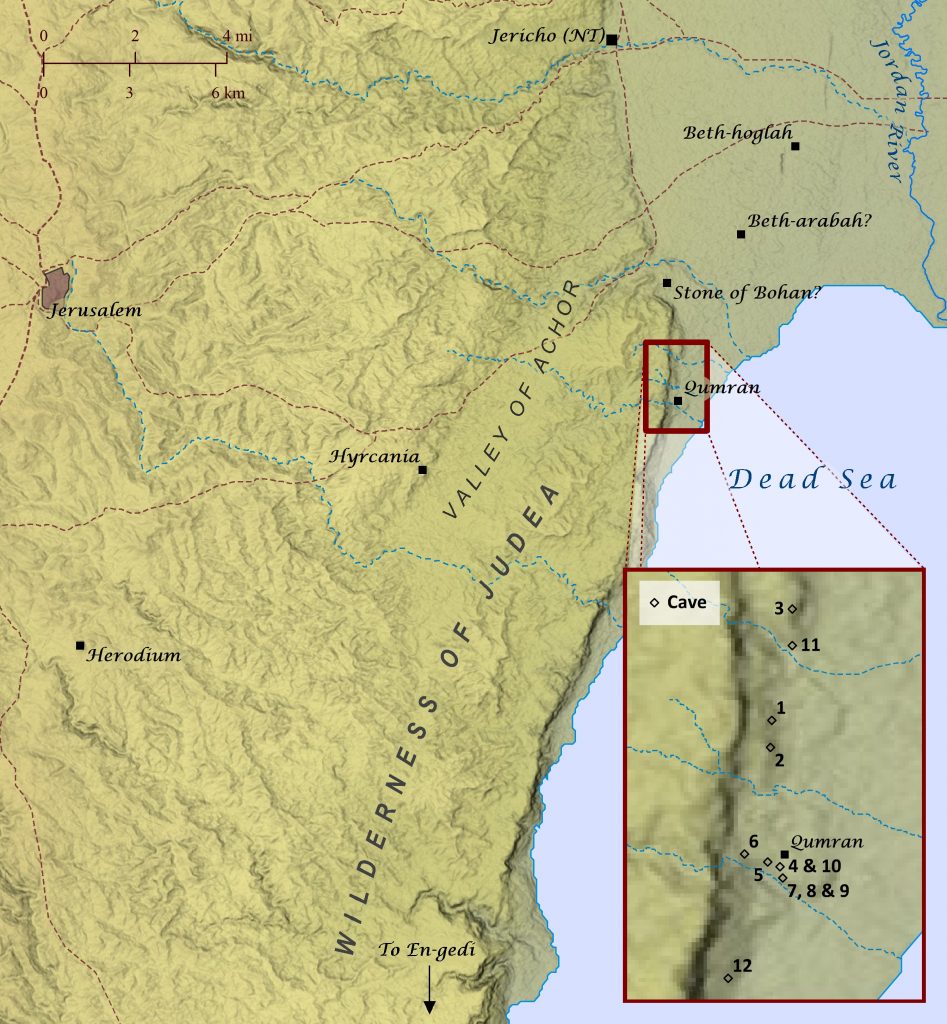
The small desert community of Qumran is a study in contrasts. Established during the era of the Maccabees, the site was located less than 14 miles (22 km) east of Jerusalem and 8 miles (13 km) south of Jericho, yet its location in the arid wilderness of Judea afforded it a significant degree of intentional isolation from established Jewish society. The wilderness of Judea just west of the Dead Sea had long been a haunt for those alienated from established society, such as David, who sought refuge from Saul in the fortresses around En-gedi further south (1 Samuel 16-27). The community at Qumran also maintained a population of no more than 200 people and is not even explicitly mentioned in the Bible or Josephus’s works, yet its impact on our current understanding of the world of Jesus can hardly be overstated. Prior to the discovery of the community and the Dead Sea Scrolls they produced, the religious and political background of Jesus’ day was somewhat simplistically viewed as being limited to the groups described by Josephus, namely the Sadducees, the Pharisees, the Essenes, and the Herodians. With the discovery of many manuscripts from the community of Qumran, however, this world is now understood to be much more complex, for there also appears to have been a variety of alternate, minority perspectives among the greater political and religious movements at the time. Qumran is thought by many to have been associated with the Essenes, though others have argued against this association. Some scholars have also noted intriguing similarities between John the Baptist and the community at Qumran, though there are differences as well. Like the Qumran community, John the Baptist’s early ministry was located in the wilderness of Judea (Matthew 3:1), and it is likely that he knew of the community there, since it would have been located only a few miles away from his own ministry. John also appears to have taught his followers to abstain from alcohol and carefully observe certain dietary restrictions (Matthew 11:18; Luke 7:33), much like the community at Qumran. Finally, a key tenet of John’s preaching was the imminent arrival of the kingdom of heaven, where evil would be consumed and all things set right (Matthew 3:1-12), a view similarly held by the community at Qumran. It appears that the community at Qumran lasted until the Romans put down the Jewish Revolt of A.D. 66-73. Prior to its demise, the community produced copies of the Scriptures, biblical interpretation, and community instruction and hid these manuscripts away in at least a dozen caves nearby, the most recent of which (Cave 12) was discovered in 2017.
? download hi-res file 🔍 see in TimeGlider

TimeGlider
Just as it is important to understand where Bible events took place, it is also critically important to understand when Bible events took place. Numerous historical events worked together to form the backdrop for each passage of Scripture, and even geography itself changed over time (for example, the continual silting of the Cayster River, which slowly landlocked Ephesus), and every Bible map is best understood when it is placed within the greater context of Bible history. To this end we have created Bible Mapper TimeGlider, a free, online, scrollable, searchable timeline of Bible events. With a few button clicks you can even generate a hyperlink to display your own custom event on the timeline, and you can embed this link in digital resources (Word documents, web pages, emails, etc.) to show your event within its chronological context. Over time we will add many of the Bible Mapper Blog maps as events on the timeline, and we will also add a hyperlink to TimeGlider next to each blog article to show where it belongs within Bible history.

Jesus’ Ministry beyond Israel
Though the majority of Jesus’ ministry was performed within predominantly Jewish areas of Palestine, the Gospels also record several occasions when Jesus traveled beyond Israel and ministered to Gentiles, including a visit to Tyre and Sidon in Syria and possibly multiple visits to the region of the Decapolis southeast of the Sea of Galilee. It is difficult to be certain of the exact order of the various events of the Gospels, so it is unclear if some of these trips beyond Israel were part of a single, larger trip or if they were all made separately. Jesus’ visit to Tyre and Sidon was likely an attempt to take some time away from the great crowds he was increasingly drawing in Galilee, for Matthew specifies that Jesus “withdrew” to the region with his disciples, and Mark notes that Jesus did not want anyone to know where he was staying (Matthew 15:21-28; Mark 7:24-30). Nevertheless a Gentile woman found him and begged him to cast a demon out of her daughter, and Jesus did. Another time Jesus and his disciples got into a boat and crossed over the Sea of Galilee to the Decapolis, though the exact location is unclear. Some manuscripts record that he landed at the region “of the Gadarenes”; others read “of the Gerasenes”; and still others “of the Gergesenes.” Gadara, Gerasa, and Gergesa were all located within the Decapolis, meaning “Ten Towns,” which had been granted a special autonomous status with Rome. There Jesus cast demons out of two men, leading the residents to plead with him to leave their region (Matthew 8:28-34; Mark 5:1-20; Luke 8:26-39). On another occasion while Jesus was in the Decapolis he healed a deaf and mute man, and those who heard about it were amazed (Mark 7:31-37). The Gospels also record that Jesus traveled to the town of Caesarea Philippi at the foot of Mount Hermon in the far north of Israel (though this was technically still within the jurisdiction of Judea). Caesarea Philippi was one of the sources of the Jordan River and home to a prominent pagan shrine to the Greek god Pan. Here Peter famously declared to Jesus: “You are the Messiah, the Son of the living God” (Matthew 16:13-20; Mark 8:27-30). It was likely also here that Jesus was transfigured before his disciples on a “high mountain” (Matthew 17:1-13; Mark 9:1-13; Luke 8:28-36).

