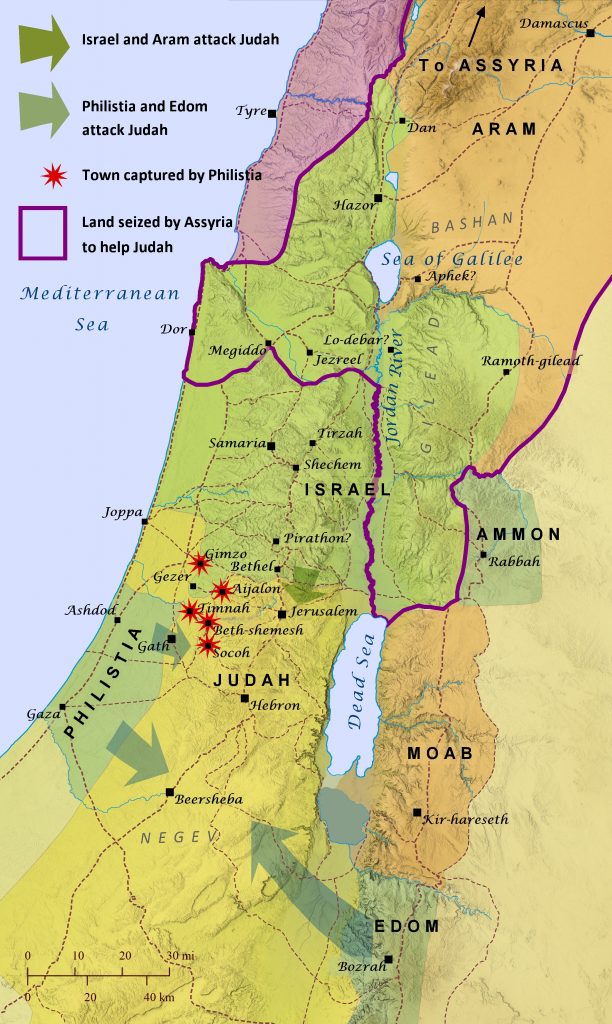
2 Kings 16-17; 2 Chronicles 28; Isaiah 7-8
The final days of the northern kingdom of Israel were marked by a failed gamble and a desperate gambit. The failed gamble came as an attempt by Aram and Israel to compel neighboring states (including Judah) to form an alliance against the expanding Assyrian Empire around 735 B.C. When Judah refused, Aram and Israel attacked Judah and tried to set up a man named Tabeel as king in Jerusalem, and it is likely that Edom and Philistia raided Judah as well. In desperation, King Ahaz of Judah made a costly gambit: He petitioned the Assyrian king Tiglath-pileser III (also called Pul) for help, but this help would come at the expense of a sizeable tribute and Judah’s independence. Assyria attacked Aram and Israel (annexing all of Aram and much of Israel), but thereafter Judah became a vassal, or subject kingdom, to Assyria and was required to pay them regular tribute. This time of intense fear, anxiety, and complex political maneuvering by Assyria, Aram, Israel, and Judah forms the backdrop for Isaiah’s famous prophecies in Isaiah 7-8. The northern kingdom of Israel never regained its strength after this and was completely absorbed into the Assyrian Empire by 722 B.C.
⤓ download hi-res file 🔍 see in TimeGlider

Paul’s Voyage to Rome
Acts 24-28
Soon after Paul arrived in Jerusalem at the end of his third missionary journey, he went up to the Temple. While he was there some Jews stirred up a riot against him. A Roman officer stationed at the Temple arrested Paul and took him to safety, eventually transferring him to the Roman headquarters at Caesarea (Acts 21:27-23:35). Paul spent about two years there under arrest and made his case to the Roman governor Felix, but Felix chose not to release Paul. Later, a new governor named Festus gave Paul another opportunity to make his case. As Paul was finishing up his defense, he invoked his prerogative as a Roman citizen to appeal his case to Caesar himself. So the governor arranged for Paul to be taken by ship to Rome, even though their voyage would take place late in the season for sea travel and would face difficult weather. Along the way they stopped at Myra in Lycia and then made their way to the southern coast of Crete to search for safe harbor. The centurion and the owner of the ship chose not to wait out the weather at Fair Havens and headed for the harbor at Phoenix further west on the coast. The strong winds, however, caused them to lose control of the ship, and they were driven along by the storm for several days. Eventually they were shipwrecked off the coast of the island of Malta, but the crew was saved. After three months the crew set sail from Malta once again, stopping at Syracuse and Rhegium before arriving at Puteoli in Italy. They traveled the rest of the journey along the Appian Way to Rome. When believers from Rome heard that Paul was coming, they came as far as the Forum of Appius about 40 miles away to meet Paul and escort him back to Rome. Paul stayed in Rome under house arrest for two years awaiting his trial before Caesar.

⤓ download hi-res file 🔍 see in TimeGlider

Patriarchs in Canaan
Abraham, Isaac, Jacob, and all of Jacob’s sons lived in Canaan, the land that the Lord promised to give to Abraham’s descendants (Genesis 12:1-9; 15:1-21), and several of the patriarchs (Abraham, Isaac, and Jacob) and their wives were buried in the family burial cave that Abraham purchased in Hebron (Genesis 23:19; 25:9; 50:1-14). Abraham built altars at Shechem, Bethel, and Hebron (Genesis 12:6-8; 13:18), and Isaac built an altar at Beersheba (Genesis 26:23-25). Jacob built another altar at Shechem (Genesis 33:18-20) and also at Bethel (Genesis 35:6-7). After Joseph was sold into slavery by his brothers at Dothan and taken to Egypt, he rose to become second in command to Pharaoh himself (Genesis 37-41). Before he died, however, Joseph instructed his brothers to bury his bones back in Canaan (Genesis 50:25). This request was later fulfilled by the Israelites when they left Egypt during the Exodus and placed his bones in a tomb at Shechem (Joshua 24:32).


The Moabite Alliance Attacks Judah
2 Chronicles 20
After King Ahab of Israel died in 853 B.C., the nation of Moab revolted and reestablished their independence from Israel (2 Kings 1:1), and then they immediately formed an alliance with the Ammonites and the Meunites to attack King Jehoshaphat of Judah. By the time Jehoshaphat was informed of the situation, the alliance had already reached Hazazon-tamar (also called En-gedi). Jehoshaphat prayed to the Lord for help, and the Lord promised to deliver the people of Judah without them even having to fight. All they needed to do was to trust in the Lord and show up for the battle in the desert near Tekoa. Jehoshaphat positioned the Levites at the head of the army to sing praises to the Lord as they marched. As they began to sing, the Lord caused the members of the alliance to begin attacking each other until there was no one left, and the armies of Judah collected a vast amount of plunder from them.


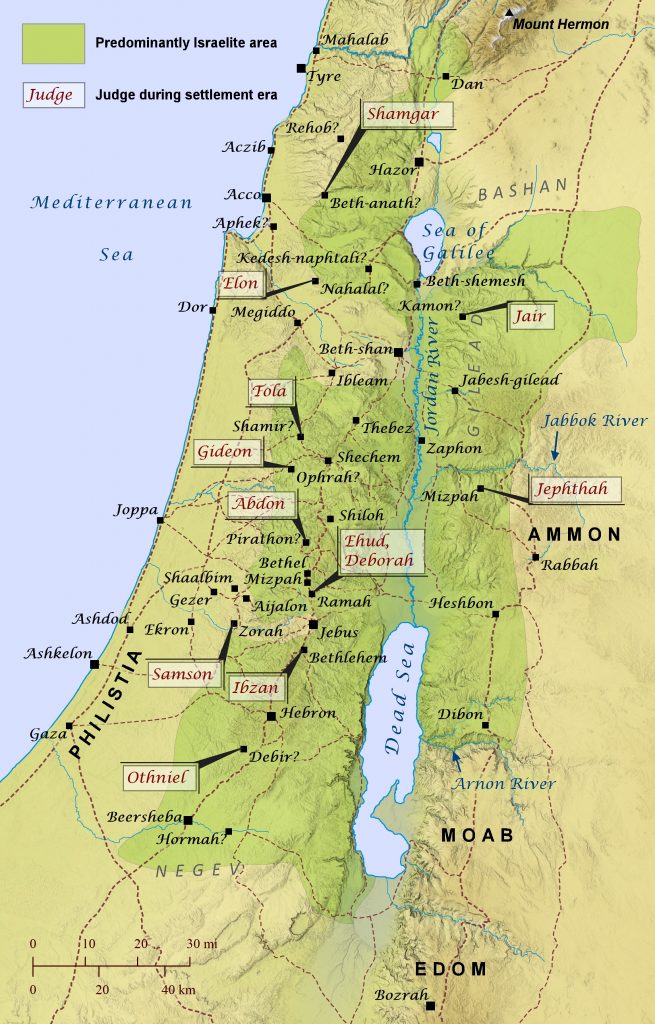
Judges of Israel
Judges 2-16
Under Joshua’s leadership the Israelites conquered and occupied most of Canaan, but Canaanites continued to occupy many parts of the land, particularly the valleys and the coastal areas. From time to time these Canaanites oppressed the Israelites, and the Lord raised up local leaders to help the Israelites fight against them. Often these local leaders then continued to serve as civic judges over the people throughout their lifetime. The book of Judges details the exploits of twelve of these leaders: Othniel, Shamgar, Deborah, Gideon, Tola, Jair, Jephthah, Ibzan, Elon, Abdon, Samson, and Ehud.