Hagar Flees from Sarai

Genesis 16

The Lord had promised repeatedly to raise up a great nation from Abram’s descendants (Genesis 12:2; 13:16; 15:5), but several years passed from the time this promise was given until Abram’s wife Sarai bore a child. During this time, Sarai sought to acquire a child for Abram through Hagar, her Egyptian servant-girl–a common practice at this time. When Hagar conceived, she began to regard Sarai with contempt, and Sarai responded by treating her harshly. Eventually Hagar ran away, heading south from Hebron (see Genesis 13:18) and following the way to Shur toward the wilderness and Kadesh-barnea. Along the way the angel of the Lord found her by a spring (also called a well in verse 14). He told her to return to her mistress Sarai, but he also promised that Hagar would bear a son, Ishmael, and that his descendants would become a great nation. In response, Hagar named the well Beer-lahai-roi, meaning “the well of the Living One who sees me.” She then returned to Sarai at Hebron and gave birth to Ishmael. The well at Beer-lahai-roi may also be the place where Hagar later found water to give to Ishmael after they were sent away from Abraham and Sarah (Genesis 21). Isaac also moved to Beer-lahai-roi for a time after his father Abraham died (Genesis 25:11). Some scholars locate Beer-lahai-roi at a well called Ain Muweileh, about 6 miles (9.5 km) northwest of Kadesh-barnea, based on speculation that the modern name is a corruption of an Arabic phrase meaning “water of the living one seeing.” But the Bible makes it clear that Beer-lahai-roi “lies between Kadesh and Bered,” and Bered was likely located at what was later called Elusa (based on the Jerusalem Targum and possibly Jerome), as shown on this map. Given this location for Bered, this author has identified the most likely location for Beer-lahai-roi to be Bi’ren–the only well located along the way to Shur between Bered and Kadesh-barnea.

⤓ download hi-res file

Top 10 Bible Mapper Atlas Maps of 2023

Here are 10 of the best Bible Mapper Atlas maps released in 2023, based purely on the author’s personal opinion:

10. David Transports the Ark of the Covenant to Jerusalem
9. Saul Attacks the Amalekites
8. The Route of David’s Census Takers
7. The Ark of the Covenant in the Promised Land
6. The Israelites’ Journeys in the Wilderness
5. David Strengthens Southern Judah
4. Poster Map of Israel and Judah
3. Israel Battles Benjamin
2. The Route of the Exodus
1. The Battle at the Pool of Gibeon

Naaman Is Healed of Leprosy

2 Kings 5

Though it is difficult to discern exactly when the various stories of Elijah and Elisha took place, all of them occurred during an era of Aramean strength, roughly spanning the ninth century B.C. In this story, a man named Naaman, commander over the Aramean army, suffered from leprosy, and a captive Israelite girl in his household told him that a prophet in Samaria could cure him. Naaman received permission from the king of Aram to travel to Samaria, and the king sent a letter with Naaman, confirming that Naaman had come to be healed of his leprosy. Naaman arrived in Samaria and gave the letter to the king of Israel, but the king tore his clothes in anguish, because he believed this was impossible, and then the Arameans would attack him for his failure to cure Naaman. But Elisha heard about this and told the king to send Naaman to him. It is not clear whether Elisha was living in the city of Samaria at this time or in another place in the greater vicinity of Samaria such as Gilgal, where Elijah and Elisha appear to have led a school of prophets (2 Kings 2:1-2; 4:38). When Naaman arrived at Elisha’s house, Elisha simply sent a messenger to the door with instructions for Naaman to go and wash in the Jordan River seven times. Naaman was initially incensed that Elisha did not come himself and instantly cure the leprosy, and he boasted that the rivers of Abana and Pharpar near Damascus were better than any of the rivers of Israel. He started to leave in anger, but his servants convinced him just to try this simple task. So Naaman went down to the Jordan River, perhaps near Jericho, and when he washed in the water he emerged with his skin free of leprosy. He returned to Elisha and declared that there is no god except the God of Israel. Naaman then offered Elisha a gift, but Elisha refused to accept it, so Naaman requested instead that he be allowed to take back two mule-loads of dirt to Aram so that he could offer sacrifices to the Lord. Naaman may have made this request because, in his pagan understanding of God, he may have believed that each god was tied to a particular land or nation, so he needed to be on Israelite soil to offer an acceptable sacrifice to the God of Israel. It appears that Elisha granted Naaman’s request and sent him on his way.

⤓ download hi-res file         ⧗ see in TimeGlider

Maps for Advent: The Hope of the World Enters History

Week 1 > The Historical Context: A People in Exile

· The Land of Exile
· Galilee throughout Bible Times

Week 2 > The Present Reality: The Fullness of Time

· Palestine under Roman Rule
· The Ministry of John the Baptist
· Nazareth and Its Surroundings

Week 3 > The Arrival of Hope: God with Us

· Jesus Is Born in Bethlehem
· Magi Worship Jesus
· Jesus’ Birth and Escape to Egypt

Week 4 > The Spread of the Good News: Disciples of All Nations

· Nations at Pentecost

Solomon’s Enemies

1 Kings 11

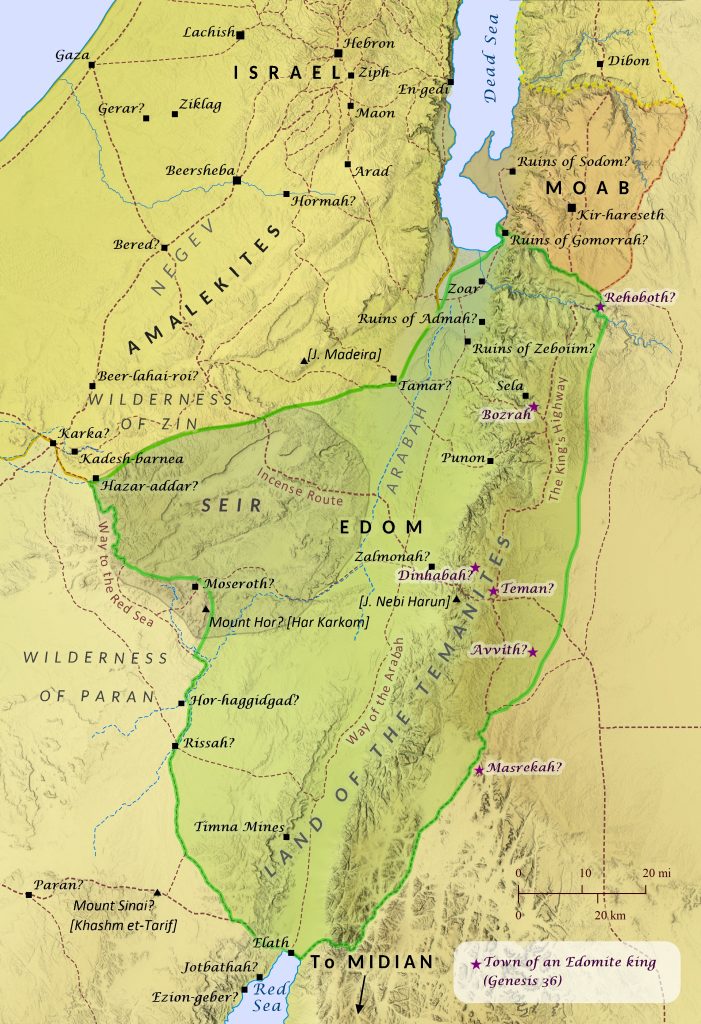
Solomon ruled over a powerful kingdom that brought him great wealth, but he allowed his many wives to lead his heart astray to worship the gods of other nations. Many of these wives were likely given to him by foreign rulers to seal political alliances (e.g., 1 Kings 3:1). Because of Solomon’s unfaithfulness to the God of Israel, the Lord declared that he would tear away much of the kingdom from Solomon and give it to one of his servants. The Bible then recounts the origins of a few adversaries of Solomon who must have caused trouble during his reign. It was actually events during David’s reign that precipitated the rise of two of these adversaries, though apparently it wasn’t until Solomon’s reign that these men became significant agents of opposition. The first adversary mentioned is Hadad the Edomite, who belonged to the royal court of Edom. Sometime during the time when David was in Edom (see 2 Samuel 8:13-14) his commander Joab tried to kill every male in Edom, but Hadad fled with some of his father’s servants. Apparently he fled first to Midian (see 1 Kings 11:18) and then made his way to Paran, where others joined him, and then they crossed the wilderness to Egypt. There Hadad was very favorably received by Pharaoh and given land, food, and even a wife from Pharaoh’s royal household. After David died, Hadad chose to return to Edom. The second adversary mentioned is Rezon, who had fled from King Hadadezer of Zobah and became the leader of a gang of rebels. After David defeated Hadadezer (2 Samuel 8-10; 1 Chronicles 18-19), Rezon and his men fled to Damascus, where they made him king over Aram. He continued to cause trouble for Solomon throughout his reign. The last adversary mentioned is Jeroboam son of Nebat, one of Solomon’s own officials, who had been put in charge of rebuilding a portion of Jerusalem. One day as Jeroboam was leaving the city, a prophet named Ahijah met him and told him that the Lord was going to tear away ten of the tribes of Israel and give them to him. Solomon must have heard about Ahijah’s prophecy, because he tried to kill Jeroboam, but Jeroboam fled to King Shishak of Egypt. Later Jeroboam would return to Israel, and the ten northern tribes appointed him king after rejecting the rule of Rehoboam, the son of Solomon (1 Kings 12; 2 Chronicles 10).

⤓ download hi-res file         🔍 see in TimeGlider