Poster Map of Paul’s Travels

Several years after Jesus ascended to heaven, a man named Paul (also called Saul) from Tarsus became a leading persecutor of Jesus’ followers (Acts 8:1-3; Philippians 3:6; 1 Timothy 1:13). He obtained permission from the high priest to arrest Jesus’ followers in Damascus and bring them back to Jerusalem. While he was traveling there, however, the risen Jesus spoke to him, and Paul himself became a believer (Acts 9:3-19). Apparently around this time he also went away into Arabia and then returned to Damascus (Galatians 1:15-18). Paul also began to preach powerfully in the synagogues of Damascus that Jesus was the Messiah (Acts 9:20-22). Later Paul went to Jerusalem and became known to the leaders of the church there. He continued to preach boldly about Jesus in Jerusalem, but fierce opposition eventually led the believers to take Paul to Caesarea and send him back to his hometown of Tarsus. Several years after this, around A.D. 45, a church leader in Antioch named Barnabas brought Paul from Tarsus to minister at the church there. Soon after this the leaders of the church at Antioch sent Paul and Barnabas to spread the gospel about Jesus the Messiah to those living on Barnabas’s home island of Cyprus and also in Galatia. Partway through the journey, Barnabas’s relative John Mark left them and returned to Jerusalem for unknown reasons (Acts 13:13). Though Paul and Barnabas suffered intense persecution in Galatia, they were successful in their ministry there and later returned to Antioch to report these things to the church leaders (Acts 13-14). As word spread that many Gentiles were becoming followers of Jesus, dissension grew regarding whether these Gentile believers were required to follow all the laws of Moses, including circumcision. Paul and Barnabas traveled to Jerusalem and participated in a church council about the matter (Acts 15). Soon after this, around A.D. 49, Paul and another leader named Silas set out on a second journey to strengthen the churches that Paul had helped to establish in Galatia, and then they carried the gospel of Jesus even further to Asia, Macedonia, and Achaia (Acts 15-18). Later, around A.D. 53, Paul set out on a third journey to strengthen the churches once again (Acts 19:1-21:17). Around A.D. 58 Paul arrived in Jerusalem and greeted the church leaders there. Several days later Paul visited the Temple, and a riot broke out by many Jews who believed that Paul was teaching people throughout the world to disregard the law of Moses. The Roman leaders transferred Paul to Caesarea to protect him as he awaited trial, and Paul’s imprisonment there lasted for two years (Acts 21-24). Paul eventually appealed his case to Caesar (Acts 26), so he was placed aboard a ship in order to make his way to Rome. Along the way, however, his ship encountered a fierce storm, and the ship was broken apart off the coast of Malta just south of Sicily and Italy. The entire crew, however, made it safely to the island, where they were treated with hospitality (Acts 27:1-28:10). Three months later, around A.D. 60, they were placed aboard another ship and made their way to Rome, where Paul lived under house arrest for two years, proclaiming the gospel without hindrance (Acts 28:11-31). Though the book of Acts ends there, comments in some of Paul’s letters, as well as church tradition, suggest that Paul was eventually released and traveled to Spain and then to Crete, Ephesus, and Nicopolis on a fourth journey (Romans 15:22-29; 2 Timothy 1:3-17; 4:10-21; Titus 1:5; 3:12). Church tradition also says that Paul was later imprisoned at Mamertine Prison in Rome and martyred during Emperor Nero’s persecutions around A.D. 67.

This map is designed to be printed at 36 in. x 24 in., but it may scale acceptably at larger or smaller sizes as well.

⤓ download 384dpi file

⤓ download 192dpi file

🔍 see in TimeGlider

Order as a pre-printed, matte poster (3 ft x 2 ft). Price: $24.90, plus shipping ($9.49) and tax.

Jacob Goes to Paddan-Aram

Genesis 26:23-29:1

While Isaac’s family was at Beersheba, Jacob stole Esau’s birthright, and Esau made plans to kill Jacob once his father had passed away. When Rebekah found out about Esau’s plan, she told Jacob to flee to her family in Paddan-aram (also called Aram-naharaim, meaning “Aram of the two rivers”) and garnered Isaac’s support by telling him that she was concerned that Jacob might marry one of the local Canaanite woman. So Isaac sent Jacob to Paddan-aram to find a wife there, much like Abraham had sent his servant Eleazar to this area to find a wife for Isaac (Genesis 24:10). Jacob left Beersheba and headed for Haran in Paddan-aram, and as night fell he stopped at a town called Luz. There he slept with his head resting on a stone and dreamed of a staircase to heaven with angels ascending and descending it. The Lord also spoke to him and reaffirmed his promise to give Canaan to his descendants. The Lord also promised to bring Jacob back to Canaan from Haran. When Jacob woke from his sleep, he declared the place to be the house of God and renamed it Bethel (meaning, “house of God”). Later Bethel appears to have served as an early location of the Ark of the Covenant in the Promised Land (Judges 20; see “The Ark of the Covenant in the Promised Land” map). From Bethel Jacob continued on to the general area of Haran, likely following the same route in reverse that he followed upon his return journey to Canaan from Haran (Genesis 31-35). Sometime before Jacob returned, however, Esau moved away from Canaan and settled in Seir (Genesis 32:3; 36:1-8; ; see “Edom and the Land of Seir” map).

⤓ download hi-res file

The Israelites Conquer Ai

Joshua 8

[Author’s note: This map and article assume that Ai was located at Khirbet al-Maqatir and Bethel was located at al-Bira. It is beyond the scope of this article to present all the convincing reasons for these assumptions, but they are well summarized in the following articles: “Traditional Site of Bethel Questioned,” “Location of Biblical Bethel and Ai Reconsidered,” and “The Khirbet el-Maqatir Excavations.” The expected locations for Roman mile markers are also included on this map, which confirm that al-Bira is located precisely at the twelfth mile marker from Jerusalem, as Eusebius and Jerome both asserted. All other maps in this Atlas have been recently updated to use these same locations for Ai and Bethel.

Soon after the Israelites entered the Promised Land and captured the city of Jericho, they sent a force of only three thousand men to capture the much smaller fortified town of Ai (Joshua 7). They suffered defeat, however, and the Lord revealed to them that this happened because a man named Achan had taken some of the devoted items from Jericho. So Joshua took Achan and his family to the Valley of Achor and executed them there (see Israel Enters the Promised Land map). Later the Lord told Joshua to attack Ai again, because this time he was going to give them the town. It appears that Ai, which had a direct line of sight to the more powerful city of Jerusalem to the south, must have served as a sort of early warning outpost for the larger city. Thus, capturing Ai was critical to staging an effective battle campaign throughout southern Canaan. So Joshua advanced with thirty thousand troops during the night and camped north of the city, and he positioned a force of five thousand men in ambush between Bethel and Ai, just to the west of Ai. The men in ambush were also just east of the mountain where Abraham had pitched his tent centuries earlier (Genesis 12:8). Joshua himself spent the night in the valley between Ai and the main Israelite camp. Early the next morning, the king of Ai led all the inhabitants of the town in an attack on the main camp of the Israelites, who feigned retreat into the wilderness. After the Israelite army had drawn the people of Ai away from the town, the Israelites hiding in ambush rose up and captured Ai. They set the town on fire, sending a signal to the the main army of Israelites to turn back upon the forces of Ai. The Israelites completely destroyed the people of Ai and reduced the town to a burning heap of ruins.

⤓ download hi-res file         ⧗ see in TimeGlider

Tyre’s International Trade

Ezekiel 27

Throughout Bible times, the island city of Tyre was renowned for its extensive and prosperous international trade. Located immediately northwest of Galilee, Tyre was one of the most important cities of Phoenicia (see “Phoenicia and Tyre” map) and had ready access to the Mediterranean Sea as well as to the land routes leading to Egypt, Anatolia, and Mesopotamia. The city was established before the Great Pyramids of Egypt and no doubt took part in the Phoenician colonization of distant lands throughout the Mediterranean Sea, including Spain, Sardinia, and Carthage. Many of these colonies continued to trade with Tyre even after they established their independence from the Phoenicians. Tyre’s extensive trade led to immense wealth and international influence, but according to the prophet Ezekiel, this also led the city to be filled with arrogance and pride. Ezekiel 27 mentions all the locations shown on this map as providing goods to Tyre, but Ezekiel artistically foretells of Tyre’s coming destruction by portraying it as a heavily laden merchant ship that suffers a disastrous wreck after being caught in a storm on the high seas.

⤓ download hi-res file         🔍 see in TimeGlider

Edom and the Land of Seir

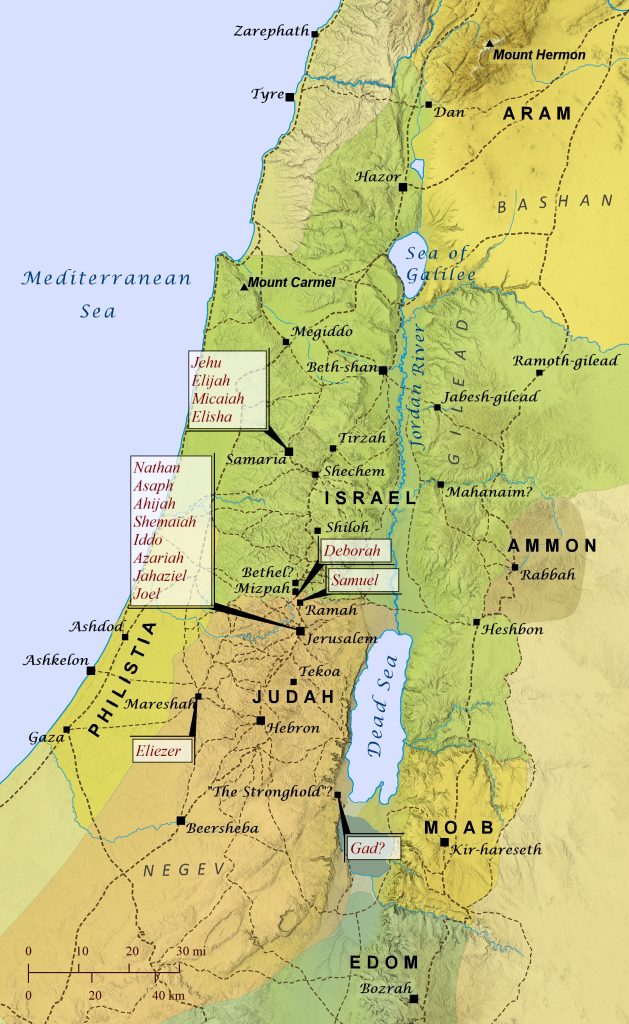
While the location of Mount Sinai is arguably the most significant unresolved debate remaining in Bible geography, it is this author’s estimation that the borders of Edom and Seir (also called “Mount Seir” and “the highlands of Seir”) have actually led to a greater amount of confusion regarding where related events took place. This confusion stems primarily from a key misunderstanding widely held about Edom and Seir: that Seir was located either solely or primarily on the eastern side of the Arabah (the low valley dividing virtually all of Israel from the northern end of the Jordan River to the city of Elath on the Red Sea). But this author is convinced that, prior to the later Old Testament, all biblical references to Seir regard it as a sub-region within the greater area of Edom, and it was located on the western side of the Arabah. To be clear, the biblical accounts consistently affirm that the nation of Edom (the descendants of Esau) occupied the eastern side of the Arabah and even had their own rulers before the Israelites had kings (Genesis 36), as shown on this map. But this area is not typically what is intended when the biblical writers use the term Seir. (A nearly exhaustive list of references to Seir as a geographical term includes: Genesis 14:6; 32-33; 36; Numbers 24:18; Deuteronomy 1:2, 44; 2:1-12, 22-29; 33:2; Joshua 11:17; 12:7; 24:4; Judges 5:4; 1 Chronicles 1:38; 4:42; 2 Chronicles 20:10-23; 25:11-14; Isaiah 21:11; Ezekiel 35:2-15.) Also, it should be noted that the assumption that Seir was located east of the Arabah is at least as old as the writings of Josephus (Ant., IV, iv, 7) immediately after the New Testament, for he seems to assume this. Yet, Josephus’s overall reliability regarding the location of the events of the wilderness wanderings (and thus Seir) is called into question by his misidentification of Mount Hor with Jebel Nebi Harun (see “The Israelites’ Journeys in the Wilderness” map), so it is very possible he was also mistaken about Seir. Similarly, though it is commonly concluded that the term Seir can be found in the name ash-Sharat, it should be noted that this Arabic term for the eastern mountains of Edom was likely applied to the region several hundred years after the close of the Old Testament era and the time of Josephus, so it is possible that the term Seir had long since shifted to the eastern mountains by this time. Also, while archeological data confirms that eastern Edom was populated with a settled civilization before western Edom, this data likely would not accurately reflect habitation by semi-nomadic peoples such as Esau and his earlier descendants, whose settlements would have been largely temporary and unlikely to be recovered. In terms of biblical evidence, however, several verses support and even seem to require that Seir be located on the western side of the Arabah (Deuteronomy 2:1; Joshua 12:7; 1 Chronicles 4:42-43; see also Joshua 15:1) and also that Seir was only a sub-region within the larger Edomite nation (Ezekiel 35:15). And while some verses seem ambiguous regarding the location of Seir, none of them offer compelling testimony that it should be located east of the Arabah. A few passages (for example, 2 Chronicles 25; Ezekiel 35 [though see v. 15]) seem at times to use the term Seir to refer to all of Edom, but they never use it to refer only to eastern Edom. Instead, they appear to use the term in a similar way that the biblical writers sometimes symbolically use the term Ephraim to refer to all the northern Israelite tribes (Isaiah 7-11; Jeremiah 31; Hosea 5-14; Zechariah 9-10), though it was widely understood that Ephraim only occupied a specific portion of tribal territory within the land of Israel. If the borders of Seir, however, are relocated west of the Arabah, as shown here at the time of Joshua’s allotment of Canaan, several related stories in the Bible make better sense. For example, the journeys of Jacob and Esau as they meet each other and part once again make the best sense if Esau was arriving from a location on the west side of the Jordan River (Genesis 32-33; also see “Jacob Returns to Canaan” and “Jacob Travels to Southern Canaan” maps). Likewise it is easiest to envision the Israelites skirting the land of Seir after turning back from Kadesh (Deuteronomy 2:1; see “The Israelites’ Journeys in the Wilderness” map) if Seir was located west of the Arabah. Joshua’s description of Judah’s southern border also makes the most sense if Seir (and thus Edom) was located west of the Arabah (Joshua 15:1). In the time of Hezekiah, a western location for Seir makes it easiest to envision a company of 500 Simeonites exterminating a remnant of Amalekites there and settling in their place (1 Chronicles 4:42-43; see “Hezekiah Strengthens Judah” map). Finally, the prophet Ezekiel cursed the Edomites for encroaching far north of Judah’s southern border after the Babylonians ravaged the land (Ezekiel 35), and this is easiest to envision if the Edomites already occupied land immediately south of Judah. And by way of extrapolation, if it is to be assumed that the Horites, who formerly inhabited Seir (Deuteronomy 2:12), took their name from Mount Hor or that Mount Hor was named after them, then it is likely that this peak where Aaron died was located somewhere within the region of Seir as it is shown here (see “The Israelites’ Journeys in the Wilderness” map).

⤓ download hi-res file