
2 Kings 18:1-12; 1 Chronicles 4:39-43; 2 Chronicles 29-31
Throughout his reign, Hezekiah strengthened Judah by restoring proper worship of the Lord and preparing the nation for revolt against Assyria. Though the Bible does not clearly say, both of these aspects of Hezekiah’s reign may have been borne out of a desire to undo the detrimental choices of his father, Ahaz, who had promoted idolatry through Judah (2 Chronicles 28:1-4) and made Judah a vassal to the king of Assyria in exchange for help against Israel and Aram (2 Kings 16-17; 2 Chronicles 28; Isaiah 7-8; see also “The Final Days of the Northern Kingdom of Israel” map). Later, when Hezekiah was a teenager, he witnessed Assyria’s grueling three year siege to capture Samaria (2 Kings 17:1-6; 18:9-12), perhaps cementing his resolve to throw off Judah’s yoke of servitude to Assyria (2 Kings 18:7). Whatever the reasons for his actions as king, Hezekiah spent considerable resources promoting the worship of the Lord and preparing for the inevitable Assyrian attack that would follow Judah’s refusal to submit to Assyria any longer. Hezekiah began by directing the priests and Levites to consecrate themselves and restore ritual purity to the Temple and all its furnishings (2 Chronicles 29). He sent word throughout all Israel and Judah to come and celebrate Passover together once again in Jerusalem (2 Chronicles 30). Though only a few from Israel accepted Hezekiah’s invitation, the Passover was a time of great celebration and worship for all who did come from Israel and Judah. After this, the worshipers went throughout Israel and Judah and destroyed the pagan worship centers (2 Kings 18:4; 2 Chronicles 31:1). Hezekiah also conducted a series of actions to strengthen Judah against the coming Assyrian attack. On the west he attacked the Philistines as far as Gaza (2 Kings 18:8). Part of this effort may have included a Simeonite attack on some Meunites in the valley of Gerar (as in the Septuagint; the Hebrew reading Gedor is likely due to a misreading of the letter r as the similarly shaped letter d), which is recounted in 1 Chronicles 4:39-41. Elsewhere in Scripture the Meunites appear to have lived in the region of Seir (2 Chronicles 20), south of Judah, but a remnant of them may have fled toward Gerar during Uzziah’s time when he attacked them and likely took some of them captive to serve at the Temple of the Lord in Jerusalem (Ezra 2:50; Nehemiah 7:52; also see “Resurgence of Israel and Judah” map). Other Simeonites attacked a remnant of Amalekites living in Seir, thus providing increased protection on Judah’s southern border (1 Chronicles 4:39-43). Hezekiah also fortified Jerusalem and redirected various sources of water away from enemies who might lay siege to the city (2 Chronicles 32:1-8). As part of these preparations Hezekiah commissioned the hewing of a tunnel that channeled water from the Gihon spring (probably also called the “waters of Shiloah” in Isaiah 8:6) away from the eastern side of the city and deposited it in the Lower Pool (also called the Pool of Siloam) further inside the city walls. Hezekiah also repaired portions of the wall that were broken down and built a second wall outside it, likely in the Kidron Valley (see “Jerusalem during the Early Old Testament” map). He also produced many weapons and shields. The writer of Chronicles appears to portray these preparations as being in keeping with Hezekiah’s other acts of faithfulness and righteousness. Some scholars, however, suspect that Isaiah 22:1-14 may reflect another perspective regarding Hezekiah’s preparations, though it is not certain that this passage refers to Hezekiah’s efforts.

⤓ download hi-res file 🔍 see in TimeGlider

The Final Stops along Paul’s Third Missionary Journey
Acts 21
The final days of Paul’s third missionary journey are a beautiful snapshot of the love and hospitality that characterized the early church. The story picks up just after Paul and his coworkers had boarded a ship in Patara on the Lycian coast and headed for Phoenicia. They landed at the international commercial hub of Tyre, where the ship unloaded its cargo. While they were there they found some believers and stayed with them for seven days. Such an unannounced and lengthy request for hospitality would likely be met with offense and resentment by many in the Western world today, but in ancient times travel and lodging were not always safe, and accommodations with a trusted friend were highly valued–by both host and guest–for just as hosts provided guests with safe, warm lodging, guests often provided hosts with news updates or cherished greetings from loved ones far away. Thus, hospitality for traveling believers became a hallmark of the early church as they sought to care for the needs of those within the family of God, regardless of their personal familiarity with them (see 2 John 10; 3 John 5-8). During this time in Tyre, the believers, no doubt aware of Jewish animosity against Paul, urged Paul not to go to Jerusalem. Yet Paul was determined to continue his journey, so all the believers and their entire families escorted him to the beach where he was to board another ship. There they knelt down, prayed, and said their farewells. The next day Paul arrived in Ptolemais and stayed with believers there for one day. Then he set sail for Caesarea, the headquarters of Roman forces in Palestine and also the home of Philip the Evangelist, a prominent deacon in the church who had led many Samaritans, an Ethiopian royal official, and many people along the coast to faith in Christ (Acts 6:1-7; 8:1-40). While he was there, a prophet named Agabus came down from Judea and warned Paul of his impending arrest in Jerusalem if he continued on. When other believers heard this, they began to weep and urged Paul not to go. Yet Paul remained resolute, and after several days he and his coworkers headed to Jerusalem. Some believers from Caesarea traveled with Paul and made arrangements for him to stay with a believer named Mnason from Cyprus. Paul was warmly received by believers in Jerusalem, and the next day he visited James and the other elders of the church. He recounted to them all the things God had done among the Gentiles through his ministry, and they praised God. They also mentioned, however, that many Jews living in Jerusalem had been hearing false reports that Paul was teaching Jews to abandon the laws of Moses. So they requested that Paul take part in and even pay for a vow ceremony (likely a nazirite vow; see Numbers 6) for four men to demonstrate that he still observed and valued the law of Moses. Paul agreed, but, ironically, it was this very act of obedience to the law of Moses that ultimately led to a riot among the Jews, for some of them accused Paul of defiling the holy place by bringing Greeks into the Temple.

⤓ download hi-res file 🔍 see in TimeGlider

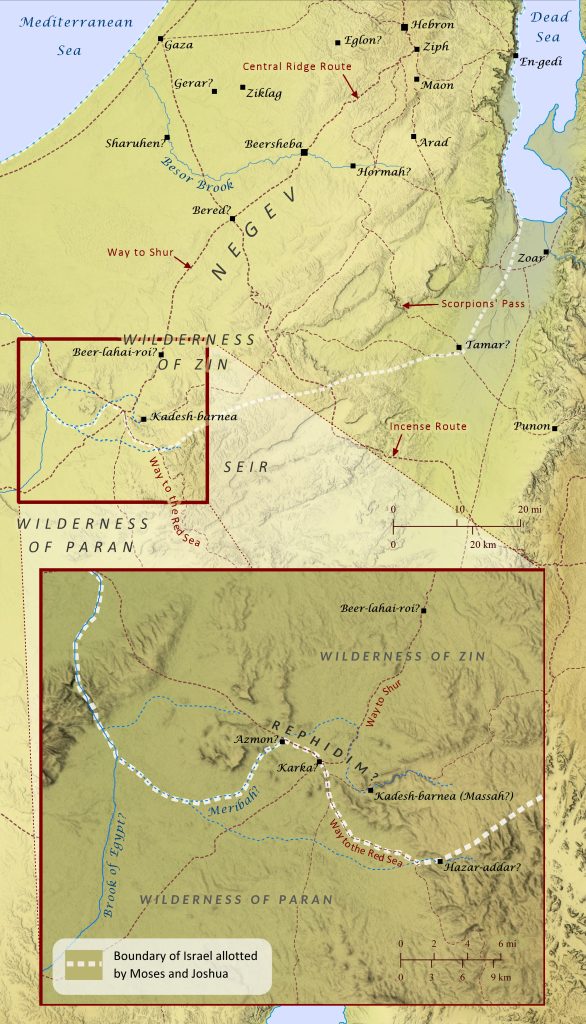
Kadesh-Barnea and Its Surroundings
Though located in the arid desert region south of Israel, the town of Kadesh-barnea was relatively well supplied with water, making it one of the most important oases in the entire region. Multiple springs can be found within 6 miles (10 km) of Kadesh, including Ain Qedeis (possibly Hazar-addar), Ain el-Qudeirat (Kadesh-barnea), el-Qoseimeh (possibly Karka), and el-Muweilah (possibly Azmon), all of which drain into the Wadi al-Arish, likely the biblical Brook of Egypt, about 14 miles (23 km) to the west. Kadesh and its springs are sandwiched between the biblical locations of the Wilderness of Zin and the Wilderness of Paran, which explains why Kadesh is sometimes associated in Scripture with Zin (Numbers 20:1; 33:36; Deuteronomy 32:51) and other times with Paran (Numbers 13:26). The site is first mentioned in Scripture as one of the places through which Chedorlaomer’s army passed on its way to reconquer the cities of the plain (Genesis 14), and apparently at that time it was called Enmishpat, meaning “spring of judgment” (see “The Battle at the Valley of Siddim” map), perhaps indicating that it was a place where legal judgments could be sought for disputes throughout the region. Later Kadesh may have been where the Israelites on their way to Mount Sinai “tested” God, or perhaps more accurately, put God on trial, asking whether the Lord was with them or not (Exodus 17:7; see “The Route of the Exodus” map). If so, then Kadesh is also where Jethro observed Moses settling disputes among the Israelites and advised him to allow smaller cases to be settled by local leaders (Exodus 18:13-27). Kadesh also became a central location for the Israelites after they left Mount Sinai and prepared to enter Canaan. From there they sent spies to scout out the land, but when the spies returned with an intimidating report about the inhabitants of Canaan, the people became afraid and longed to return to Egypt (Numbers 13-14; Deuteronomy 1:19-45). As punishment, the Lord condemned that generation to wander in the wilderness, apparently in the general area of Kadesh, until the people died off. Moses’ sister Miriam later died at Kadesh and was buried there (Numbers 20:1). Then, when the springs of Kadesh must have been producing little water, the people became angry with Moses again, so he struck a rock, causing water to flow from it (Numbers 20:2-13). After this, Moses called the place Meribah, meaning “quarreling” (Numbers 13; see also Numbers 20:24; 27:14; Deuteronomy 33:8; Psalm 81:7; 95:8; 106:32). It was also from Kadesh that Moses sent messengers to the king of Edom, asking permission to pass through his land as the Israelites made their way to Canaan. When the king of Edom refused, they turned back and traveled to Mount Hor instead (Numbers 20:14-22; Deuteronomy 1:46-2:1; Judges 11:16-17; see “The Journey to Abel-Shittim” map). After the Israelites entered Canaan, Kadesh marked the extreme southern boundary of Israel’s land (Numbers 33:4; Joshua 10:41; 15:3). Kadesh is never explicitly mentioned in Scripture after this except in reference to earlier events that happened there.

Hagar Flees from Sarai
Genesis 16
The Lord had promised repeatedly to raise up a great nation from Abram’s descendants (Genesis 12:2; 13:16; 15:5), but several years passed from the time this promise was given until Abram’s wife Sarai bore a child. During this time, Sarai sought to acquire a child for Abram through Hagar, her Egyptian servant-girl–a common practice at this time. When Hagar conceived, she began to regard Sarai with contempt, and Sarai responded by treating her harshly. Eventually Hagar ran away, heading south from Hebron (see Genesis 13:18) and following the way to Shur toward the wilderness and Kadesh-barnea. Along the way the angel of the Lord found her by a spring (also called a well in verse 14). He told her to return to her mistress Sarai, but he also promised that Hagar would bear a son, Ishmael, and that his descendants would become a great nation. In response, Hagar named the well Beer-lahai-roi, meaning “the well of the Living One who sees me.” She then returned to Sarai at Hebron and gave birth to Ishmael. The well at Beer-lahai-roi may also be the place where Hagar later found water to give to Ishmael after they were sent away from Abraham and Sarah (Genesis 21). Isaac also moved to Beer-lahai-roi for a time after his father Abraham died (Genesis 25:11). Some scholars locate Beer-lahai-roi at a well called Ain Muweileh, about 6 miles (9.5 km) northwest of Kadesh-barnea, based on speculation that the modern name is a corruption of an Arabic phrase meaning “water of the living one seeing.” But the Bible makes it clear that Beer-lahai-roi “lies between Kadesh and Bered,” and Bered was likely located at what was later called Elusa (based on the Jerusalem Targum and possibly Jerome), as shown on this map. Given this location for Bered, this author has identified the most likely location for Beer-lahai-roi to be Bi’ren–the only well located along the way to Shur between Bered and Kadesh-barnea.


Top 10 Bible Mapper Atlas Maps of 2023
Here are 10 of the best Bible Mapper Atlas maps released in 2023, based purely on the author’s personal opinion:
10. David Transports the Ark of the Covenant to Jerusalem
9. Saul Attacks the Amalekites
8. The Route of David’s Census Takers
7. The Ark of the Covenant in the Promised Land
6. The Israelites’ Journeys in the Wilderness
5. David Strengthens Southern Judah
4. Poster Map of Israel and Judah
3. Israel Battles Benjamin
2. The Route of the Exodus
1. The Battle at the Pool of Gibeon