
Matthew 26-27; Mark 14-15; Luke 22-23; John 13-19
On the Thursday before he was crucified, Jesus had arranged to share the Passover meal with his disciples in an upper room, traditionally thought to be located in the Essene Quarter of Jerusalem. After they finished the meal, they went to the Garden of Gethsemane, where Jesus often met with his disciples. There Judas Iscariot, one of Jesus’ own disciples, betrayed him to soldiers sent from the High Priest, and they took Jesus to the High Priest’s residence. In the morning the leading priests and teachers of the law put Jesus on trial and found him guilty of blasphemy. The council sent Jesus to stand trial for treason before the Roman governor Pontius Pilate, who resided at the Praetorium while in Jerusalem. The Praetorium was likely located at the former residence of Herod the Great, who had died over 30 years earlier. When Pilate learned that Jesus was from Galilee, he sent him to Herod Antipas, who had jurisdiction over Galilee. But when Jesus gave no answer to Herod’s many questions, Herod and his soldiers sent him back to Pilate, who conceded to the people’s demands that Jesus be crucified. Jesus was forced to carry his cross out of the city gate to Golgotha, meaning Skull Hill, referring to what may have been a small unquarried hill in the middle of an old quarry just outside the gate. After Jesus was unable to carry his cross any further, a man named Simon from Cyrene was forced to carry it for him. There at Golgotha they crucified Jesus. After Jesus died, his body was hurriedly taken down before nightfall and placed in a new rock-cut tomb owned by Joseph of Arimathea, a member of the Jewish high council. This tomb was likely located at the perimeter of the old quarry.

⤓ download hi-res file 🔍 see in TimeGlider

Bethany and Bethphage
Matthew 21:1-17; Mark 11:1-11; Luke 19:28-48; John 12:1-19; see also Matthew 26:6-13; Mark 14:3-9
At the start of Passover one week before he was crucified, Jesus and his disciples traveled to Jerusalem, approaching the city from the east. When they arrived at the village of Bethphage, Jesus mounted a donkey and rode down the Mount of Olives as a humble king entering his capital city. Along the way, many people laid branches and cloaks in his path to welcome him. After Jesus entered the city, he immediately went up to the Temple and drove out the moneychangers and merchants there, and he healed the blind and the lame. Then he traveled nearly two miles outside the city to the village of Bethany to spend the night, which appears to have been where he typically lodged each night while visiting Jerusalem during the crowded Passover festival. Bethany is also where Jesus’ close friends Mary, Martha, and Lazarus lived. One evening while Jesus was there at a large dinner party given in his honor, Martha served the food, and Mary poured expensive perfume on Jesus’ feet and wiped his feet with her hair.


Temple of the Lord
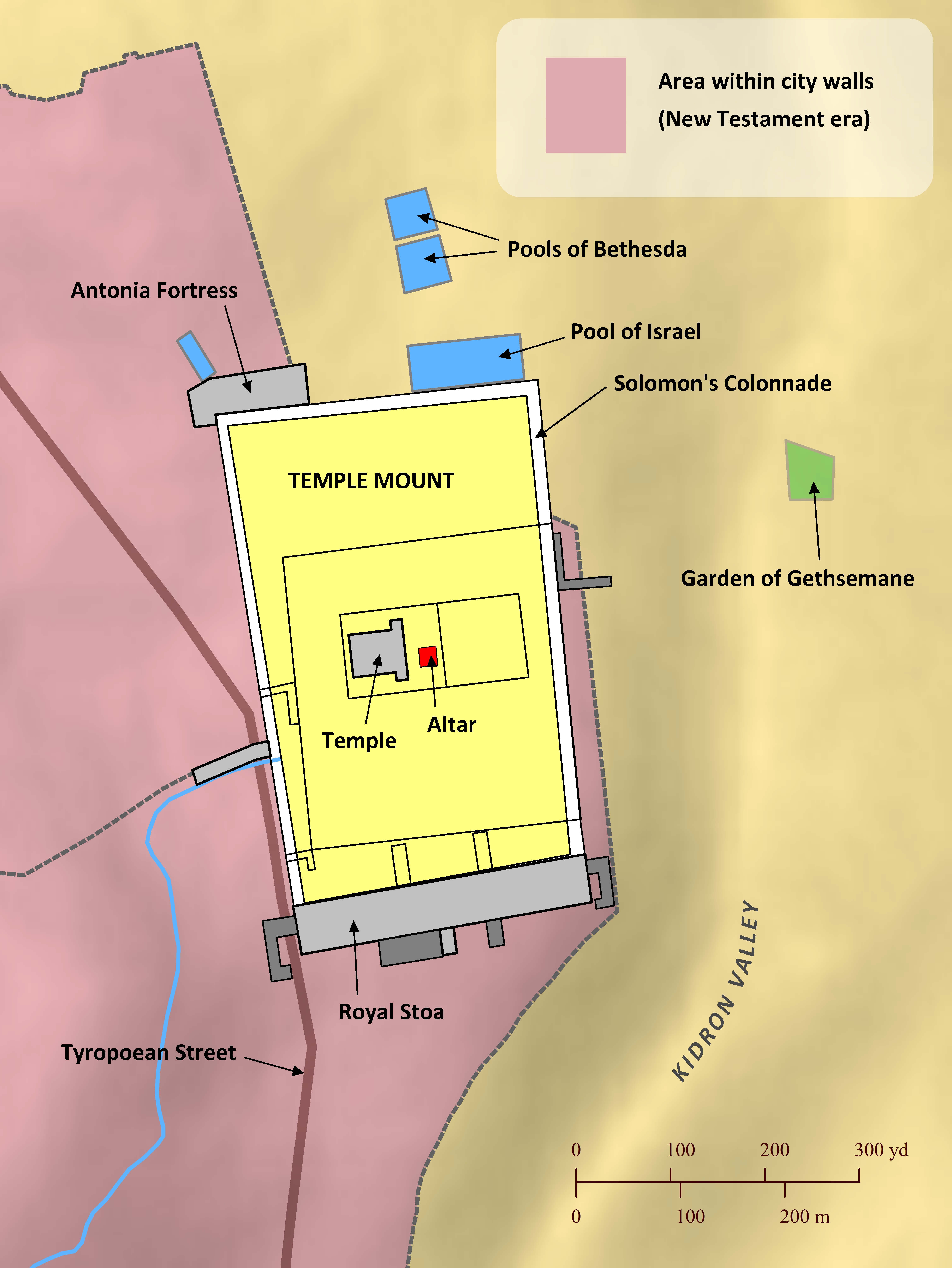
The Temple of the Lord in Jerusalem, where all Israelite males were commanded to offer sacrifices to the Lord (Exodus 23:14-19; Deuteronomy 16:16-17), underwent several stages of reconstruction and development over hundreds of years. The first Temple was built by King Solomon to replace the aging Tabernacle, and it was constructed on a threshing floor on high ground on the north side of the city (2 Samuel 24; 1 Chronicles 21). Hundreds of years later King Hezekiah expanded the platform surrounding the Temple. When Jerusalem fell to the Babylonians in 586 B.C., the Temple was completely destroyed (2 Kings 25:1-21; 2 Chronicles 36:17-21; Jeremiah 39:1-10; 52:1-30). It was rebuilt in 515 B.C. after a group of Jews returned to Judea from exile in Babylon (Ezra 1:5-6:15; Nehemiah 7:5-65). Herod the Great completely rebuilt and expanded the Temple once again around 20 B.C., making it one of the largest temples in the Roman world. Jesus’ first believers often met together in Solomon’s Colonnade, a columned porch that encircled the Temple Mount, perhaps carrying on a tradition started by Jesus himself (John 10:23; Acts 3:11; 5:12). But Herod’s Temple did not last long: After many Jews revolted against Rome, the Romans eventually recaptured Jerusalem and destroyed the Temple in A.D. 70.

Crete, Cyrene, and Syrtis
Though the Old Testament never directly mentions Crete (shown in inset), this island had a significant impact on the history of Israel. Crete was home to the ancient city of Knossos and the great Minoan civilization, the first advanced society in Europe, which flourished from before the time of Abraham until around the time of Moses. As this civilization declined, many people from Crete and mainland Greece began to migrate in vast numbers to new lands further east, including Israel. This is likely how the Philistines came to inhabit the Mediterranean coast of southern Israel. In the centuries that followed, various world powers gained control over Crete until finally it came under the rule of Rome, which grouped it together with the area around Cyrene on the North African coast to form a single province. (Cyrene was the home of a man named Simon, who carried Jesus’ cross for him after Jesus was no longer able to carry it.) As Paul was on his way to stand trial in Rome (Acts 27), he sailed along the southern coast of Crete, and there the captain lost control of the ship in a storm while attempting to reach safe harbor at Phoenix. The sailors became terrified that they would run aground on the sandbars of Syrtis, but instead they were driven by the storm to the island of Malta much further west, and the crew was saved.


Mesopotamia
The region commonly called Mesopotamia (“between the rivers”) was home to some of the oldest civilizations in the world and is often speculated to be the location of the Garden of Eden (Genesis 2:8-14). Located between the Tigris and Euphrates Rivers, Mesopotamia formed a large portion of what is often called the Fertile Crescent, and it gave rise to the nations of Elam, Babylonia, and Assyria, each of which interacted with the people of Israel at various points in history. Mesopotamia was the birthplace of Abraham, the ancestor of the Israelite people. Much later during the Old Testament the Assyrians exiled many Israelites to Assyrian lands (2 Kings 15:29; 17:1-6; 1 Chronicles 5:26), and the Babylonians exiled many other Israelites (primarily from the tribe of Judah) to Babylon and its surroundings (2 Kings 24:15-17; 25:8-12; 2 Chronicles 36:20). Hundreds of years later in the time of Jesus, Magi (priestly astrologers) traveled from this region to worship Jesus, for they had seen a sign in the heavens that signaled the birth of the king of the Jews (Matthew 2).

