Abraham, the father of the Israelites, grew up in the ancient city of Ur of the Chaldeans, but he moved to Haran with his father Terah, his wife Sarai, and his nephew Lot (Genesis 11:27-31). At this time in history the Chaldeans (Kasdim) inhabited the area east of Haran, making it unlikely that Abraham’s city of Ur was the one located in southern Babylonia. After his father died, Abraham completed his family’s original intention to move to Canaan (Genesis 12:1-5), and the Lord promised to give Canaan to him and his descendants. After he reached Canaan, Abraham first set up camp in Shechem, but he continued to move throughout the land from time to time (Genesis 12-20). Later he traveled to Egypt to find relief from a famine, but then he returned to Canaan once again (Genesis 12:10-20). Abraham’s son Isaac grew up in Canaan (Genesis 21-22), but when it came time for him to marry, Abraham sent his servant back to Haran to find a wife for him there (Genesis 24). Later Isaac’s son Jacob also traveled from Canaan to Haran to escape the wrath of his twin brother Esau, and he married two women from there (Genesis 27-29; see “Jacob Goes to Paddan-Aram” map). Jacob returned to Canaan (Genesis 31; see “Jacob Returns to Canaan” map), but when he was old he moved his whole family to Egypt during Joseph’s time there as second in command to Pharaoh (Genesis 46).
During the days when Israel was led by judges, Samson was born to an Israelite couple from the tribe of Dan near the border of Philistia. Samson was specially dedicated to God as a Nazirite (see Numbers 6:1-21), and the Lord foretold that Samson would lead the Israelites against the Philistines, who were oppressing Israel at the time. When Samson grew up, he asked his parents to arrange for him to marry a Philistine woman he had seen in Timnah. During the feast before the wedding, Samson told a riddle and promised to provide his guests with new garments if they solved the riddle before the feast was over. After they solved the riddle, Samson went down to Ashkelon, killed thirty men, and took their garments to pay off his wager. Later when the Philistines tried to capture Samson at Lehi, Samson killed a thousand of them with only the jawbone of a donkey. Another time the people of Gaza were waiting to kill Samson at dawn, but in the middle of the night he left the city, tearing off the city gates and carrying them all the way to Hebron. After this the Philistines succeeded in binding Samson, gouging out his eyes, and taking him to Gaza as prisoner. Then the Philistines brought Samson into the temple of Dagon to celebrate their victory, but the Lord answered Samson’s prayer to gave him strength one last time. He knocked down the two central pillars holding up the temple, killing many people gathered there.
Sometime after he finished his second missionary journey, Paul and Silas left Antioch and began a third missionary journey. As with their previous journey, they revisited the churches in Galatia and Phrygia and encouraged them. Then Paul fulfilled his promise to return to Ephesus, where he ministered for many months, preaching first in the synagogues but then lecturing daily in the hall of Tyrannus. Paul sent his coworkers Timothy and Erastus ahead of him to Macedonia while he continued to minister in Ephesus. Eventually a riot broke out in Ephesus, where the temple of Artemis was located, because the local silversmiths feared that Paul’s evangelistic work there would harm their business of making shrines of Artemis. So Paul left for Macedonia and southern Greece, most likely visiting the churches in Philippi, Thessalonica, and Corinth. Before Paul set sail to return to Antioch, a plot on his life was discovered, so he traveled back through Macedonia, probably by land. Paul eventually arrived at Troas, and then traveled on to Miletus, where he sent for the elders of the Ephesian church about 30 miles away to come and meet him. After speaking with the Ephesian elders and exchanging farewells, Paul set sail for Jerusalem. Paul’s ship stopped briefly at Tyre and then at Ptolemais before finally arriving at Caesarea on the coast of Palestine. Despite various warnings not to travel to Jerusalem, Paul pressed on until he reached Jerusalem, where he was greetedly warmly by the elders of the church there.
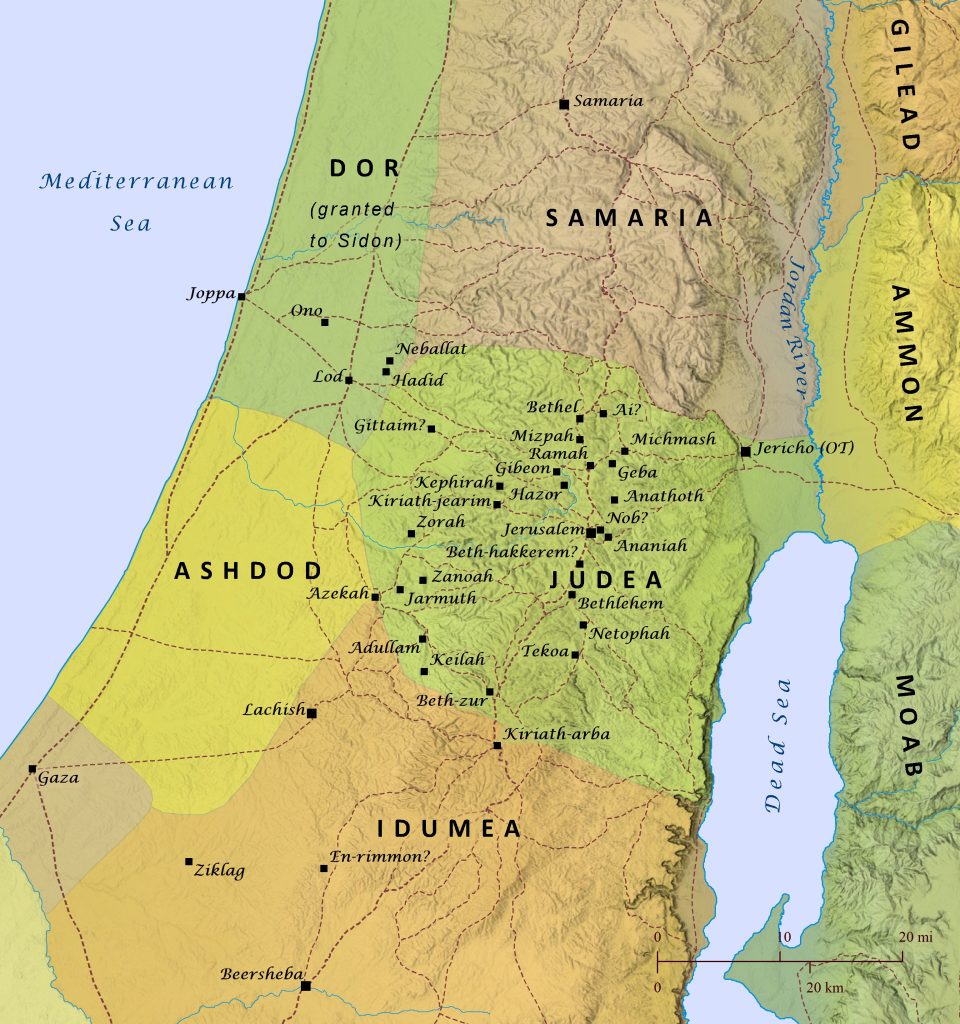
In 539 B.C., King Cyrus of Persia conquered Babylon, and a year later he announced that any exiled Jews who wanted to return to their homeland could do so (2 Chronicles 36:22-23; Ezra 1:1-2). A contingent of Jews under the leadership of Zerubbabel did return (Ezra 1:3-2:70) and established the minor Persian province of Judea within the larger province called Beyond the River (referring to the Euphrates River). This small province was much smaller than the kingdom of Judah before the exile, partially due to the migration of Edomites (now called Idumeans) into the region just south of Judea, where they too formed a new province.
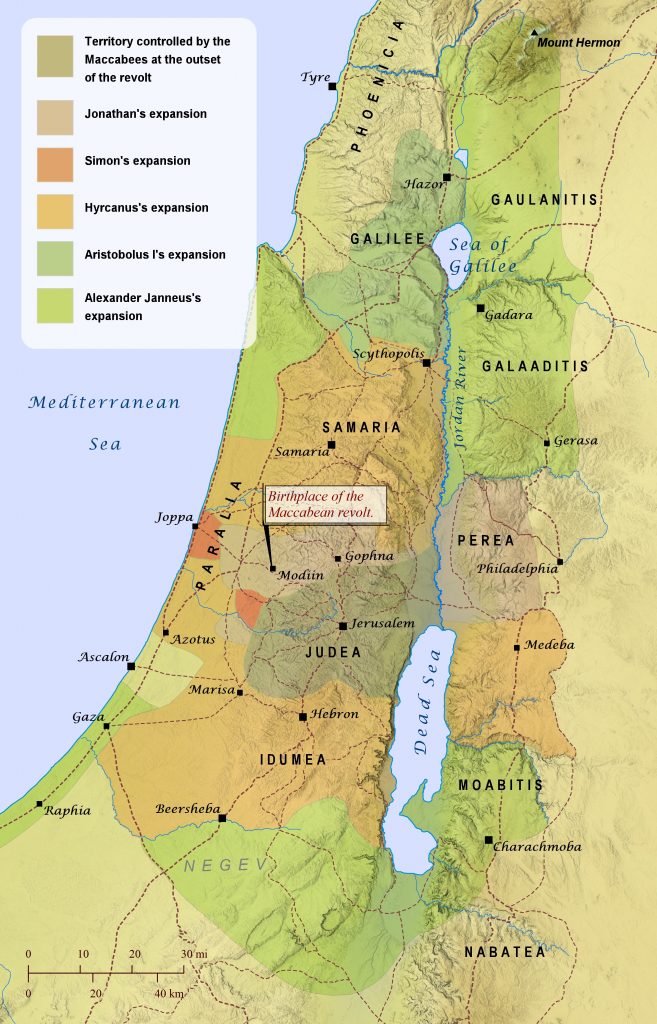
As the Seleucid Empire continued to lose land to rival powers and internal revolts, Antiochus IV Epiphanes sought to unify his diverse domain by forcing Greek religious and political practices upon all his subjects (1 Maccabees 1; 2 Maccabees 6-7). Eventually his harsh policies fomented open rebellion by faithful Jews under the leadership of Mattathias Maccabeus and his sons (1 Maccabees 2; 2 Maccabees 8). Beginning in Judea in 167 B.C., the Maccabean leaders established an independent kingdom and gradually accumulated more and more land until their domain roughly equalled the territory allotted to the twelve tribes of Israel (1 Maccabees 3-16; 2 Maccabees 9-15).