
Genesis 10
The descendants of Noah’s son Ham are listed in what is commonly called the Table of Nations, the Israelites’ oldest catalog of the peoples of the ancient Near East. While it is difficult to identify with certainty where many of these peoples lived, generally they are believed to have been located as shown here. Ham’s sons Cush, Egypt, and Canaan each gave rise to other people groups cited in the list, so they have been shown as broad regions on the map rather than as specific people groups. Ham’s son Put is displayed this way as well, though no specific peoples are listed as descending from him. By viewing the sons as regions, one thing that becomes clear is that for the Israelites the term Cushites referred to more than just the people living directly south of Egypt. It also included those along the entire eastern coast of the Red Sea (see also Numbers 12:1; 2 Chronicles 14:8-14) and even the area surrounding Babylon.


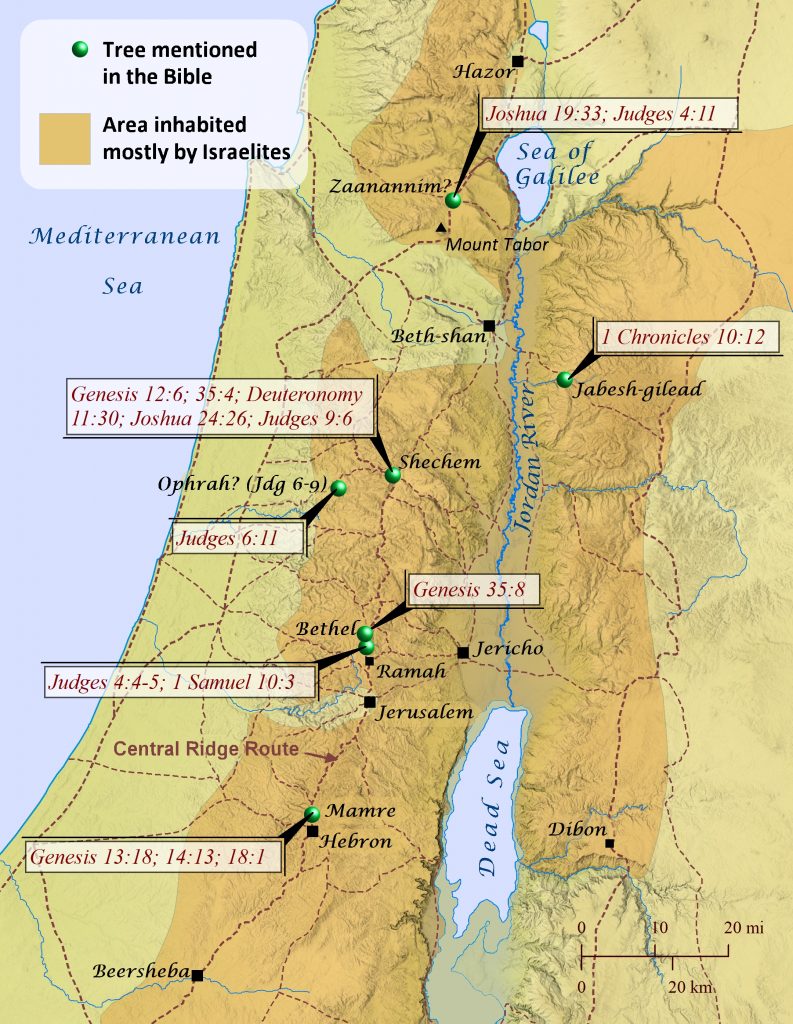
Places Referenced by Trees in the Bible
When modern readers encounter a verse in Scripture that references a “great tree” to locate where an event took place, there is a good chance they will dismiss it as somewhat irrelevant to the significance of the passage. But for the original audience of Scripture, these tangible references provided a very real connection to the event and allowed people to readily visualize what took place, because many of these people were probably already familiar with the great tree referenced or could possibly go see it for themselves. There are at least a dozen references to seven different great trees in Scripture (Genesis 12:6; 13:18; 14:13; 18:1; 35:4-8; 1 Samuel 10:3; Deuteronomy 11:30; Joshua 24:26; Judges 4:4-11; 6:11; 9:6; 1 Chronicles 10:12), and these references span from the time of Abraham to the time of Saul. There were no doubt other great trees that existed that were simply never mentioned in the Bible. The trees noted in Scripture were typically oaks or terebinths, although even palm trees could become noteworthy landmarks. For example, the judge Deborah held court under a palm tree between Bethel and Ramah (Judges 4:4-5). Besides simply being points of reference, these trees sometimes took on ceremonial significance as well, either religiously or politically. When the citizens of Shechem gathered to crown Abimelek king during the time of the Judges, they did so beside the great tree at the pillar in Shechem (Judges 9:6). The prophet Hosea later condemned Israel for offering pagan sacrifices under “oak, poplar, and terebinth, where the shade is pleasant” (Hosea 4:13). No doubt many of these pagan sacrifices were performed under great trees that served as recognized places for making offerings. It is not surprising, then, that most of the locations associated with great trees in the Bible lay along main routes in Israel, especially the Central Ridge Route, which ran from Shechem to Beersheba. On a more personal note, while my wife and I were teaching at a Bible college in rural Kenya we witnessed a similar method of place referencing by means of a great tree. Our campus was dominated by a massive, 500-year old mumbu tree (typically called a baobab tree by Westerners), and, as a result, the town nearby was named Mumbuni (“place of the mumbu”). The college president, who was Kenyan, told us that before the coming of Christianity to the area, the tree had been a place where locals offered animal sacrifices to spirits.

Deborah and Barak Defeat Sisera
Judges 4-5
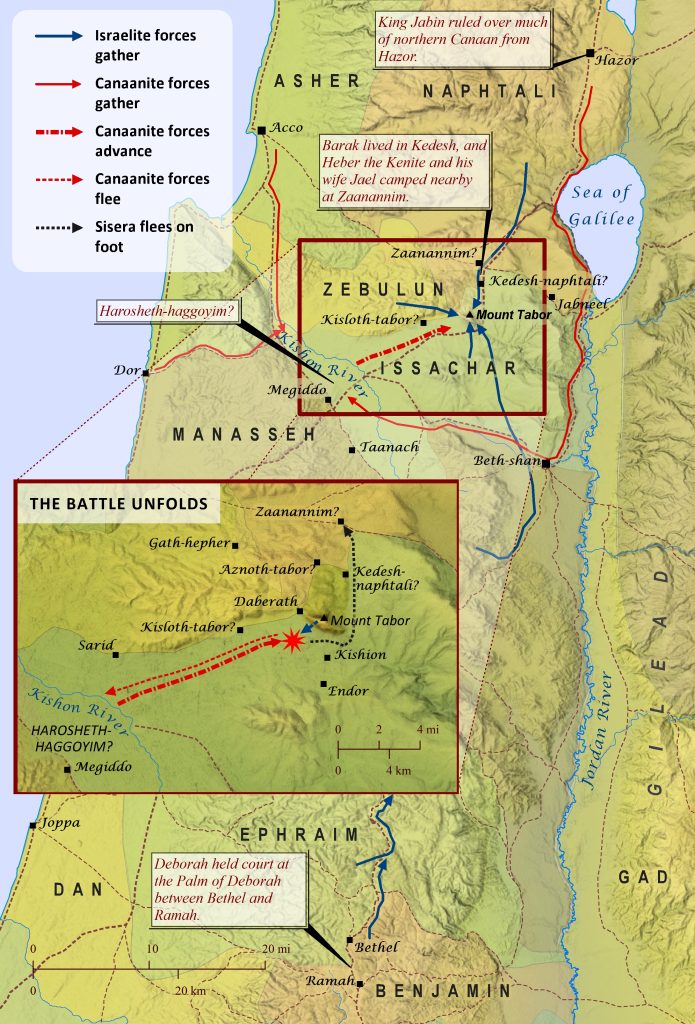
The story of the victory of Deborah and Barak over Jabin and Sisera is well known, and the location of the battle is clear. Less clear, however, are the locations of other places mentioned in the story, but the context of the story and Joshua’s descriptions of Israel’s tribal boundaries (Joshua 19) enable some possible identifications to be made. The story takes place in the time of the Judges, and a judge named Deborah was holding court in the territory of Benjamin. Meanwhile a man named Jabin was ruling over the Canaanites in the north, and his capital was located at Hazor, which must have been reinhabited after the Israelites had completely destroyed it during the conquest of Canaan (Joshua 11). Jabin’s commander Sisera was located in Harosheth-haggoyim (possibly meaning “farmland of the Gentiles”), a location that is not certain, but the context of the story suggests it refers to the plain near Megiddo and the Kishon River. Deborah called upon a man named Barak to lead an army of Israelites up Mount Tabor to draw Sisera to attack with his forces. Barak was from Kedesh-naphtali, a town that is noted as being close to Zaanannim. At some point a Kenite named Heber and his wife Jael had also set up their camp at the Oak at Zaanannim, which must have been located a little west of Jabneel (Joshua 19:33). The location of Jabneel is well established, leading some scholars locate Zaanannim a little further west near modern ash-Shagara, which is also called Ilanya and likely preserves the word Elon (“oak”). Regarding Kedesh-naphtali, this author has recently discovered that Khirbet Kastah would make a good candidate (shown on this map), since it satisfies the requirements of Joshua 19:33 and Judges 4 very well. Ash-Shagara and Khirbet Kastah are both appropriately located within territory that belonged to Naphtali, and they sit along two key routes just north of Mount Tabor, where Israel’s troops were gathered. So it is fitting that Sisera would have passed by these locations as he fled the battle on foot, perhaps on his way to King Jabin in Hazor. Finally, it is not difficult to see how the name Kedesh could have evolved into Kastah over time. Returning to the story, we read that Sisera and his vast army of chariots advanced to Mount Tabor, and the Israelites charged quickly down the mountain to counter-attack. The Israelites routed the Canaanites and pursued them all the way back to Harosheth-haggoyim. Deborah’s song commemorating the victory suggests that a sudden downpour also swelled the Kishon River, causing the chariots to become stuck in the mud (Judges 5:4-21). The story concludes by recounting how Sisera himself met his demise at the hands of Jael while he was fleeing on foot. After this, Jabin’s strength was broken, and the Israelites continued to press against him until he was destroyed.
⤓ download hi-res file 🔍 see in TimeGlider

Jehu Executes Judgment
2 Kings 9-10
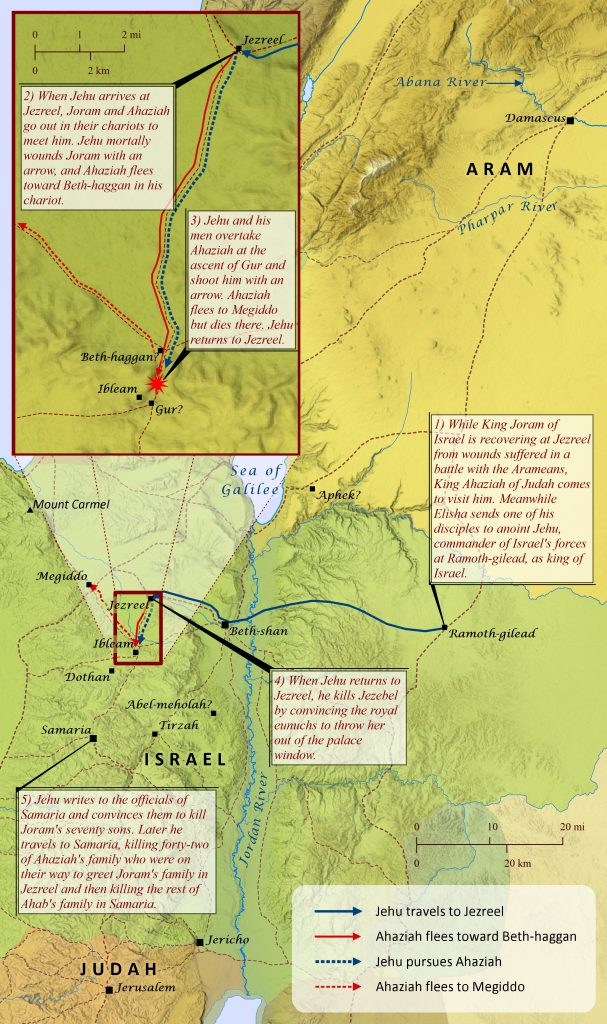
More than two centuries before the prophet Habakkuk struggled to understand how God could use the wicked Babylonians to accomplish his good purposes (Habakkuk 1), a man named Jehu rose to power over Israel and carried out deeds that were similarly God-ordained yet incredibly brutal. We first hear of Jehu while the prophet Elijah is listening for God’s voice in the cave at Horeb (1 Kings 19:16-17). There God tells Elijah to anoint Hazael as king over Aram, Jehu as king over Israel, and Elisha as the prophet to succeed him. Together these three men would carry out God’s judgment upon the wicked in Israel. Elijah then found Elisha and anointed him as prophet, and sometime later Elisha carried out the rest of God’s commands to anoint Hazael and Jehu (2 Kings 8:7-15; 2 Kings 9:6-10). This was completed as King Joram of Israel was at Jezreel recovering from wounds suffered in a battle with the Arameans at Ramoth-gilead. While he was there, King Ahaziah of Judah came to visit him, and Elisha sent one of his disciples to Ramoth-gilead to anoint Jehu, commander of Israel’s forces, as king of Israel. Jehu and his men then headed for Jezreel, and Joram and Ahaziah went out in their chariots to meet him. Jehu suddenly shot Joram with an arrow and killed him, and Ahaziah fled toward Beth-haggan in his chariot. Jehu and his men overtook Ahaziah at the ascent of Gur (likely the pass between Beth-haggan and Gur) and shot him with an arrow. At this point it appears that Ahaziah (or his chariot driver) must have reversed direction–perhaps desperately passing back through Jehu and his men–and headed for Megiddo, but Ahaziah later died there. After this Jehu returned to Jezreel and convinced the royal eunuchs to throw Jezebel out of the palace window to her death. Jehu then wrote to the officials of Samaria, warning them that they must prove their loyalty to him by sending him the heads of Joram’s seventy sons. Fearing Jehu’s power, the officials complied. Later Jehu traveled to Samaria, and along the way he met forty-two of Ahaziah’s family who were on their way to greet Joram’s family in Jezreel. Jehu and his men slaughtered all forty-two relatives at Beth-eked of the Shepherds, an uncertain location that must have been located somewhere along the road from Samaria to Beth-haggan. After Jehu arrived in Samaria, he and his men killed the rest of Ahab’s family. Later they slaughtered many prophets of Baal as well.

The First Jewish War against Rome
Much like the fall of Jerusalem to the Babylonians in 586 B.C., the ill-fated Jewish war against the Romans from A.D. 66-73 became a defining event in the history of Israel, and it affected the nascent Christian church as well. Tensions between Jews and Romans had run deep ever since Pompey first seized the land of Israel for Rome in 63 B.C., and some of these tensions can be seen in the Gospels (e.g., Matthew 22:15-22; Mark 12:13-17; Luke 20:20-26; John 19:1-22). Tensions continued to mount until finally, in A.D. 66–just six years after Paul was transferred from Caesarea to Rome–open rebellion broke out in Jerusalem and other areas throughout Judea and Galilee. King Agrippa II fled Jerusalem and sought refuge in Galilee, and the Roman governor in Syria, just north of Israel, assembled a legion of soldiers to quell the rebellion. Western Galilee, northern Samaria, and cities along the Mediterranean coast were soon recaptured, but the Romans suffered catastrophic defeat at the pass at Beth-horon, losing 6000 soldiers and their aquila (a highly prized standard for each legion). After this, Jewish leaders formed a provisional government in Jerusalem and appointed commanders over various regions. Galilee was placed under the command of Josephus Matthias, later called Flavius Josephus. The Sicarii, a group of fighters who had already been fighting against the Romans, also attempted to solidify power in Jerusalem, but struggles between them and the other factions forced the Sicarii to relocate to Masada, a desert fortress south of En-gedi. Early in A.D. 67 the Roman general Vespasian and his son Titus arrived in Ptolemais with several legions and began to recapture Galilee and Gaulanitis. Soon after this, however, Vespasian was recalled to Rome, where he was installed as emperor. Titus continued the effort in Judea, and by A.D. 70 the vast majority of the resistance had been crushed, including in Jerusalem itself. After a seven-month siege of the city, Jerusalem’s walls were breached and eventually razed to the ground, as was Herod’s Temple. Many of the Temple’s treasures were taken by Titus to Rome, as depicted on the Arch of Titus in Rome. The last vestiges of resistance around Machaerus were defeated by A.D. 72, leaving Masada as the final holdout for a group of about 1000 Sicarii. By A.D. 73 the Romans captured this fortress as well, ending all open rebellion in Judea. The First Jewish War had a lasting impact upon Jews in Palestine and even upon Judaism itself. The destruction of Herod’s Temple completed the shift begun centuries earlier after the destruction of the first Temple, re-centering Judaism around the synagogue instead of the Temple and placing rabbis in the role of spiritual leadership formerly held by priests. The Christian church likewise experienced a further shift of leadership from Jerusalem to Antioch and other key cities, though the fourth-century church historian Eusebius noted that bishops continued to exist in Jerusalem during the decades following the war. Eusebius also recorded that many Christians fled to the city of Pella just before the war broke out, but some scholars dispute this claim. Various passages of Scripture, including Jesus’ teachings on the Mount of Olives (Matthew 24; Mark 13; Luke 21) and the apostle John’s many visions of the end times (Revelation 6-18), are believed to allude to the traumas suffered during the First Jewish War.

