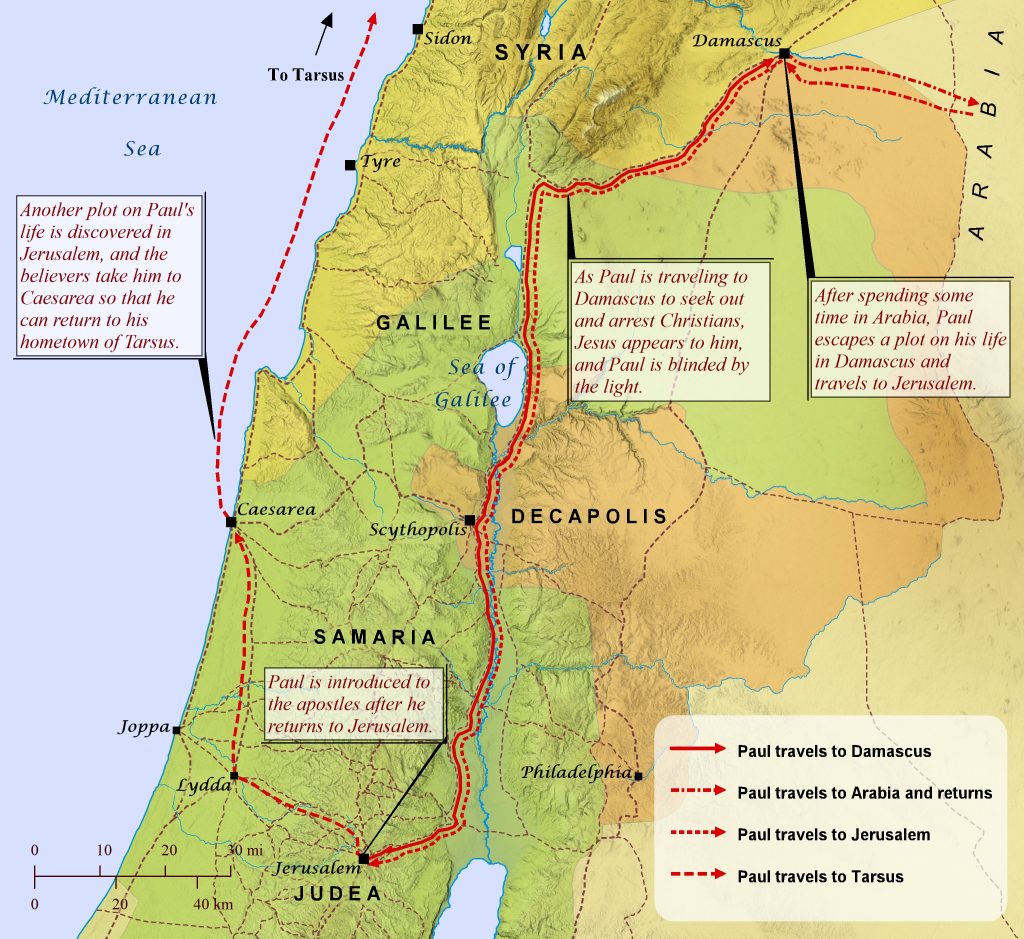
As the Israelites approached Canaan from the east, they asked the Amorite king Sihon if they could pass through his land, but he attacked them instead. The Israelites defeated him at Jahaz and captured all his land (Deuteronomy 2:24-37). After this they turned northward toward Bashan and defeated King Og at Edrei (Deuteronomy 3:1-11). Though the lands of Sihon and Og were not part of Canaan (which lay west of the Jordan River; see Numbers 34), the tribes of Reuben, Gad, and Manasseh requested that this land be allotted to them as their inheritance, and Moses agreed. The eastern tribes promised to continue helping the other tribes drive out the Canaanites from land west of the Jordan River (Numbers 32; Deuteronomy 3:12-20).
⤓ download hi-res file 🔍 see in TimeGlider

Israelites Are Exiled to Assyria
The northern kingdom of Israel had become subject to the vast Assyrian Empire as early as 740 B.C. during the reign of the Assyrian king Tiglath-pileser, and many Israelites from lands east of the Jordan River were exiled to places along the Habor River (2 Kings 15:29; 1 Chronicles 5:26). In 722 B.C., however, king Hoshea of Israel rebelled against Assyria’s rule, and king Shalmaneser of Assyria invaded the land again and besieged the capital city of Samaria. After three years Samaria fell, and many more Israelites were exiled to places along the Habor River and to Media (2 Kings 17:1-6). Shalmaneser resettled foreign peoples in Samaria, including people from the regions of Babylon and Hamath (2 Kings 17:24), in order to make it more difficult for people to join together in revolt against his rule. These foreign peoples brought with them their pagan worship practices and combined them with the worship practices of the local Israelites, and they also intermarried with them, forming a distinct Samaritan culture and religion that was often despised by Jews from Judah.

⤓ download hi-res file 🔍 see in TimeGlider

The Battle at Michmash
1 Samuel 13:23-14:23
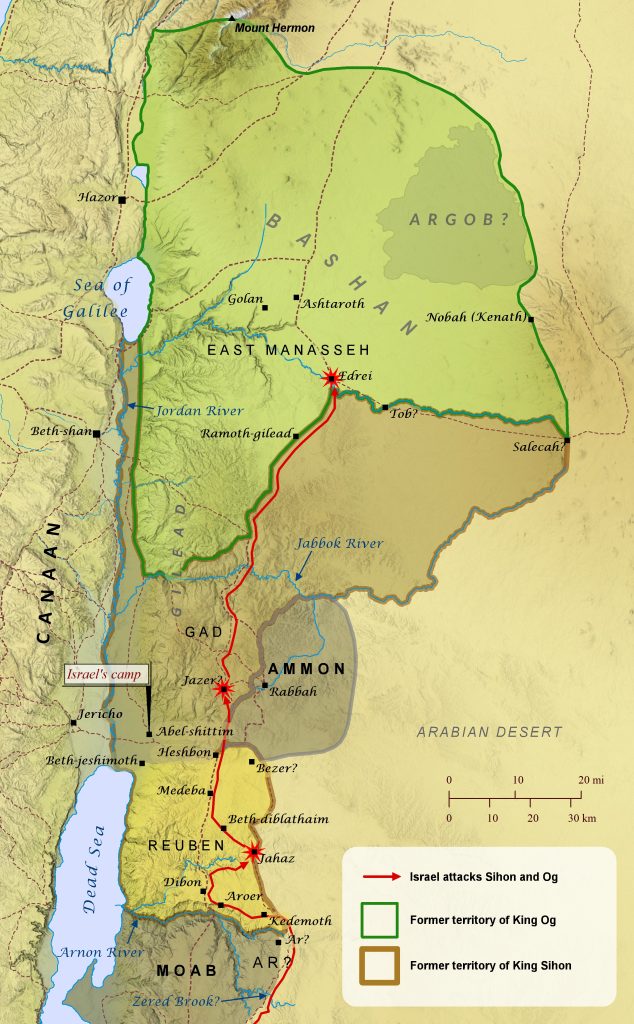
During the reign of Saul, a detachment of Philistines pushed far into the interior of Israel and occupied the strategic pass at Michmash. Saul, Jonathan, and the Israelite forces were gathered across the pass at Geba. Since the town of Migron was likely located at Makrun, about 1.4 miles (2.2 km) north of Michmash (see map; also see Isaiah 10:28), the term typically translated “at Migron” in 1 Samuel 14:2 might be best understood as “at the precipice,” suggesting that Saul was positioned at the edge of the hill at Geba to keep watch over the Philistines across the pass at Michmash. After a while Jonathan led his armor bearer in an attack on a Philistine output near Michmash by scaling the nearby cliffs of Bozez and Seneh, and the two of them killed twenty Philistines. The rest of the Philistine army was thrown into complete panic, drawing the attention of Saul at Geba. Saul’s forces then attacked the Philistines and pursued them beyond Beth-aven.

Paul’s Second Missionary Journey
Acts 15:36-18:22
Sometime after Paul’s first missionary journey, he and Barnabas decided to revisit the churches where they had preached and deliver a letter to them from the apostles in Jerusalem, but a sharp disagreement between them over Barnabas’s cousin John Mark (see Colossians 4:10) led them to separate and take separate journeys. Barnabas took John Mark with him to Cyprus, Barnabas’s home region (see Acts 4:36), and Paul took Silas, who was also called Silvanus (see 2 Corinthians 1:19; 1 Thessalonians 1:1; 2 Thessalonians 1:1; 1 Peter 5:12), to Galatia and beyond. While Paul and Silas were in Lystra, they met a young believer named Timothy, who joined their ministry and began traveling with them (Acts 16:1-3). After they reached Troas in northwest Turkey, Paul saw a vision of a man from Macedonia begging them to come and help them, so he and his team left immediately for Neapolis (Acts 16:9-11). From there they traveled to Philippi and Thessalonica, where they established new churches despite continued persecution. They traveled on to Athens, where Paul spoke about Jesus in the synagogues and also to a group of philosophers at the Areopagus. From there Paul and Silas traveled to Corinth, where he met two believers named Aquila and Priscilla, and he ministered in Corinth for a year and a half (Acts 18:11). After this Paul set out for Antioch from Cenchrea, stopping at Ephesus along the way. As he left Ephesus he promised to return to them soon. Finally Paul arrived at Antioch.

? download hi-res file 🔍 see in TimeGlider

Paul’s Conversion and Early Travels
Acts 9
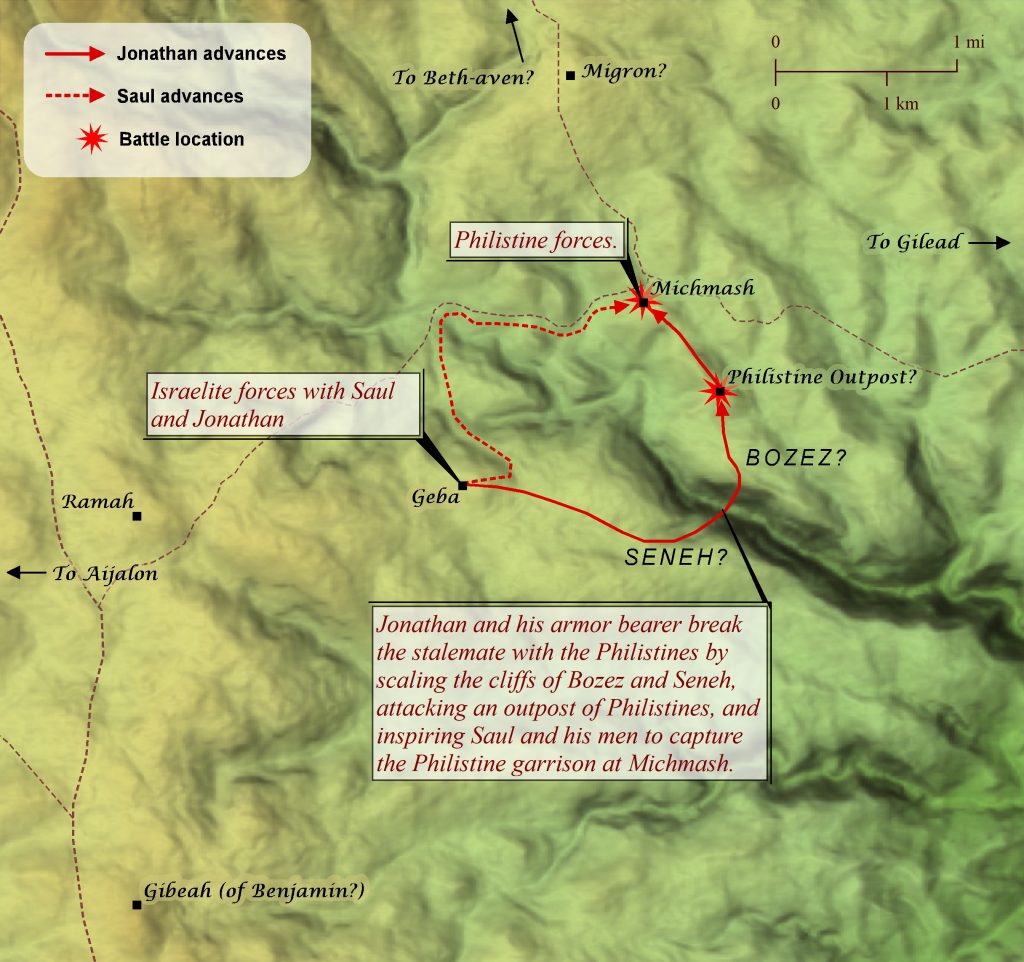
Before his conversion, Paul (or Saul, as he is sometimes called in Acts) was a Jew who was zealously seeking out those who followed Jesus to throw them into prison (Acts 8:1-3). He had obtained permission from the High Priest to go to Damascus to arrest any believers he found there and bring them to Jerusalem. But as Paul was traveling to Damascus, the resurrected Jesus appeared to him, and Paul became blind. He was led the rest of the way to Damascus, where a believer named Ananias laid hands on him and healed his sight. After spending some time with the disciples in Damascus, Paul began to preach in the synagogues there that Jesus was the Messiah. Paul also mentions in Galatians 1:17 that he went to Arabia for a time and then returned to Damascus. Sometime after this Paul discovered that the Jews were planning to kill him, but his disciples helped him escape through an opening in the city wall. Paul traveled to Jerusalem, where he met with the church leaders and began preaching boldly in the name of Jesus. When another plot on Paul’s life was discovered, the believers took him to Caesarea and sent him to his hometown of Tarsus in Cilicia.