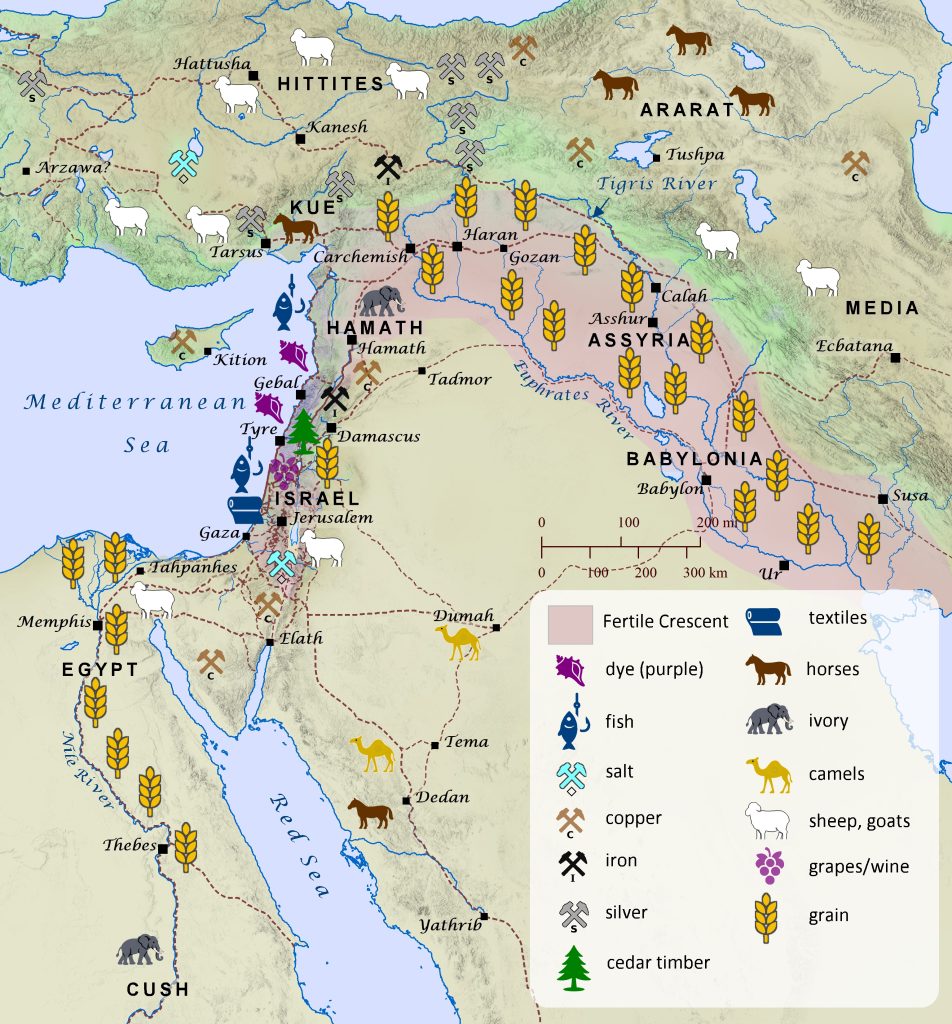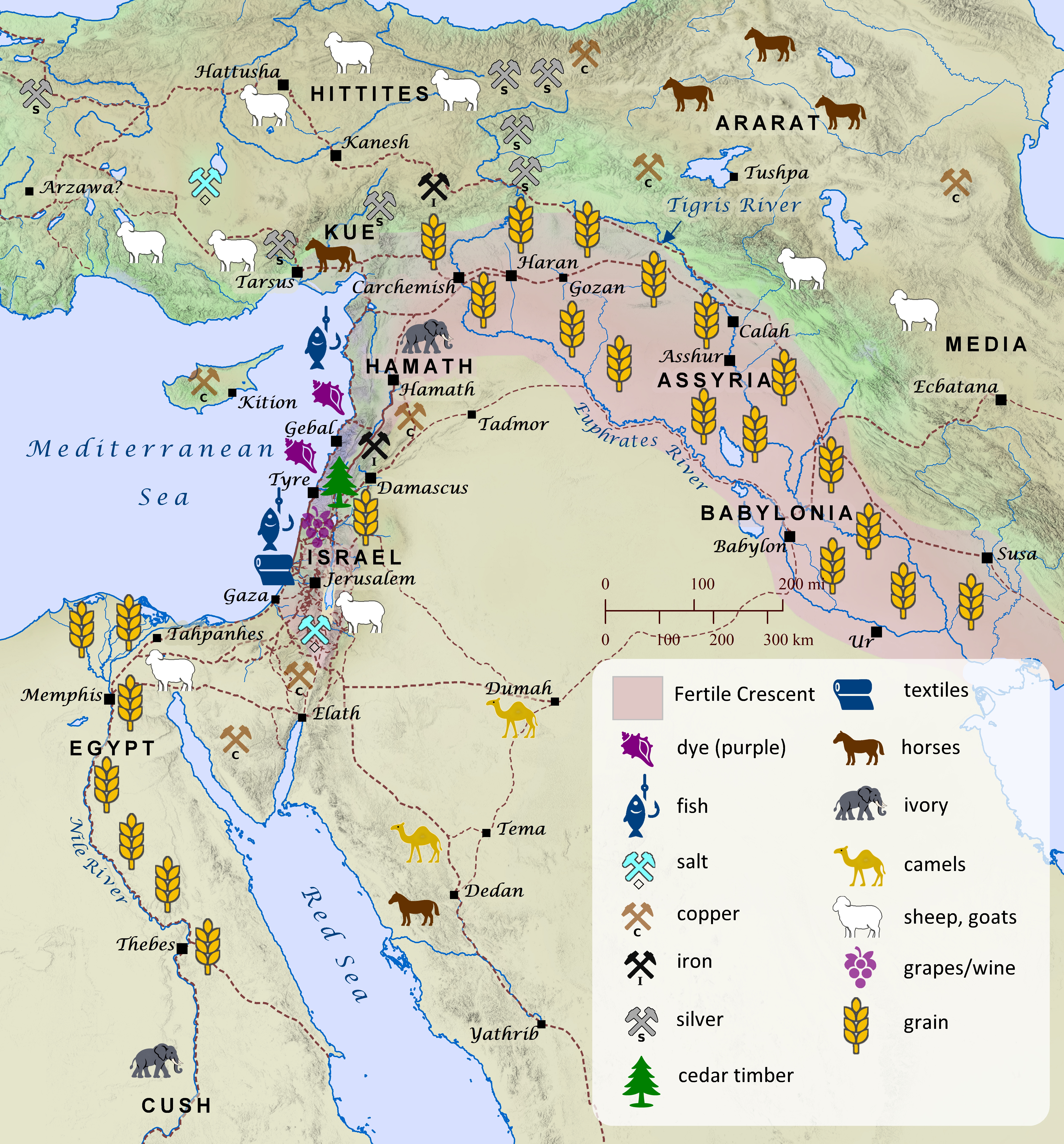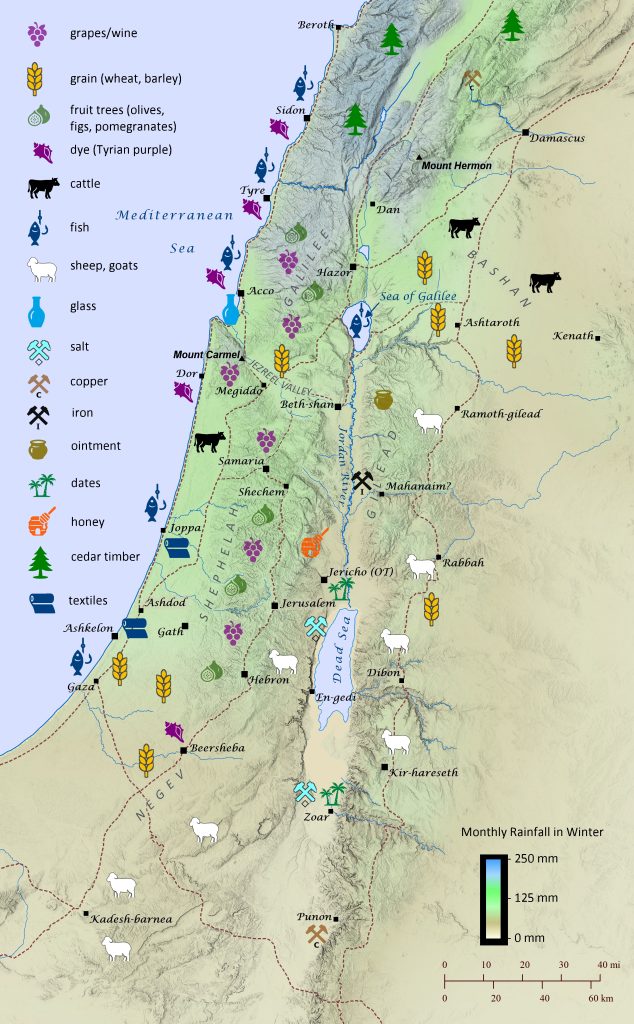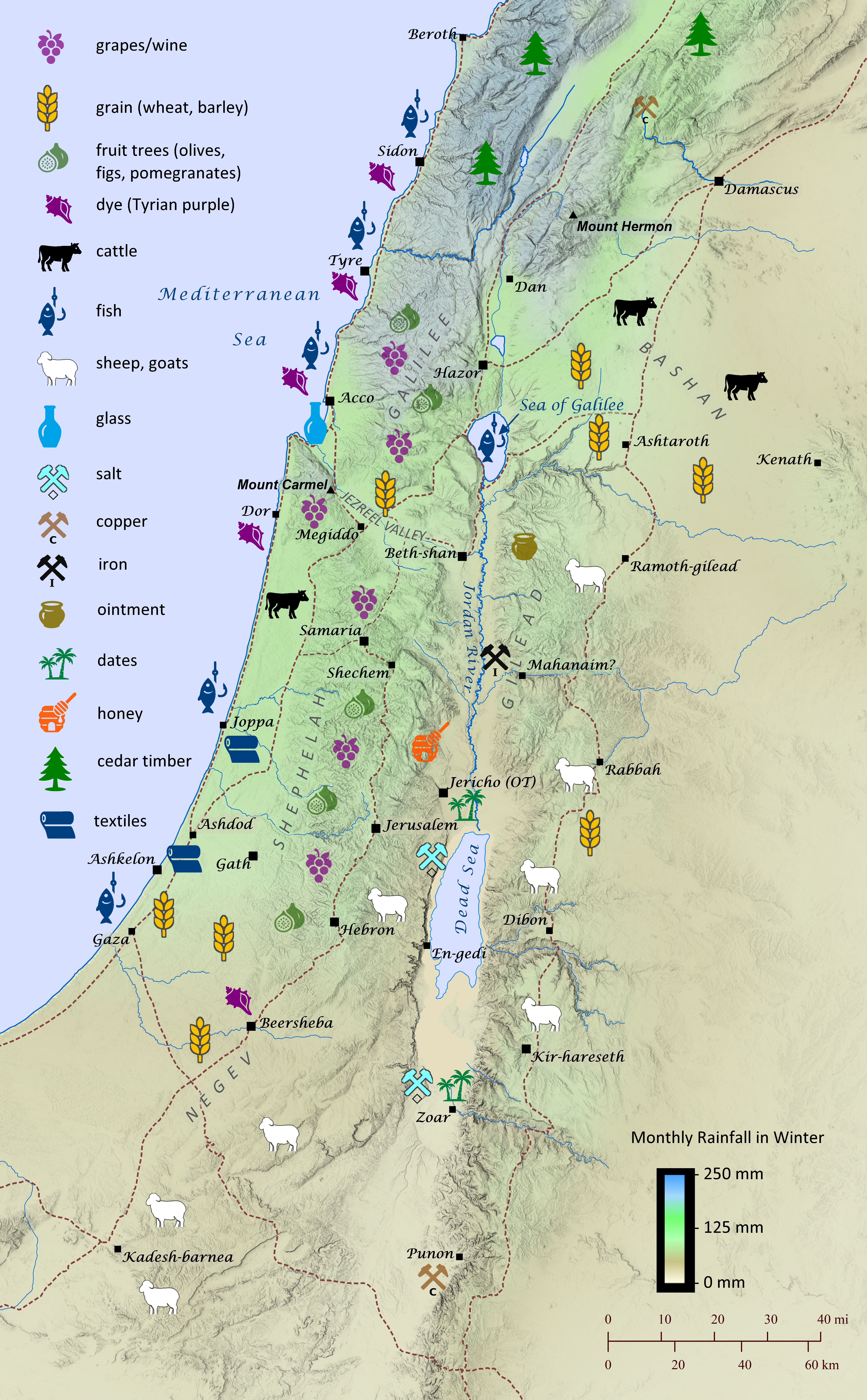
The economy of the ancient Near East, including the land of Israel, ranged from wheat farming and sheep herding to textile production and mineral mining. The land of Israel, though relatively small compared to the great civilizations of Egypt, the Hittites, and Mesopotamia, was particularly diverse in its many industries. This stemmed partially from its rapidly changing elevation and rainfall. Though many of the resources produced were for local consumption, it is clear from archaeology and the earliest stories of Scripture that international trade also played an important role throughout biblical history. The book of Genesis recounts that the patriarch Joseph was sold to Ishmaelite traders traveling from Gilead to Egypt with a load of balm and aromatic resin (Genesis 37:18-36; see “Joseph Is Sold into Slavery” map). Later Joseph rose to power in Egypt, and his own brothers repeatedly traveled from Canaan to Egypt to buy grain during a great famine (Genesis 41-42). During the reign of Saul, the Philistines made strategic use of their exclusive knowledge of iron blacksmithing by restricting any blacksmiths to ply their trade among the Israelites, because they feared they might produce weapons for them (1 Samuel 13:19–22). King Solomon appointed administrative governors to oversee the monthly collection of provisions for the royal court (1 Kings; see “Solomon’s Administrative Districts” map), and he made extensive international trade agreements, buying cedar and cypress timber from the king of Tyre to build the temple and paying him in wheat and olive oil (1 Kings 5:1-12; 2 Chronicles 2). Solomon also engaged in international arms dealing by importing horses from Kue (likely Cilicia) and chariots from Egypt and selling them to the kings of the Hittites and Arameans (1 Kings 10:28–29). His merchant ships traveled as far as Tarshish (likely modern Sardinia or Spain) and Ophir (likely near the southern end of the Red Sea) and returned every three years with precious and exotic goods (1 Kings 10; 2 Chronicles 8-9). His wisdom and riches gained him such international fame that the queen of Sheba in modern day Yemen traveled a thousand miles (1600 km) to visit him (1 Kings 10:1–13; see “Solomon’s International Presence” map). No doubt her intent was also to ensure that the trade routes from Sheba to the Mediterranean ports in southwestern Israel remained unobstructed so that the sale of aromatic resin and precious stones could continue. The Phoenicians of Sidon and Tyre likewise traded extensively throughout the entire Mediterranean world, establishing colonies in places as far away as Tunisia and Spain. During the time of the Judahite exile to Babylon, however, Ezekiel prophesied that the great wealth that the city of Tyre had gained from its worldwide economic trade would one day be swept away (Ezekiel 27; see “Tyre’s International Trade” map). By the time the Romans ruled the land of Israel, the historian Josephus and others note that the olive oil of Galilee had become famous throughout the world for its quality (The Jewish War, Book 2, Chapter 21). Likewise, glass made from the sands just south of Ptolemais (ancient Acco) is mentioned by both Tacitus (The Histories, 5.7) and Pliny the Elder (Natural History, 5.19; see “Poster Map of the Tribe of Zebulun and Its Surroundings, circa 1200 B.C.” map). By this time the Romans had even established trade connections with the land of China by means of the Silk Road (see “Lands beyond Persia” map).