Judges 9
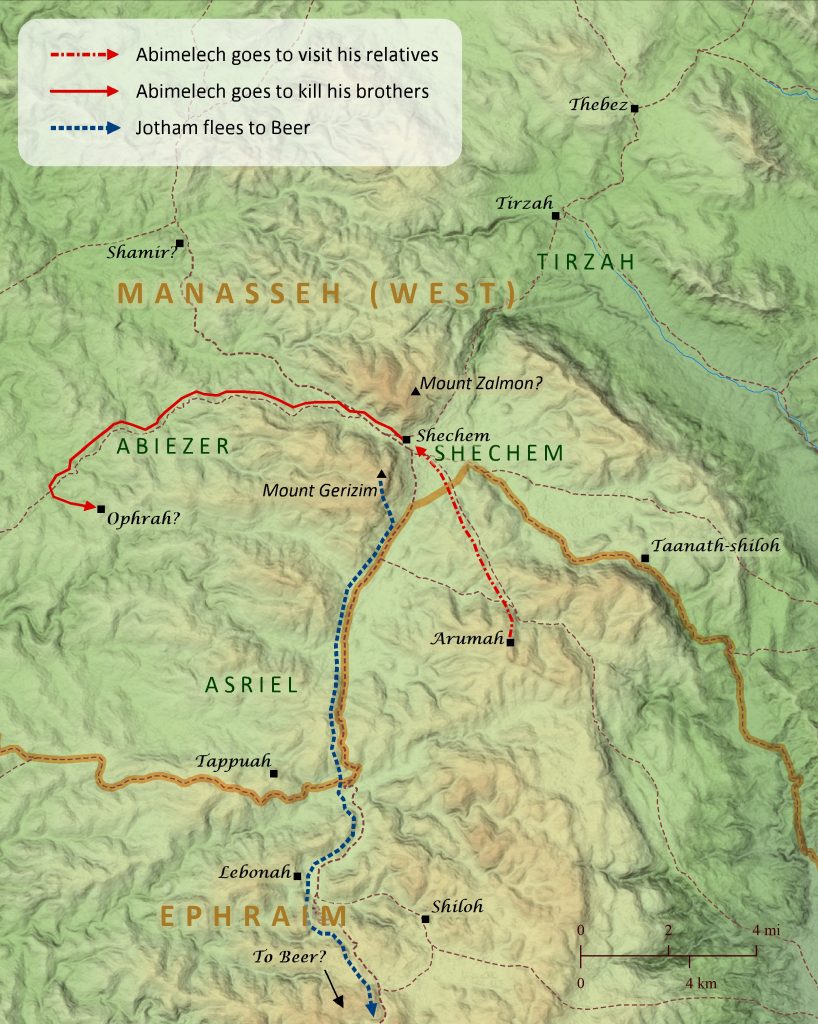
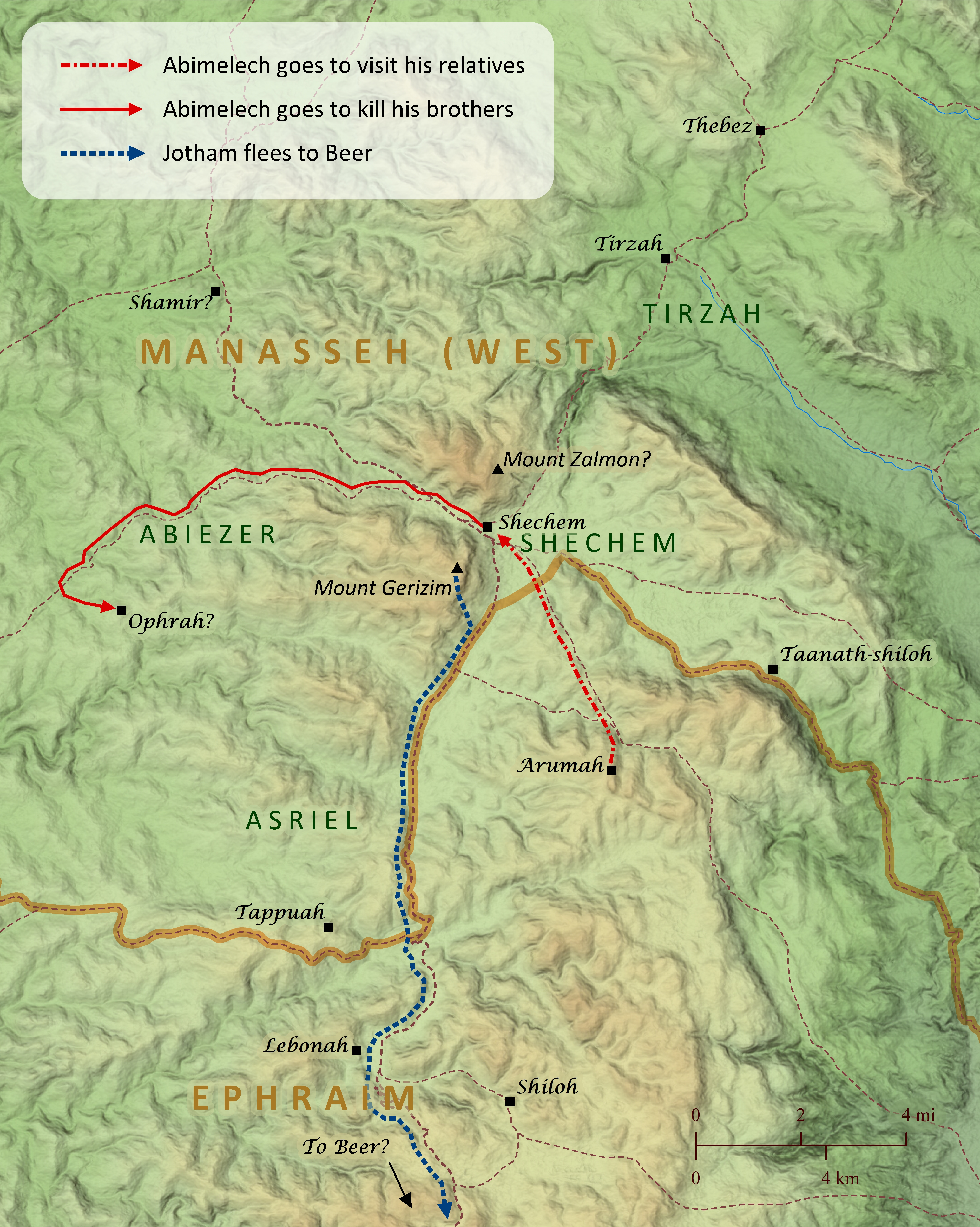
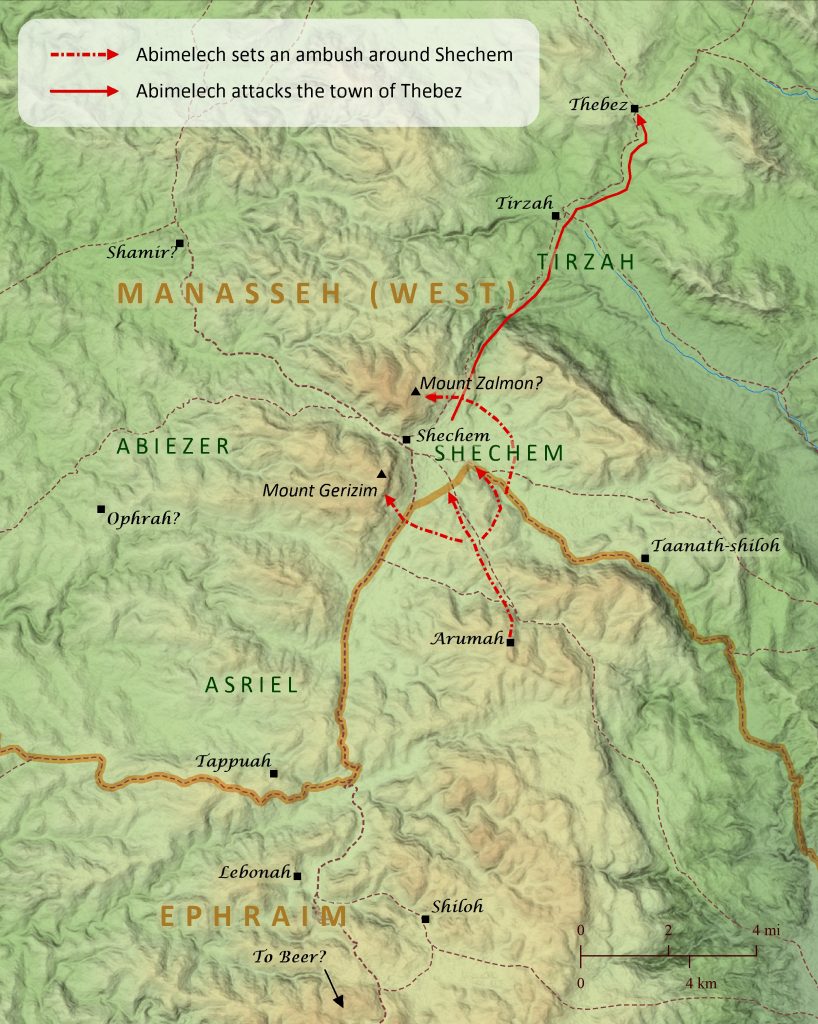
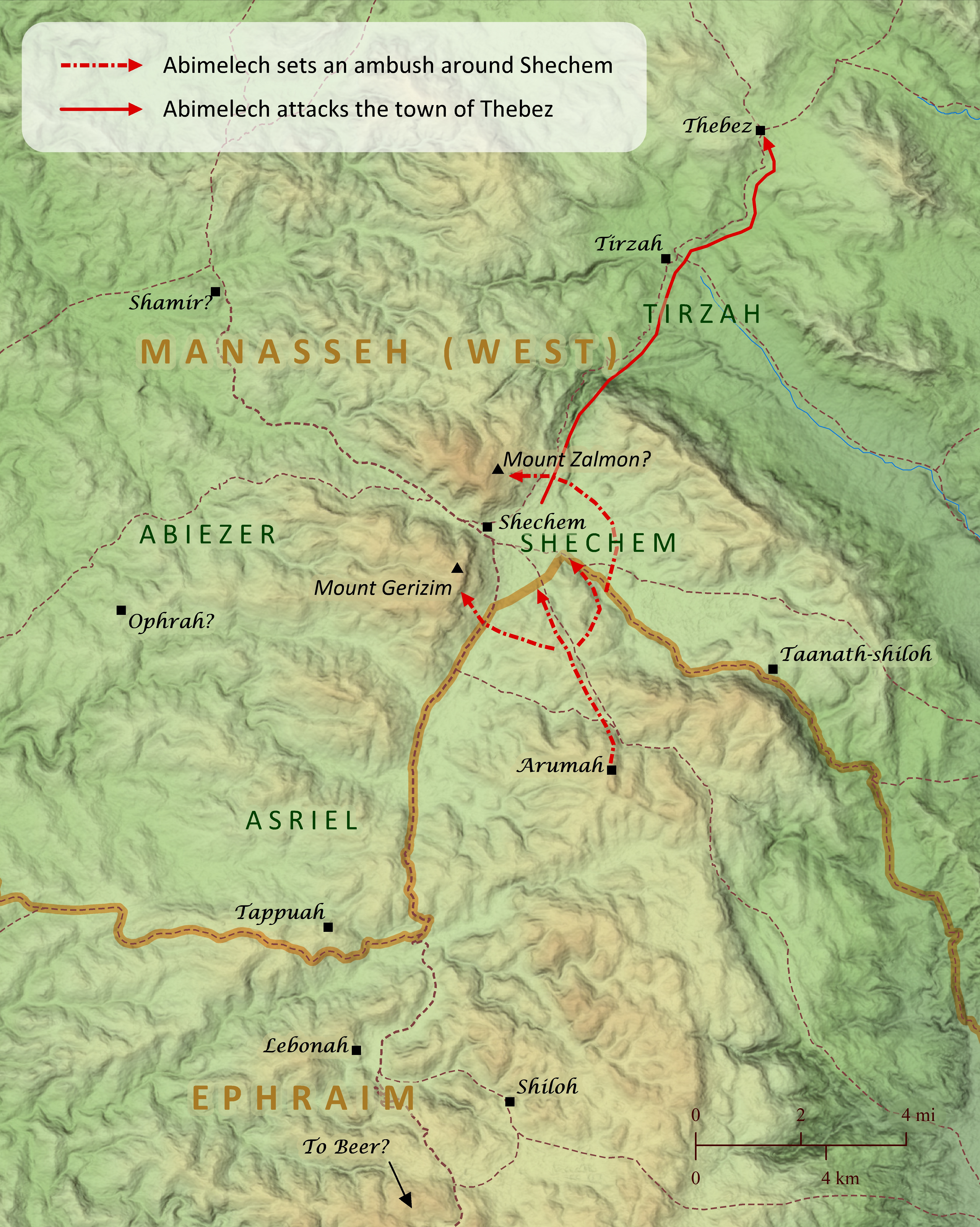
Virtually every account in the book of Judges paints this formative period in Israel’s history as a very dark, brutal time when everyone did what was right in their own eyes (Judges 17:6; 21:25). The story of Abimelech’s rise to power is no exception. Judges 6-8 recounts the heroic deeds of Gideon, a Manassite from the clan of Abiezer who rescued the Israelites from the Midianites. After Gideon’s victory, he returned to his hometown of Ophrah, and Israel enjoyed peace for the rest of his lifetime. But Gideon also left a legacy of idolatry by him, by his family, and by many Israelites. Gideon had many wives and seventy sons, as well as a concubine in Shechem who gave birth to another son named Abimelech (Judges 8:29-32). It appears that when Abimelech grew up, he settled in Arumah, (Judges 9:31), just outside Manassite territory in the tribal allotment of Ephraim (Joshua 16-17; see “Poster Map of the Tribe of Manasseh (West) and Its Surroundings, circa 1200 B.C.” map). Perhaps this move to non-Manassite territory reflected Abimelech’s lack of a legitimate heritage from his Manassite father. Later, Abimelech visited his relatives in Shechem and convinced them to persuade the leaders of Shechem to make him ruler over the city. To ensure that none of his seventy brothers, who were legitimate heirs to Gideon, challenged his authority, Abimelech went to Ophrah and killed all but one of them. The only brother to escape was Jotham, the youngest, and he went to the top of Mount Gerizim and warned them against betraying Gideon by making Abimelech king. Then he fled to the town of Beer, perhaps the same as Beeroth near the town of Gibeon. After three years, however, the leaders of Shechem began to grow dissatisfied with Abimelech as their king, and a man named Gaal offered to rule in place of him. Abimelech’s ally Zebul, who was one of the leaders of Shechem, went to Arumah and told Abimelech what Gaal was planning to do. So Gideon and his men split up into four groups and secretly surrounded the city at night. Then they attacked Gaal’s men, and Gaal’s men retreated into Shechem. Zebul drove them back out into the fields, and Abimelech’s men defeated them and captured the city. Some of the leaders of Shechem fled into the temple of El-berith (or Baal-berith), but Abimelech and his men cut down branches from Mount Zalmon (likely Mount Ebal just north of Shechem) and set fire to the temple, killing about 1000 people inside. Then Abimelech and his men went to Thebez and attacked the city. Many of the citizens took refuge inside a strong tower in the town, and Abimelech prepared to set fire to the entrance. But a woman on the roof dropped a millstone on his head, crushing his skull, so Abimelech commanded his armor bearer to kill him.