Jeremiah 31:38-40
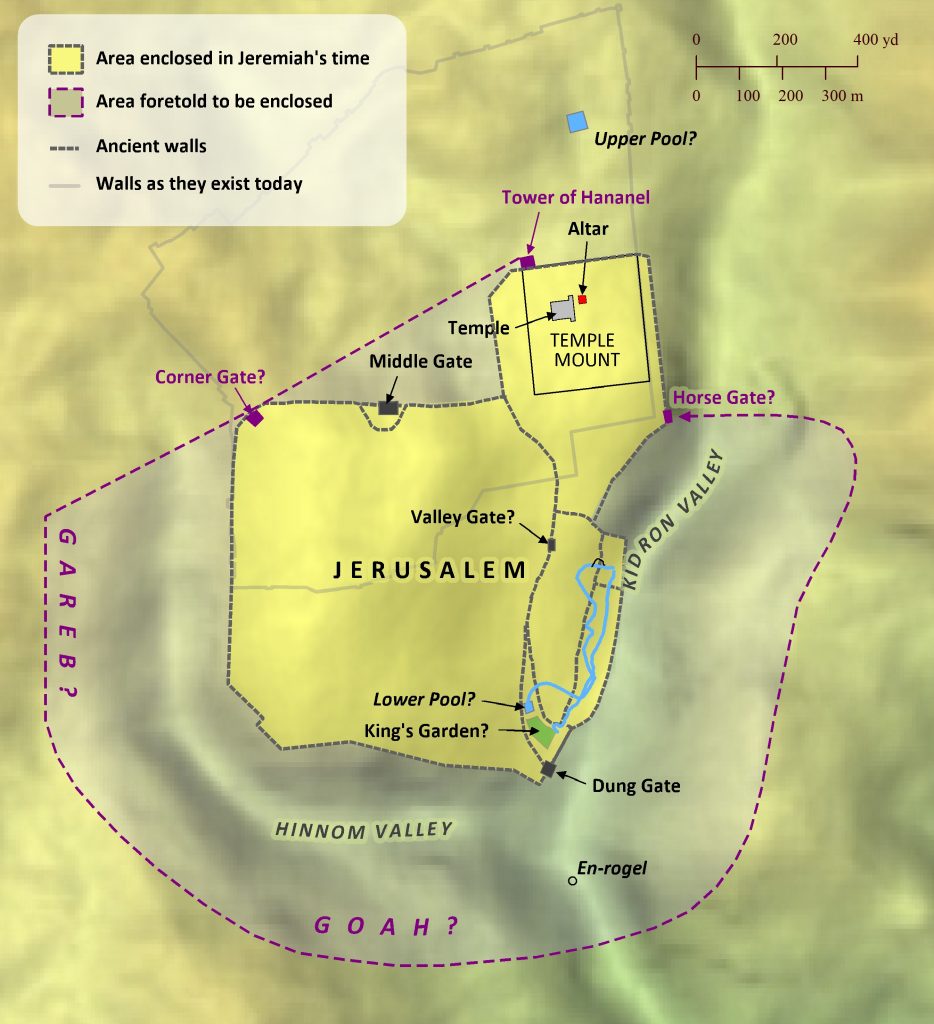
Jeremiah 30-31, often referred to as the Book of Consolation, is ultimately a message of hope after a time of judgment and exile. Though Israel and Judah have suffered devastation for abandoning the Lord, one day the Lord himself would restore them. It is not clear whether these chapters were written after the devastation (including the destruction of Jerusalem in 586 B.C.) had already occurred, or they were speaking of it in the future. In any case, they clearly foretold of a day of restoration that lay ahead for God’s people. Jeremiah 31:38-40 specifically notes that Jerusalem would one day be rebuilt as part of this restoration, but not merely as it was before. The restored city would be expanded to include even the two valleys that had previously marked the boundary of three quarters of the city. The prophecy visualized plans being made for these new boundaries (presumably to be bounded by walls) by detailing the path of a measuring line that would go out from the northwest corner of the Temple Mount, encircle the city, and return to the southeast corner of the Temple Mount (see also the “Jerusalem during the Time of Nehemiah, circa 445 B.C.” map). The “whole valley of the dead bodies and the ashes” that would be included likely refers to the Hinnom Valley. By the time of Jeremiah, this valley had become known as the location of Topheth, a pagan altar where children were burned as a sacrifice to the Canaanite god Molech (see 2 Kings 23:10; Jeremiah 7:31-32; 19:6-13). But Jeremiah foretold of a time when the Lord would bring such destruction upon Jerusalem that the valley would be filled with dead bodies (Jeremiah 19:6-9). Yet in the day of Israel and Judah’s restoration, the whole valley, along with the fields (or terraced gardens) running the whole length of the Kidron Valley, would be sacred to the Lord, and the new city would never again be uprooted or overthrown.