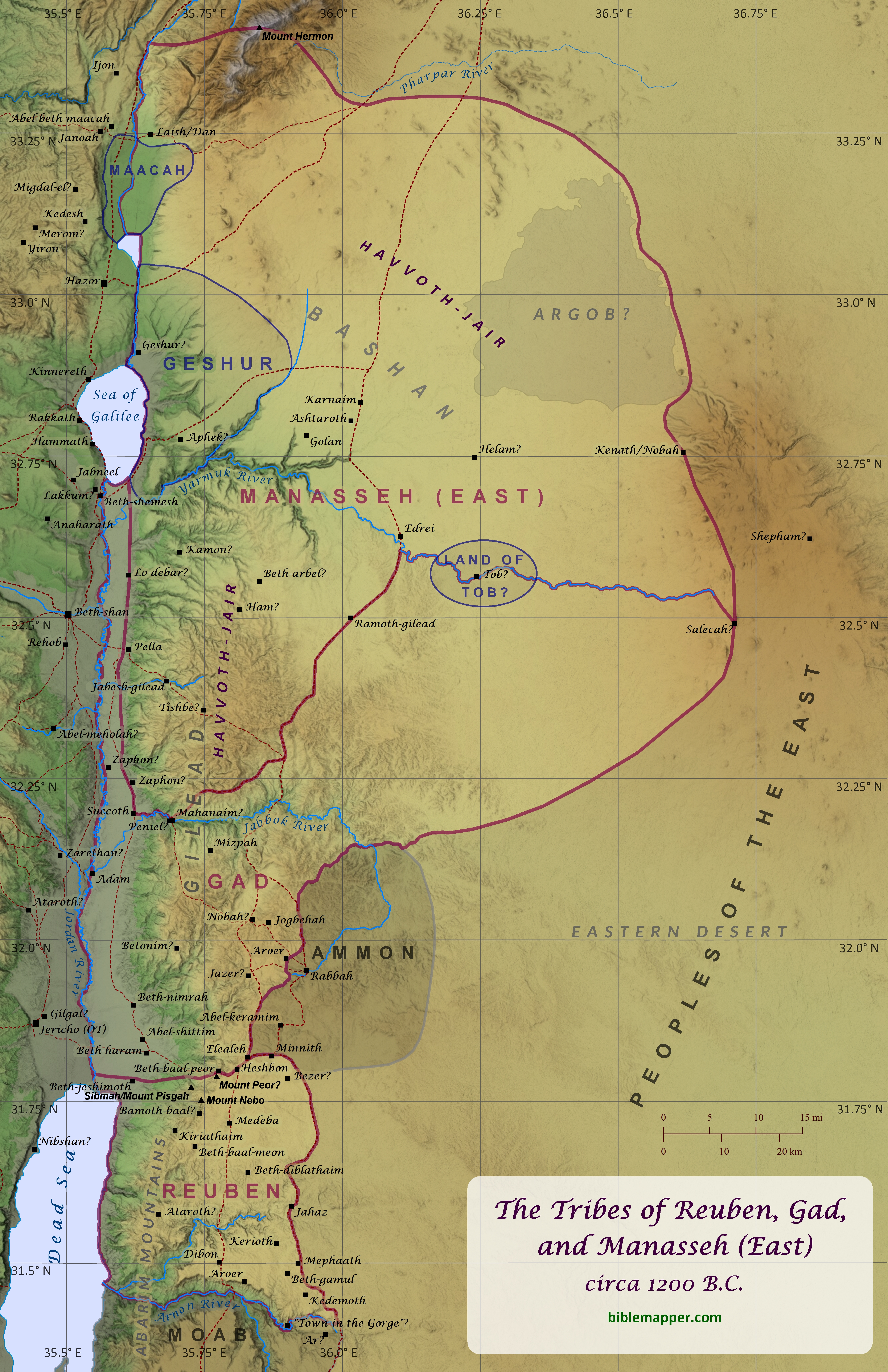
Though technically not part of the land promised to the Israelites in Numbers 34, the land immediately east of the Jordan River and the northern basin of the Dead Sea (often referred to today as the Transjordan) was conquered by the Israelites as they were preparing to enter the Promised Land (Numbers 21:21-35; 32:1-42; Deuteronomy 2:24-37; Judges 11:19-22). Moses agreed to allot this land to the tribes of Reuben, Gad, and half the tribe of Manasseh, provided that they continued to help the other tribes conquer the land of Canaan (Numbers 32:1-42; Deuteronomy 3:12-20). The area allotted to Reuben had been ruled by King Sihon of the Amorites, who had taken this land years earlier from the Moabites (Numbers 21:26). Moab’s prior rule over the territory alloted to Reuben explains why the plain to the northwest of this region continued to be referred to as the plains of Moab even during the time of Joshua (Joshua 13:32). This region also appears to have been claimed by the Ammonites (Judges 11:13), though it is not clear whether they ever actually controlled it. Sihon had also taken from the Ammonites the area later allotted to Gad (Joshua 13:25; see “Sodom and Gomorrah Are Destroyed” map). North of this was the area of Bashan, which had been ruled by King Og, who was among the last of the Rephaites (Deuteronomy 3:11-13; Joshua 12:4; 13:12). All of this was captured by the Israelites on their way to the Promised Land (Joshua 12:1-6; Deuteronomy 3:1-11).
As far as the specific borders of each of the three eastern Israelite tribes, those of Reuben are delineated in Joshua 13:15-23, those of Gad are delineated in Joshua 13:24–28 (note that Joshua 13:25 asserts that Aroer literally “faced” Rabbah, which in this context meant that it lay west of it, not east), and those of half the tribe of Manasseh are delineated in Joshua 13:29–31. Interestingly, Numbers 32:34-36 notes that Gad rebuilt the towns of Dibon, Ataroth, and Aroer, which Joshua 13:15-23 places within the boundaries of Reuben, but perhaps Gad rebuilt the towns prior to being formally allotted their territory further north. Several other passages also note that Ramoth-gilead, a city of refuge, belonged to Gad (Deuteronomy 4:43; Joshua 20:8; Joshua 21:38; 1 Chronicles 6:80).
It is also interesting to note that virtually all of the eastern land of Manasseh was conquered under the leadership of Jair, who was actually a Judahite by his father’s lineage but was typically regarded a Manassite through his mother’s lineage (Numbers 32:40-42; Deuteronomy 3:14; Joshua 13:30; Judges 10:3-5; 1 Kings 4:13; 1 Chronicles 2:22-23; see “Bashan” map). This may be in keeping with the Manassite tradition of allowing daughters to receive an inheritance (and, presumably, recognition of their descendants) just as they allowed sons to receive an inheritance (Numbers 27; Joshua 17:1-6; see also “The Towns and Clans of Eastern Judah, circa 1200 B.C.”).
Further insight into the allotments of the Transjordan is gained through 1 Chronicles 5, which notes that Gad’s territory extended as far as Salecah. This requires that its territory was notably larger than it is depicted on most Bible maps today, which typically limit its eastern boundary to the border of Ammon. This may seem at odds with several other passages that mention the Jabbok River as the northern boundary of Sihon’s land and make no mention of Salecah and the land northwest of the Jabbok River (Numbers 21:24; Deuteronomy 3:16; Joshua 12:2; Judges 11:13-22). But, as noted above, several other passages also note that Ramoth-gilead belonged to Gad, which is (like Salecah) located far north of the Jabbok River. This author has concluded that the northeastern boundary between Gad and Manasseh almost certainly followed the Yarmuk River all the way to Salecah and also passed through Tob.
First Chronicles 5 also notes that later, under the reign of Saul, the Israelite eastern tribes joined together to capture territory east of Gilead, which was inhabited by the nomadic descendants of Hagar and her son Ishmael (1 Chronicles 5:10-22; see also “Nomadic Range of Ishmael’s Descendants”), who are often referred to in Scripture as “peoples of the East” (Genesis 29:1; Judges 6-8; 1 Kings 4:30; Job 1:3; Isaiah 11:14; Jeremiah 4:28; Ezekiel 25:4; 25:10). It is not clear, however, that this territory was ever formally considered to belong to the territory of Israel.
Also located within the territory of the Transjordanian tribes were the enclaves of Geshur, Maacah, and the land of Tob. Geshur and Maacah are mentioned among those who remained as non-Israelite enclaves within Israel’s territory ((Joshua 12:5; 13:1-13). The land of Tob must have functioned similarly within Israel as well, because it contributed troops to the Ammonite and Aramean alliance that fought against David’s forces (2 Samuel 10:6). This also makes better sense of Jephthah’s decision to retreat to the land of Tob after he was driven away by his brothers (Judges 11:3).

This map is designed to be printed at 11 in. x 17 in., but it may scale acceptably at larger or smaller sizes as well.